Japanese Yen extends decline as US Dollar advances due to market caution
- The Japanese Yen edges lower despite the hawkish sentiment surrounding the BoJ policy decision due on Wednesday.
- The Bank of Japan is widely expected to raise interest rates by ten basis points.
- CME FedWatch Tool suggests a 100% probability of at least a 25 basis points Fed rate cut in September.

The Japanese Yen (JPY) extends its losses against the US Dollar (USD) for the second successive day on Tuesday. Traders remain cautious ahead of the Bank of Japan’s (BoJ) policy meeting on Wednesday, which could potentially result in a rate hike. Markets are speculating that the BoJ may increase rates by ten basis points to 0.1% and is widely expected to announce its bond purchase tapering plans.
Japan’s Chief Cabinet Secretary Yoshimasa Hayashi stated on Tuesday that the Bank of Japan and the government will closely coordinate, but the specifics of monetary policy remain the BoJ's prerogative. Hayashi emphasized that the BoJ will work closely with the government to implement appropriate monetary policies aimed at achieving the inflation target.
The US Dollar may face challenges as the US Federal Reserve (Fed) is expected to keep rates unchanged on Wednesday. However, traders anticipate a Fed rate cut in September, with the CME FedWatch Tool indicating a 100% probability of at least a quarter percentage point cut. Additionally, signs of cooling inflation and easing labor market conditions in the United States have fueled expectations of three rate cuts by the Fed this year.
Daily Digest Market Movers: Japanese Yen declines despite hawkish sentiment surrounding BoJ
- Japan's Unemployment Rate was 2.5% in June, slightly lower than market forecasts of 2.6% and the rate observed over the previous four months. This marks the lowest jobless rate since January.
- Japan's top council has urged the government and the Bank of Japan to be mindful of the weak JPY when formulating policy. The council emphasized that the impact of a weak Yen and rising prices on consumption cannot be simply overlooked.
- Reuters has published an extensive article on the Bank of Japan (BoJ) review of past policy, highlighting a significant shift in the central bank's approach to inflation. The key message from the review is that Japan is "ready for higher rates." However, the review will not result in changes to the price goal or policy framework.
- On Friday, the US Personal Consumption Expenditures (PCE) Price Index rose by 2.5% year-over-year in June, down slightly from 2.6% in May, meeting market expectations. On a monthly basis, the PCE Price Index increased by 0.1% after being unchanged in May.
- Japan's top currency diplomat, Masato Kanda, informed the G20 on Friday that foreign exchange (FX) volatility negatively impacts the Japanese economy. Kanda noted an increasing likelihood of a soft landing and emphasized the need to monitor the economy and implement necessary measures closely, according to Reuters.
- Bank of America indicates that strong economic growth in the United States allows the Federal Open Market Committee (FOMC) to "afford to wait" before making any changes. The bank states that the economy "remains on robust footing" and continues to expect the Fed to start cutting rates in December.
- The BlackRock Investment Institute noted in its mid-year outlook that Japan’s that the Bank of Japan will not raise interest rates at next week's meeting. Additionally, JP Morgan has also anticipated no rate hike from the Bank of Japan (BoJ) in July or at any point in 2024.
Technical Analysis: USD/JPY advances to near 154.00
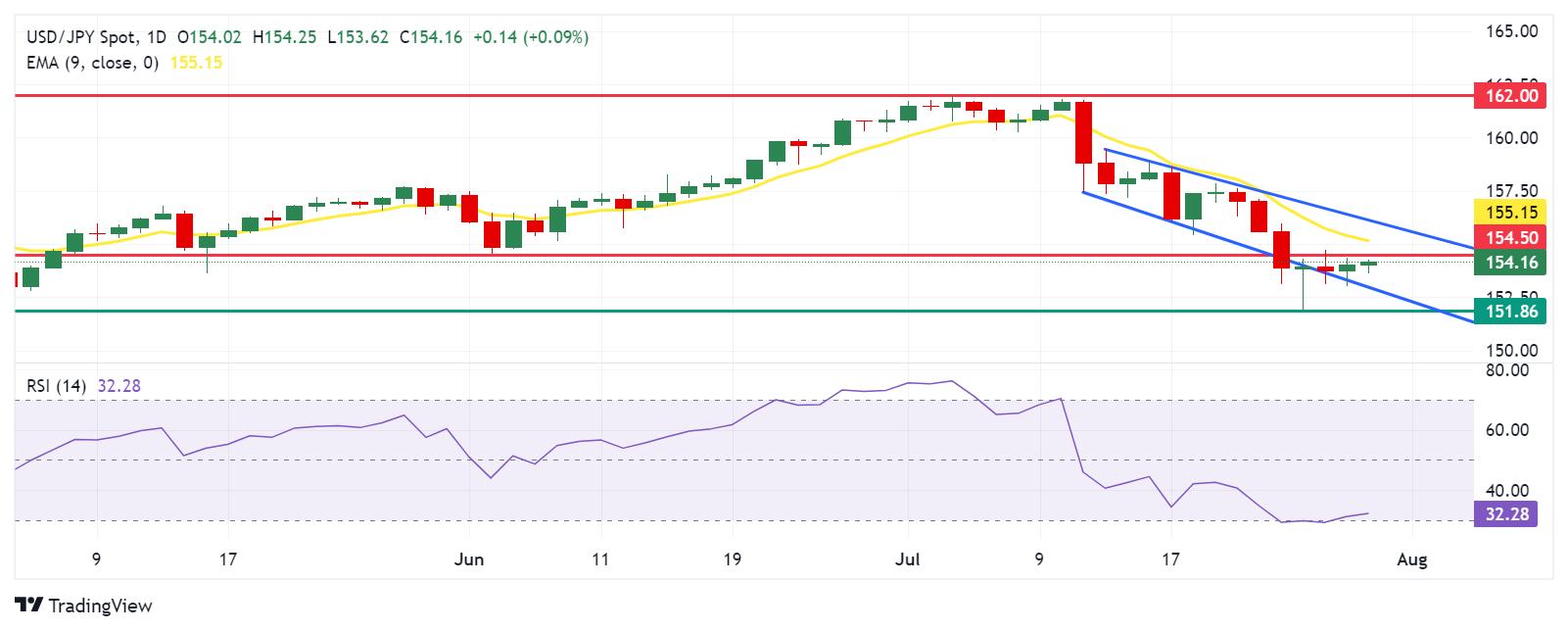
USD/JPY trades around 154.00 on Tuesday. The daily chart analysis shows that the pair is consolidating within a descending channel, indicating a bearish bias. However, the 14-day Relative Strength Index (RSI) is slightly above 30, which could suggest a potential short-term rebound.
Immediate support is located near the lower boundary of the descending channel, around 153.00. A drop below this level could push the USD/JPY pair lower, possibly revisiting May's low of 151.86. Additional support may emerge at the psychological level of 151.00.
On the upside, the pair tests the "throwback support turned resistance" at around 154.50. Further resistance is anticipated at the nine-day Exponential Moving Average (EMA) of 155.13, with additional resistance near the upper boundary of the descending channel around 156.20.
USD/JPY: Daily Chart
Japanese Yen PRICE Today
The table below shows the percentage change of Japanese Yen (JPY) against listed major currencies today. Japanese Yen was the weakest against the New Zealand Dollar.
| USD | EUR | GBP | JPY | CAD | AUD | NZD | CHF | |
|---|---|---|---|---|---|---|---|---|
| USD | -0.02% | 0.05% | 0.65% | -0.06% | -0.19% | -0.40% | 0.15% | |
| EUR | 0.02% | 0.07% | 0.72% | -0.02% | -0.18% | -0.38% | 0.18% | |
| GBP | -0.05% | -0.07% | 0.64% | -0.09% | -0.22% | -0.43% | 0.08% | |
| JPY | -0.65% | -0.72% | -0.64% | -0.72% | -0.85% | -1.06% | -0.52% | |
| CAD | 0.06% | 0.02% | 0.09% | 0.72% | -0.13% | -0.34% | 0.17% | |
| AUD | 0.19% | 0.18% | 0.22% | 0.85% | 0.13% | -0.23% | 0.29% | |
| NZD | 0.40% | 0.38% | 0.43% | 1.06% | 0.34% | 0.23% | 0.53% | |
| CHF | -0.15% | -0.18% | -0.08% | 0.52% | -0.17% | -0.29% | -0.53% |
The heat map shows percentage changes of major currencies against each other. The base currency is picked from the left column, while the quote currency is picked from the top row. For example, if you pick the Japanese Yen from the left column and move along the horizontal line to the US Dollar, the percentage change displayed in the box will represent JPY (base)/USD (quote).
Interest rates FAQs
Interest rates are charged by financial institutions on loans to borrowers and are paid as interest to savers and depositors. They are influenced by base lending rates, which are set by central banks in response to changes in the economy. Central banks normally have a mandate to ensure price stability, which in most cases means targeting a core inflation rate of around 2%. If inflation falls below target the central bank may cut base lending rates, with a view to stimulating lending and boosting the economy. If inflation rises substantially above 2% it normally results in the central bank raising base lending rates in an attempt to lower inflation.
Higher interest rates generally help strengthen a country’s currency as they make it a more attractive place for global investors to park their money.
Higher interest rates overall weigh on the price of Gold because they increase the opportunity cost of holding Gold instead of investing in an interest-bearing asset or placing cash in the bank. If interest rates are high that usually pushes up the price of the US Dollar (USD), and since Gold is priced in Dollars, this has the effect of lowering the price of Gold.
The Fed funds rate is the overnight rate at which US banks lend to each other. It is the oft-quoted headline rate set by the Federal Reserve at its FOMC meetings. It is set as a range, for example 4.75%-5.00%, though the upper limit (in that case 5.00%) is the quoted figure. Market expectations for future Fed funds rate are tracked by the CME FedWatch tool, which shapes how many financial markets behave in anticipation of future Federal Reserve monetary policy decisions.
Author
Akhtar Faruqui
FXStreet
Akhtar Faruqui is a Forex Analyst based in New Delhi, India. With a keen eye for market trends and a passion for dissecting complex financial dynamics, he is dedicated to delivering accurate and insightful Forex news and analysis.

















