Japanese Yen extends its steady intraday descent against USD; US PCE data in focus
- The Japanese Yen drifts lower in reaction to BoJ Governor Kazuo Ueda's remarks this Friday.
- BoJ rate hike bets, geopolitical risk, and trade war fears could underpin the safe-haven JPY.
- Subdued USD price action might contribute to capping USD/JPY ahead of the US PCE data.


The Japanese Yen (JPY) attracts some intraday sellers and snaps a two-day winning streak against its American counterpart after Bank of Japan (BoJ) Governor Kazuo Ueda said this Friday that the underlying inflation is still somewhat below 2%. Apart from this, a modest bounce in the US Treasury bond yields and a generally positive risk tone undermines the safe-haven JPY. This, in turn, assists the USD/JPY pair in rebinding nearly 100 pips from the Asian session low.
Meanwhile, data released earlier today showed that consumer prices in Tokyo – Japan's capital – rose in January. This keeps hopes alive for further BoJ policy tightening and should limit any meaningful JPY depreciation. Furthermore, the uncertainty over US President Donald Trump's policies holds back the US Dollar (USD) bulls from placing aggressive bets and might cap the USD/JPY pair ahead of the US Personal Consumption Expenditure (PCE) Price Index data.
Japanese Yen weakens after BoJ Governor Kazuo Ueda's remarks; downside seems limited
- Bank of Japan Governor Kazuo Ueda said on Friday that underlying inflation is still somewhat below 2% and added that the central bank would maintain an accommodative policy to support price trends.
- The Statistics Bureau of Japan reported this Friday that the headline Tokyo Consumer Price Index (CPI) accelerated from 3.0% to 3.4% YoY in January – the highest level since April 2023.
- Adding to this, core CPI, which excludes volatile fresh food prices, picked up from the 2.4% seen in December and rose 2.5% YoY during the reported month – representing an 11-month high.
- Meanwhile, a core CPI gauge that excludes both fresh food and energy prices remained close to the Bank of Japan's 2% annual target and climbed 1.9% YoY in January from the 1.8% previous.
- BoJ Deputy Governor Ryozo Himino reiterated that real rates remain negative and that the central bank would consider more rate increases if economic and price developments align with expectations.
- State-run TASS news agency reported, citing the Russian Defense Ministry, that two Russian Tu-95 strategic bombers conducted a routine flight over the Sea of Okhotsk and the Sea of Japan on Thursday.
- According to the first estimate published by the US Bureau of Economic Analysis (BEA) on Thursday, the US Gross Domestic Product (GDP) grew at an annual rate of 2.3% in the fourth quarter.
- The reading marked a notable slowdown from the 3.1% expansion recorded in the previous quarter and was below the market expectation of 2.6%, though it did little to influence the US Dollar.
- US President Donald Trump reiterated his threat to impose 25% tariffs on Mexico and Canada – the top two US trade partners – and warned of potential 100% tariffs if BRICS attempts to replace the USD.
- Japan’s Prime Minister Shigeru Ishiba said on Friday that the government will continue to invest and create jobs in the US and further stated that he will urge the US to provide a stable energy supply.
- Concerns that Trump's protectionist policies will boost inflation, along with the Federal Reserve's hawkish outlook, provide a modest lift to the US Treasury bond yields, which underpin the buck.
- Investors now look forward to the release of the US Personal Consumption Expenditure (PCE) Price Index – the Fed's preferred inflation gauge – for fresh impetus on the last day of the week.
USD/JPY could attract fresh sellers near the 155.00 psychological mark; not out of the woods yet
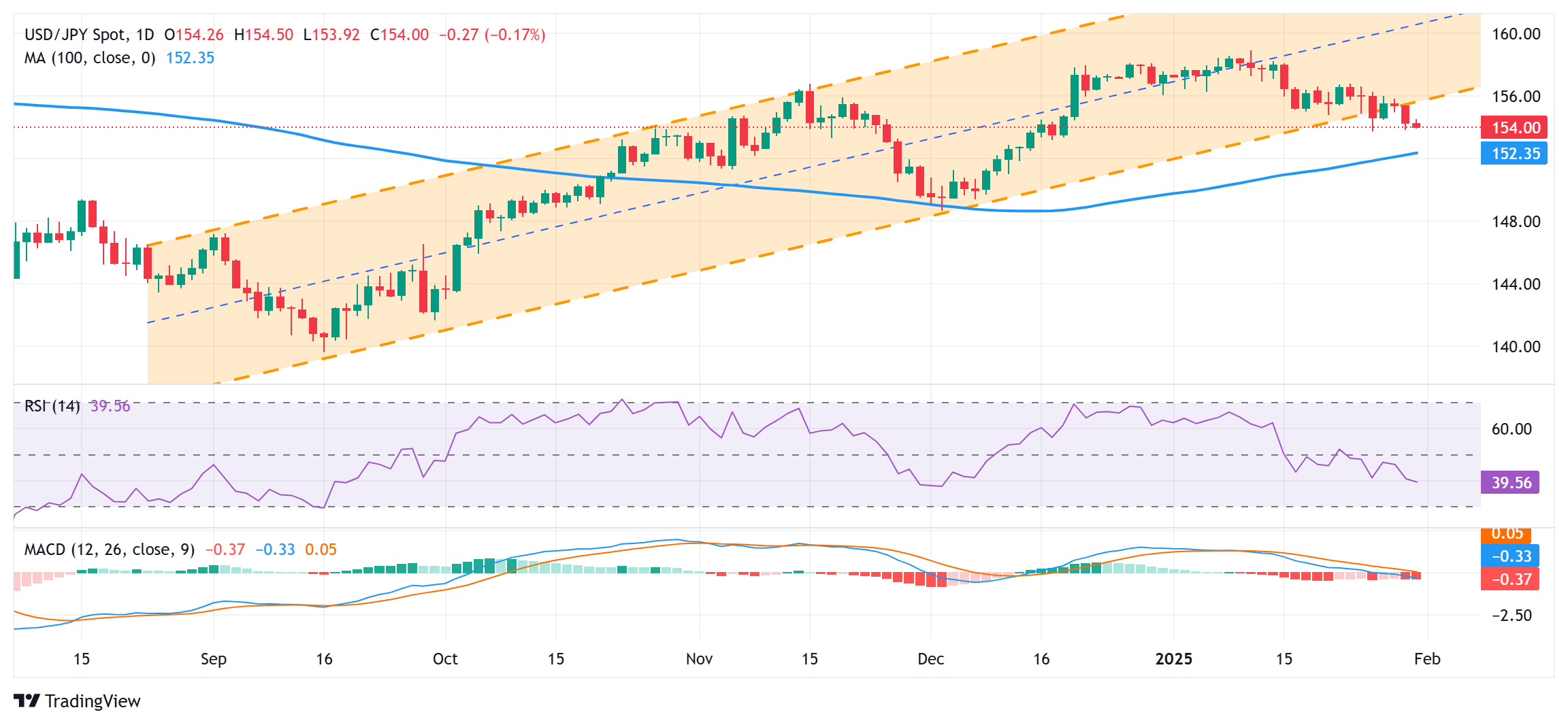
Against the backdrop of the recent breakdown below a short-term ascending trend channel, some follow-through selling below the monthly swing low, around the 153.70 area touched on Monday, will be seen as a key trigger for bearish traders. Moreover, oscillators on the daily chart have been gaining negative traction and are still away from being in the oversold zone. Hence, the subsequent downfall could drag the USD/JPY pair towards the 153.00 round figure en route to the 152.40 area and the 152.00 mark. The latter coincides with the 100-day Simple Moving Average (SMA) and could offer decent support to spot prices.
On the flip side, any attempted recovery above mid-154.00s now seems to confront a stiff barrier near the 155.00 psychological mark. A sustained strength, however, might trigger an intraday short-covering move towards the 155.40-155.45 region en route to the 156.00 round figure and the weekly top, around the 156.25 area. The next relevant hurdle is pegged near the 156.75 region, which if cleared decisively might shift the near-term bias in favor of bullish traders and pave the way for additional gains.
Economic Indicator
Personal Consumption Expenditures - Price Index (YoY)
The Personal Consumption Expenditures (PCE), released by the US Bureau of Economic Analysis on a monthly basis, measures the changes in the prices of goods and services purchased by consumers in the United States (US). The YoY reading compares prices in the reference month to a year earlier. Price changes may cause consumers to switch from buying one good to another and the PCE Deflator can account for such substitutions. This makes it the preferred measure of inflation for the Federal Reserve. Generally, a high reading is bullish for the US Dollar (USD), while a low reading is bearish.
Read more.Next release: Fri Jan 31, 2025 13:30
Frequency: Monthly
Consensus: 2.6%
Previous: 2.4%
Source: US Bureau of Economic Analysis
Author
Haresh Menghani
FXStreet
Haresh Menghani is a detail-oriented professional with 10+ years of extensive experience in analysing the global financial markets.