Japanese Yen remains confined in a range against USD; bullish potential seems intact
- The Japanese Yen draws some support from persistent worries about a global trade war.
- Expectations that the Fed could delay rate cuts benefit the USD and support USD/JPY.
- Bets that the BoJ will hike rates further underpin the JPY and cap the upside for the pair.


The Japanese Yen (JPY) extends its sideways consolidative price move heading into the European session on Tuesday, with the USD/JPY pair holding steady around the 152.00 mark amid mixed cues. US President Donald Trump's new tariffs reignite global trade war fears. This, along with the growing acceptance that the Bank of Japan (BoJ) will hike interest rates further, turn out to be key factors underpinning the safe-haven JPY.
Meanwhile, Trump's no-exemption tariffs on commodity imports effectively end deals with the European Union, the United Kingdom, Japan, and other countries, which could endanger Japan's economic stability. This, in turn, holds back the JPY bulls from placing fresh bets. Apart from this, a modest US Dollar (USD) strength acts as a tailwind for the USD/JPY pair ahead of Fed Chair Jerome Powell's congressional testimony.
Japanese Yen bulls remain on the sidelines amid Trump-related anxieties
- US President Donald Trump signed an order Monday that imposes a 25% tariff on imports of steel and aluminum into the US, fueling trade war fears and underpinning the safe-haven Japanese Yen.
- Bank of Japan Governor Kazuo Ueda and Deputy Governor Himino recently signaled the possibility of another interest rate hike if the economy and prices align with the central bank's projections.
- Adding to this, BoJ board member Naoki Tamura said last week policymakers need to bump up interest rates to 1% by the second half of the fiscal year beginning in April to fend off rising prices.
- Moreover, several BoJ officials are in favor of more rate hikes as inflation is weighing on consumer spending. Japan's core consumer inflation has exceeded the BoJ's 2% target for nearly three years.
- Meanwhile, worries that Trump's policies would reignite inflation in the US might force the Federal Reserve to stick to its hawkish stance on the back of a still resilient US economy and labor market.
- The market focus now shifts to Fed Chair Jerome Powell's two-day congressional testimony starting this Tuesday, which might provide cues about the rate-cut path and influence the US Dollar.
- Apart from this, the release of the latest US consumer inflation figures on Wednesday will determine the near-term USD trajectory and provide some meaningful impetus to the USD/JPY pair.
USD/JPY seems vulnerable; 152.50 confluence breakpoint holds the key
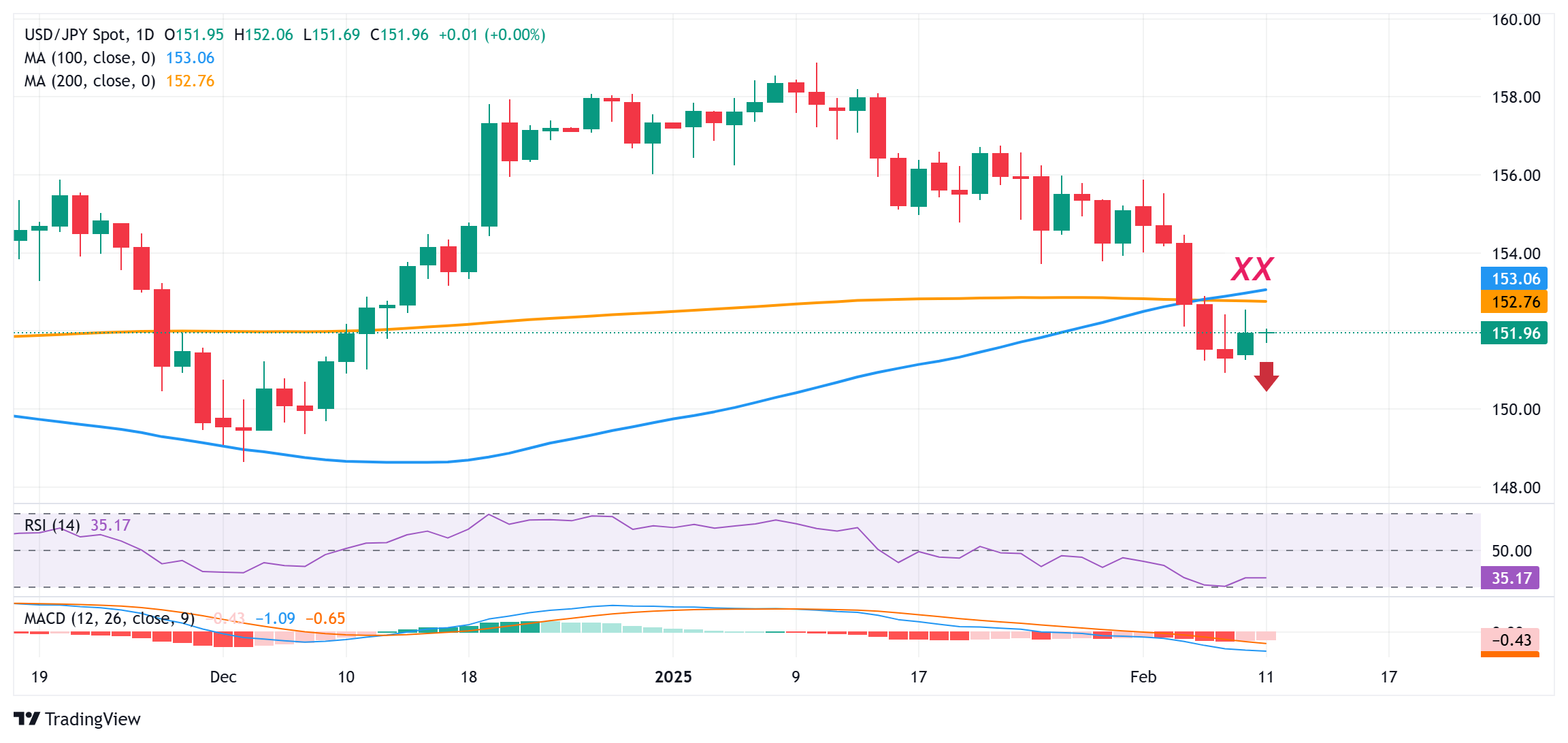
From a technical perspective, the overnight failure near the 152.50 confluence support breakpoint now turned resistance, and the subsequent downtick favors bearish traders. Moreover, oscillators on the daily chart are holding deep in negative territory and are still away from being in the oversold zone. This, in turn, suggests that the path of least resistance for the USD/JPY pair is to the downside.
However, any further slide is more likely to find some support near the 151.30 horizontal zone ahead of the 151.00-150.90 area, or the lowest level since December 10 touched last Friday. Some follow-through selling below will reaffirm the negative bias and make the USD/JPY pair vulnerable to weaken further to the 150.00 psychological mark with some intermediate support near the 150.55 region.
On the flip side, the 152.50 confluence – comprising the 100- and the 200-day Simple Moving Averages (SMAs) – might continue to act as a strong immediate hurdle. A sustained strength beyond, however, might trigger a short-covering move and allow the USD/JPY pair to reclaim the 153.00 round figure. The recovery could extend further, though it is likely to remain capped near the 153.75 region.
Economic Indicator
Fed's Chair Powell testifies
Federal Reserve Chair Jerome Powell testifies before Congress, providing a broad overview of the economy and monetary policy. Powell's prepared remarks are published ahead of the appearance on Capitol Hill.
Read more.Next release: Tue Feb 11, 2025 15:00
Frequency: Irregular
Consensus: -
Previous: -
Source: Federal Reserve
Tariffs FAQs
Tariffs are customs duties levied on certain merchandise imports or a category of products. Tariffs are designed to help local producers and manufacturers be more competitive in the market by providing a price advantage over similar goods that can be imported. Tariffs are widely used as tools of protectionism, along with trade barriers and import quotas.
Although tariffs and taxes both generate government revenue to fund public goods and services, they have several distinctions. Tariffs are prepaid at the port of entry, while taxes are paid at the time of purchase. Taxes are imposed on individual taxpayers and businesses, while tariffs are paid by importers.
There are two schools of thought among economists regarding the usage of tariffs. While some argue that tariffs are necessary to protect domestic industries and address trade imbalances, others see them as a harmful tool that could potentially drive prices higher over the long term and lead to a damaging trade war by encouraging tit-for-tat tariffs.
During the run-up to the presidential election in November 2024, Donald Trump made it clear that he intends to use tariffs to support the US economy and American producers. In 2024, Mexico, China and Canada accounted for 42% of total US imports. In this period, Mexico stood out as the top exporter with $466.6 billion, according to the US Census Bureau. Hence, Trump wants to focus on these three nations when imposing tariffs. He also plans to use the revenue generated through tariffs to lower personal income taxes.
Author
Haresh Menghani
FXStreet
Haresh Menghani is a detail-oriented professional with 10+ years of extensive experience in analysing the global financial markets.

















