Hiding for safety: Screening for low volatility stocks with high dividends


Key points
-
Defensive investment strategy: Investors looking for capital preservation and consistent returns in uncertain times may benefit from exposure to high-dividend, low-volatility stocks.
-
How this strategy works: Low-volatility stocks reduce overall portfolio risk, while dividend-paying stocks provide regular income even during market downturns. This combination can provide both capital preservation and steady cash flow, making them an attractive option for defensive investors.
-
Sector diversification: Our screener showed up a list of stocks with the above characteristics in several defensive sectors such as consumer staples (PG, KO, PEP), healthcare (JNJ, ABBV), utilities (SO, DUK) and telecom (T, VZ).
We talked about the risks of U.S. exceptionalism fading and the diluting Magnificent 7 leadership in previous articles. This is leading to a risk-off sentiment in global markets, and a rush to safe havens.
When markets get choppy, some investors reach for cash. Others look for the smoothest ride possible, and that’s where low-volatility stocks come in. These are companies with steady earnings, strong balance sheets, and a history of riding out economic turbulence better than the broader market.
That’s where low-volatility, high-dividend stocks come into play. These stocks tend to have low beta values, meaning they move less dramatically than the overall market, while also offering attractive dividend yields. This combination can provide both capital preservation and steady cash flow, making them an excellent option for defensive investors.
Why low volatility matters
Volatility is often an investor’s worst enemy, especially during market downturns. Low-volatility stocks tend to hold their ground better, reducing overall portfolio risk. They are typically found in sectors such as utilities, consumer staples, and healthcare—industries where demand remains stable regardless of economic cycles.
A stock’s beta measures its sensitivity to market movements. A beta below 1 indicates lower volatility compared to the broader market, meaning these stocks tend to decline less in bear markets while still participating in bull markets, albeit to a lesser extent.
The power of high dividends
Dividend-paying stocks offer an additional layer of security by providing regular income, even during market downturns. Companies with strong, sustainable dividends often have healthy balance sheets, stable earnings, and a commitment to returning value to shareholders. High-yield stocks can help offset price declines and enhance total return over time.
Screening for low-volatility, high-dividend stocks
We ran a defensive equity screener on Bloomberg, based on the following criterion:
-
30-day annualized volatility < 30% - Ensures relatively stable stock performance
-
6-month beta < 0.5 - Focuses on low-volatility stocks
-
12-month dividend yield > 2% - Targets income-generating stocks
-
Current price/earnings < 25 - Avoids overpriced stocks
Several standout stocks fit this defensive profile. Here are a few notable names grouped by sector:
Consumer staples
-
Procter & Gamble (PG) – With a beta of 0.25 and a 2.33% dividend yield, this consumer staples leader provides steady income and low volatility.
-
Coca-Cola (KO) – A household name with a beta of 0.28 and a 2.70% yield, benefiting from consistent global demand.
-
PepsiCo (PEP) – With a beta of 0.26 and a 2.83% yield, PepsiCo remains a resilient consumer staples giant.
-
Mondelez International (MDLZ) – A low-beta consumer goods stock (0.21) with a 2.15% dividend yield, benefiting from steady snack food demand.
-
Altria Group (MO) – This tobacco giant provides a massive 8.74% yield and a beta of 0.26, appealing to income-focused investors.
Healthcare and Pharmaceuticals
-
Johnson & Johnson (JNJ) – A healthcare giant with a beta of 0.25 and a 2.93% dividend yield, offering stability through its diversified health businesses.
-
AbbVie (ABBV) – This pharmaceutical company features a beta of 0.33 and a strong 4.10% dividend yield, making it a solid defensive pick.
Utilities
-
Southern Co. (SO) – A regulated utility stock with a beta of 0.21 and a high dividend yield of 4.15%, offering stability through predictable cash flows.
-
Duke Energy (DUK) – A utility stock with a beta of 0.26 and a 4.20% yield, offering steady cash flow and defensive characteristics.
Telecommunications
-
AT&T (T) – A telecom giant with a beta of 0.30 and a 6.11% dividend yield, offering a stable revenue stream through its communications services.
-
Verizon Communications (VZ) – Another major telecom provider with a beta of 0.32 and a strong 6.45% dividend yield, making it a solid defensive pick.
Below are the top 20 stocks by market cap that came up from the screener:
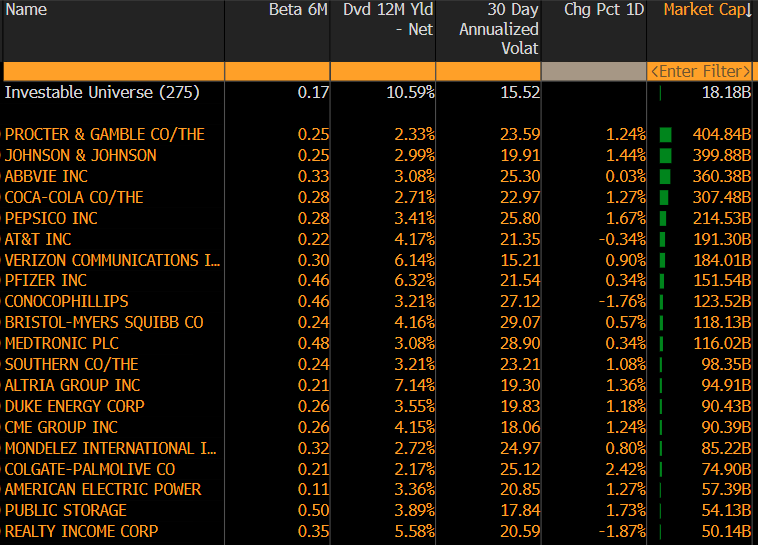
Source: Bloomberg
Positioning for stability
For investors seeking a balance of risk management and income, a mix of low-volatility, high-dividend stocks can be a smart addition to a diversified portfolio. These stocks provide protection during market downturns while still generating returns through dividends.
While no investment is without risk, these stocks present a strong case for those looking to minimize volatility without sacrificing yield. By focusing on companies with stable cash flows and sustainable dividends, investors can create a more resilient portfolio in today’s uncertain market environment.
Read the original analysis: Hiding for safety: Screening for low volatility stocks with high dividends
Author
Saxo Research Team
Saxo Bank
Saxo is an award-winning investment firm trusted by 1,200,000+ clients worldwide. Saxo provides the leading online trading platform connecting investors and traders to global financial markets.