Gold price remains near YTD peak, approaches $2,800
- Gold reaches a new ATH at $2,790, bolstered by election uncertainty and steady US economic growth.
- US Q3 GDP and ADP jobs data show economic resilience, caps Gold’s gains as Treasury yields slip.
- Year-to-date, Bullion prices had surged over 35%, analysts project further gains, potentially hitting $3,000 by 2025.
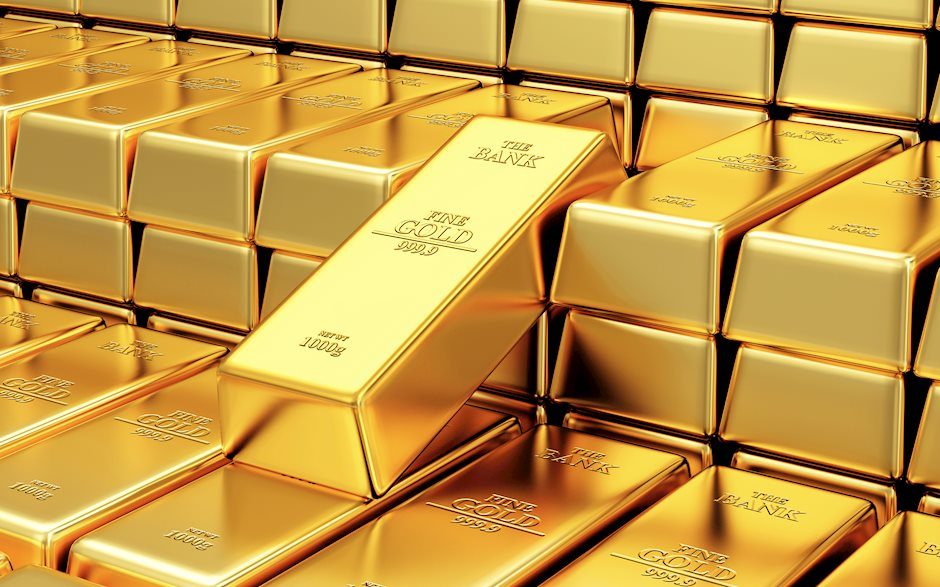

Gold price soared to a record high of $2,790 during the North American session, as investors remain uncertain about the outcome of the US Presidential Elections. Upbeat economic data in the US put a lid on the precious metal advance, as the economy grew steadily while the jobs market remained robust.
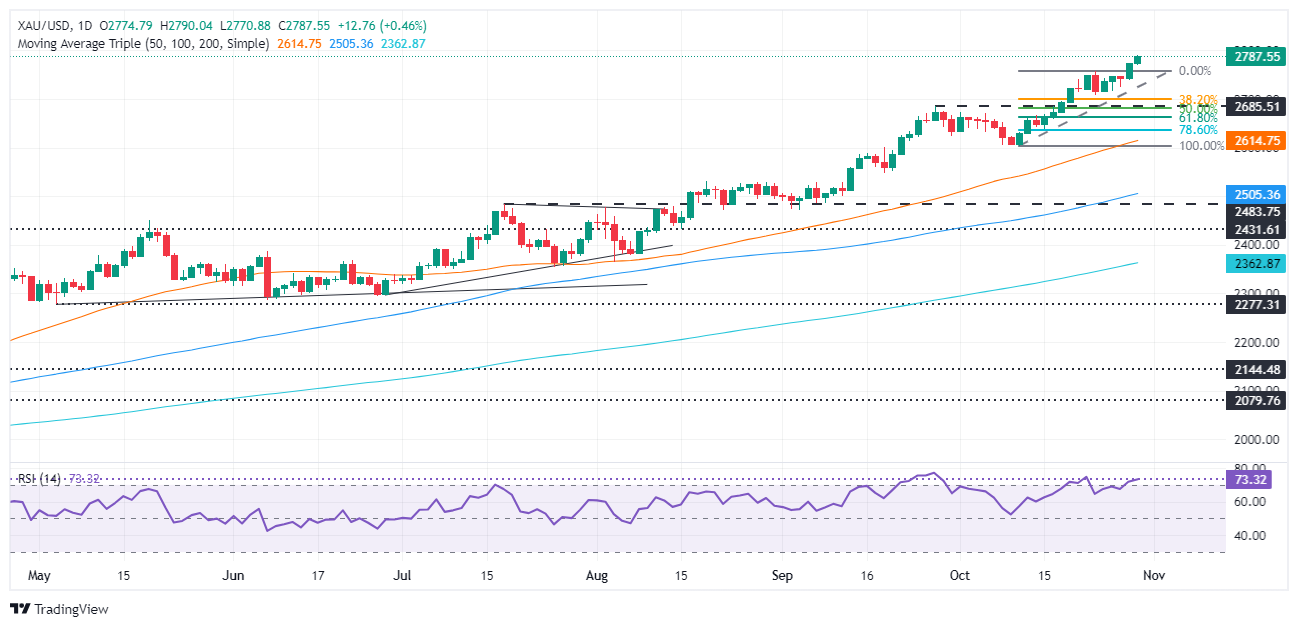
The XAU/USD trades at $2,785, gains over 0.40%, and is slightly below the all-time high (ATH) after the yellow metal bounced off daily lows of $2,771. US Treasury bond yields disappointed during the session as investors' confidence improved that the Fed would achieve its soft-landing scenario.
Data from the United States (US) showed the economy continued to grow steadily while the labor market remained robust. The Gross Domestic Product (GDP) for the third quarter of 2024 dipped below estimates. The ADP Employment Change report for October showed that private companies hired more personnel than foreseen.
At the same time, US Pending Home Sales soared due to buyers taking advantage of the combination of lower mortgage rates and more inventory choices, commented Lawrence Yun, Chief Economist of the National Association of Realtors (NAR).
The US election is reaching its boiling point as we approach November 5, Super Tuesday. The Democratic Vice-President Kamala Harris and former President Donald Trump clash in a tight race, as polls showed.
So far, Bullion’s price has surged over 35%, its most significant gain in twelve months, and is on its way to its best yearly performance since 1979. Sources cited by Reuters commented that Gold may reach $3,000 by 2025 due to “emerging market concerns, gold ETF inflows, and post-election market adjustments.”
Gold remains supported by safe-haven flows amid the ongoing conflict in the Middle East, even though Israeli officials commented that Hezbollah is ready to distance itself from Hamas in Gaza, and the IDF is close to finishing its ground operations.
Daily digest market movers: Gold price prolongs its positive streak
- The US Dollar Index (DXY), which tracks the Dollar's value against a basket of six currencies, drops 0.18% at 104.08.
- The ADP National Employment Change for October rose by 233K, surpassing estimates of 115K and the September figure of 159K.
- The US Bureau of Economic Analysis (BEA) reported that the US economy grew by 2.8% quarter-over-quarter (QoQ) in the third quarter of 2024, below the Q2 final reading and estimates of 3%.
- Pending Home Sales in September expanded by 7.4% month-over-month (MoM), exceeding estimates and August's figures. On an annual basis, sales grew by 2.6%, rebounding from August's -3% contraction.
- The Atlanta Fed GDP Now model suggests the economy grew by 2.8% in Q3 2024.
- Data from the Chicago Board of Trade, via the December fed funds rate futures contract, shows investors estimate 49 bps of Fed easing by the end of the year.
XAU/USD Technical Outlook: Gold price rallies to an all-time peak of $2,790
Gold price uptrend remains intact, with the yellow metal hitting a record high at $2,790. A breach of the latter will expose the $2,800 figure, followed by the psychological levels of $2,850 and $2,900.
On the other hand, if sellers move in and push prices below $2,750, the next support would be $2,700. Up next the September 26 swing high, which turned support at $2,685, followed by the 50-day Simple Moving Average (SMA) at $2,603.
Momentum suggests the non-yielding metal could consolidate as the Relative Strength Index (RSI) remains bullish, aiming higher, breaking the last peak. This means that buyers are gathering steam.
Gold FAQs
Gold has played a key role in human’s history as it has been widely used as a store of value and medium of exchange. Currently, apart from its shine and usage for jewelry, the precious metal is widely seen as a safe-haven asset, meaning that it is considered a good investment during turbulent times. Gold is also widely seen as a hedge against inflation and against depreciating currencies as it doesn’t rely on any specific issuer or government.
Central banks are the biggest Gold holders. In their aim to support their currencies in turbulent times, central banks tend to diversify their reserves and buy Gold to improve the perceived strength of the economy and the currency. High Gold reserves can be a source of trust for a country’s solvency. Central banks added 1,136 tonnes of Gold worth around $70 billion to their reserves in 2022, according to data from the World Gold Council. This is the highest yearly purchase since records began. Central banks from emerging economies such as China, India and Turkey are quickly increasing their Gold reserves.
Gold has an inverse correlation with the US Dollar and US Treasuries, which are both major reserve and safe-haven assets. When the Dollar depreciates, Gold tends to rise, enabling investors and central banks to diversify their assets in turbulent times. Gold is also inversely correlated with risk assets. A rally in the stock market tends to weaken Gold price, while sell-offs in riskier markets tend to favor the precious metal.
The price can move due to a wide range of factors. Geopolitical instability or fears of a deep recession can quickly make Gold price escalate due to its safe-haven status. As a yield-less asset, Gold tends to rise with lower interest rates, while higher cost of money usually weighs down on the yellow metal. Still, most moves depend on how the US Dollar (USD) behaves as the asset is priced in dollars (XAU/USD). A strong Dollar tends to keep the price of Gold controlled, whereas a weaker Dollar is likely to push Gold prices up.
Author
Christian Borjon Valencia
FXStreet
Markets analyst, news editor, and trading instructor with over 14 years of experience across FX, commodities, US equity indices, and global macro markets.