Gold appreciates toward all-time highs on Fed’s dovish hold
- Gold rallies and trades between $2,150 and $2,180 after the Federal Reserve's latest policy meeting.
- Fed keeps interest rates steady but adjusts its longer-term FFR projections for 2025, highlighting ongoing inflation challenges.
- Economic projections show an optimistic view for 2024 GDP growth, with core inflation expectations slightly elevated.
- Fed’s Powell: More evidence Is needed before the first interest rate cut.


Gold prices skyrocketed late in the North American session after the Federal Reserve decided to keep rates unchanged but upward revised the Federal Funds Rates (FFR) projections for 2025. At the time of writing, XAU/USD trades volatile around the $2170-$2180 area, posting gains of more than 1%.
The US central bank has kept rates at 5.25%-5.50% unchanged and maintained their balance sheet reduction at the same pace since May 2023. In their statement, Fed officials underscored the US economy's solidity and the labor market's robustness. They have acknowledged the progress on inflation but also emphasized that the job is incomplete. They have stated that the risks to achieving their dual mandate are moving into a better balance, and they will continue to rely on data for their decisions.
The Fed Chair Jerome Powell echoed his and colleagues' previous remarks, saying that more evidence is needed before cutting rates for the first time. When asked about tolerance for higher inflation, he said they expected a “bumpy road” on the disinflation process toward the Fed’s 2% goal. He added that higher-than-expected inflation figures at the start of the year didn’t change the broader story that price gains were slowing
Daily digest market movers: Gold stays firm amid weak US Dollar
- After posting two months of surprisingly high inflation reports, the Federal Reserve tweaked its monetary policy expectations for 2025, though for 2024 the median stood at 4.6% as in December. Nevertheless, they upward revised the FFR from 3.6% to 3.9% in 2025. Additional figures were updated:
- The Gross Domestic Product (GDP) for 2024 was revised to 2.1% up from 1.4% in December.
- The Unemployment Rate was not revised, as is expected to remain at 4.0% down from 4.1%.
- The Personal Consumption Expenditure (PCE) Price Index target wasn’t changed, remaining at 2.4%, while core PCE is estimated to end 2024 at 2.6%, up from 2.4%.
- The latest US economic data witnessed mixed business activity readings, making it challenging to predict the pace of economic deceleration in the US. The labor market has shown signs of cooling, though the economy added more people to the workforce than expected, while fewer people applied for unemployment benefits.
- Recent inflation data in the US showed that inflation on the consumer and producer side surprised to the upside, suggesting that inflation is stickier than expected.
- Given the backdrop, Fed Chair Jerome Powell’s testimony at the US Congress earlier this month, suggesting the Fed would begin to cut borrowing costs, were justified. However, last week’s inflation figures and Retail Sales data triggered a repricing of Fed rate cut bets, aligning with the US central bank's view of 75 basis points of easing toward the end of 2024.
- According to the CME FedWatch Tool, expectations for a June rate cut stand at 64%, down from 72% a week ago.
Technical analysis: Gold traders push XAU/USD north of $2,170
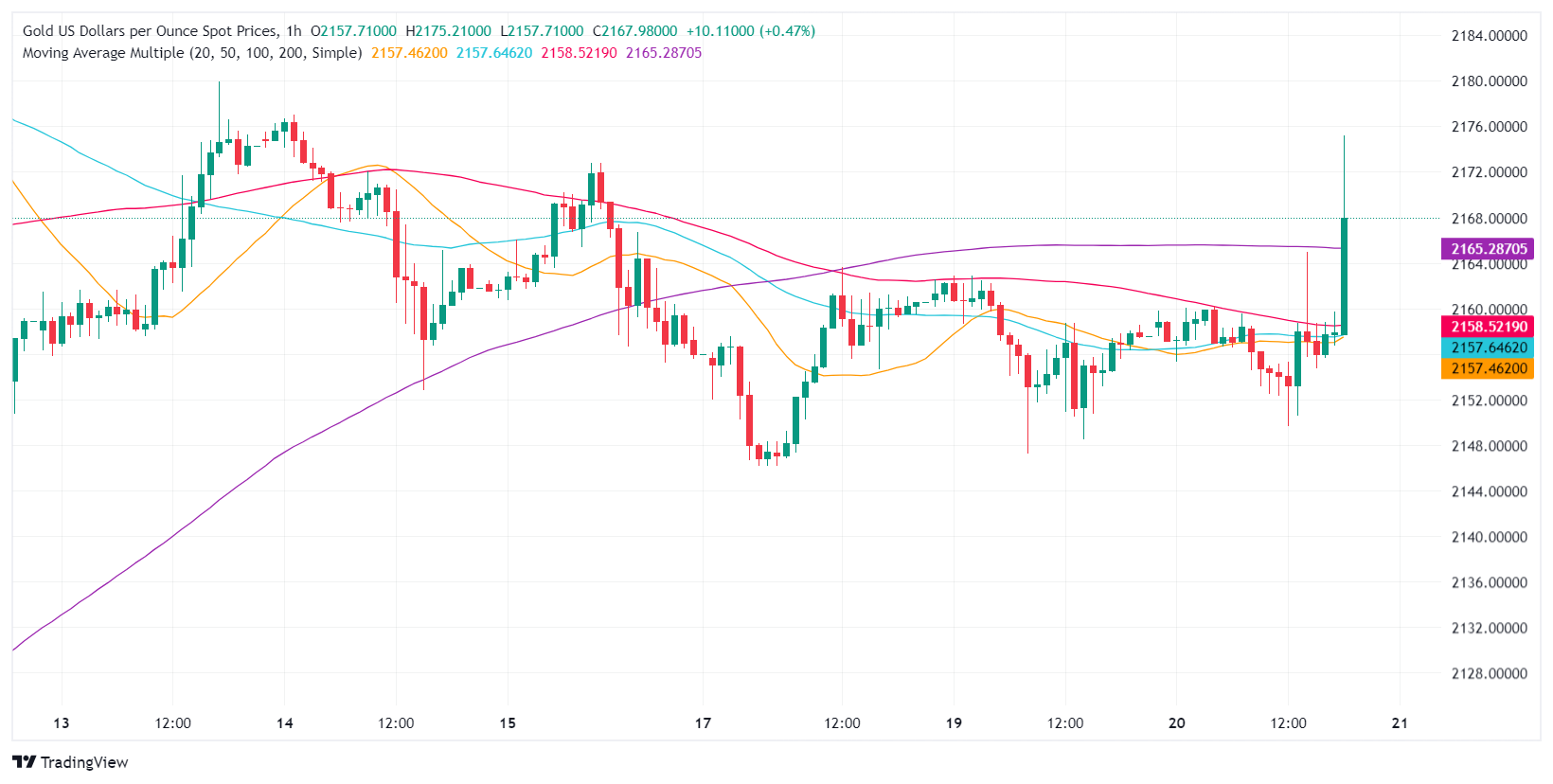
XAU/USD price hovers around $2,150 unmoved ahead of the FOMC decision. A dovish tilt could open the door for a rally that prompts a jump in Gold prices, opening the door to challenge the all-time high (ATH) at $2,195.15. A retest there would expose $2,200 next.
On the other hand, if Gold spot price tumbles below $2,150, look for a breach below December’s 3 high, exposing the March 6 low of $2,123.80, followed by $2,100.
Gold FAQs
Gold has played a key role in human’s history as it has been widely used as a store of value and medium of exchange. Currently, apart from its shine and usage for jewelry, the precious metal is widely seen as a safe-haven asset, meaning that it is considered a good investment during turbulent times. Gold is also widely seen as a hedge against inflation and against depreciating currencies as it doesn’t rely on any specific issuer or government.
Central banks are the biggest Gold holders. In their aim to support their currencies in turbulent times, central banks tend to diversify their reserves and buy Gold to improve the perceived strength of the economy and the currency. High Gold reserves can be a source of trust for a country’s solvency. Central banks added 1,136 tonnes of Gold worth around $70 billion to their reserves in 2022, according to data from the World Gold Council. This is the highest yearly purchase since records began. Central banks from emerging economies such as China, India and Turkey are quickly increasing their Gold reserves.
Gold has an inverse correlation with the US Dollar and US Treasuries, which are both major reserve and safe-haven assets. When the Dollar depreciates, Gold tends to rise, enabling investors and central banks to diversify their assets in turbulent times. Gold is also inversely correlated with risk assets. A rally in the stock market tends to weaken Gold price, while sell-offs in riskier markets tend to favor the precious metal.
The price can move due to a wide range of factors. Geopolitical instability or fears of a deep recession can quickly make Gold price escalate due to its safe-haven status. As a yield-less asset, Gold tends to rise with lower interest rates, while higher cost of money usually weighs down on the yellow metal. Still, most moves depend on how the US Dollar (USD) behaves as the asset is priced in dollars (XAU/USD). A strong Dollar tends to keep the price of Gold controlled, whereas a weaker Dollar is likely to push Gold prices up.
Author
Christian Borjon Valencia
FXStreet
Markets analyst, news editor, and trading instructor with over 14 years of experience across FX, commodities, US equity indices, and global macro markets.