Gold rises on worsening geopolitics and Fed rate cut expectations
- Gold continues to edge higher as fears of an escalation of the Gaza conflict and falling interest-rate expectations support the metal.
- US inflation data out this week could color expectations of the trajectory for interest rates.
- The precious metal is trading in an up leg within a sideways trend, with a risk it could extend its trendless mode.

Gold (XAU/USD) trades in the $2,440s on Monday, clocking up around a 0.45% gain from the previous day on a combination of safe-haven demand due to geopolitical risk and rising bets the Federal Reserve (Fed) will move to cut interest rates at its next meeting. The expectation of interest rates falling is positive for Gold since it lowers the opportunity cost of holding Gold which is a non-interest paying asset.
Gold rises on geopolitical risks and bets interest rates will fall
Gold is rising at the start of the trading week as fears the conflict in Gaza is about to escalate send investors into safe-haven assets. Israel is expecting Iran to mount a large-scale military attack on Israel, according to the Israeli Defence Minister, Yoav Gallant, as reported by Axios news. Such an attack would escalate the conflict substantially and threaten global stability.
The precious metal is further gaining traction as traders continue to bet on the Fed making cuts to its main interest rate, the fed funds rate, in September. The probability of a 0.25% cut in September stands at 49.5% and the chances of a 0.50% cut at 50.5%, according to the CME FedWatch Tool, which calculates the probability based on the price of 30-day fed funds futures.
US Consumer Price Index (CPI) data for July, to be released on Wednesday, and Producer Price Index (PPI) data on Tuesday could color expectations regarding future changes to interest rates. This in turn could impact Gold.
US CPI is expected to have risen by 0.2% in July compared with the previous month, both for headline and core. This comes after a 0.1% decline for headline in June (0.1% rise for core). If the real figure overshoots expectations, indicating sticky prices, it could bring into doubt the assumption the Fed will cut aggressively in September, hurting Gold price in the process.
PPI is forecast to have increased by 0.1% in July when figures are published on Tuesday, after a 0.2% gain in June.
Technical Analysis: Gold rises up within range
Gold is trading in a sideways trend, within which it is currently rising in an up leg. Given “the trend is your friend” it is expected to continue trading in a range until a significant breakout occurs in either direction. The range is narrowing, suggesting the possibility it might be forming a triangle pattern, but it is too early to say for sure.
XAU/USD 4-hour Chart
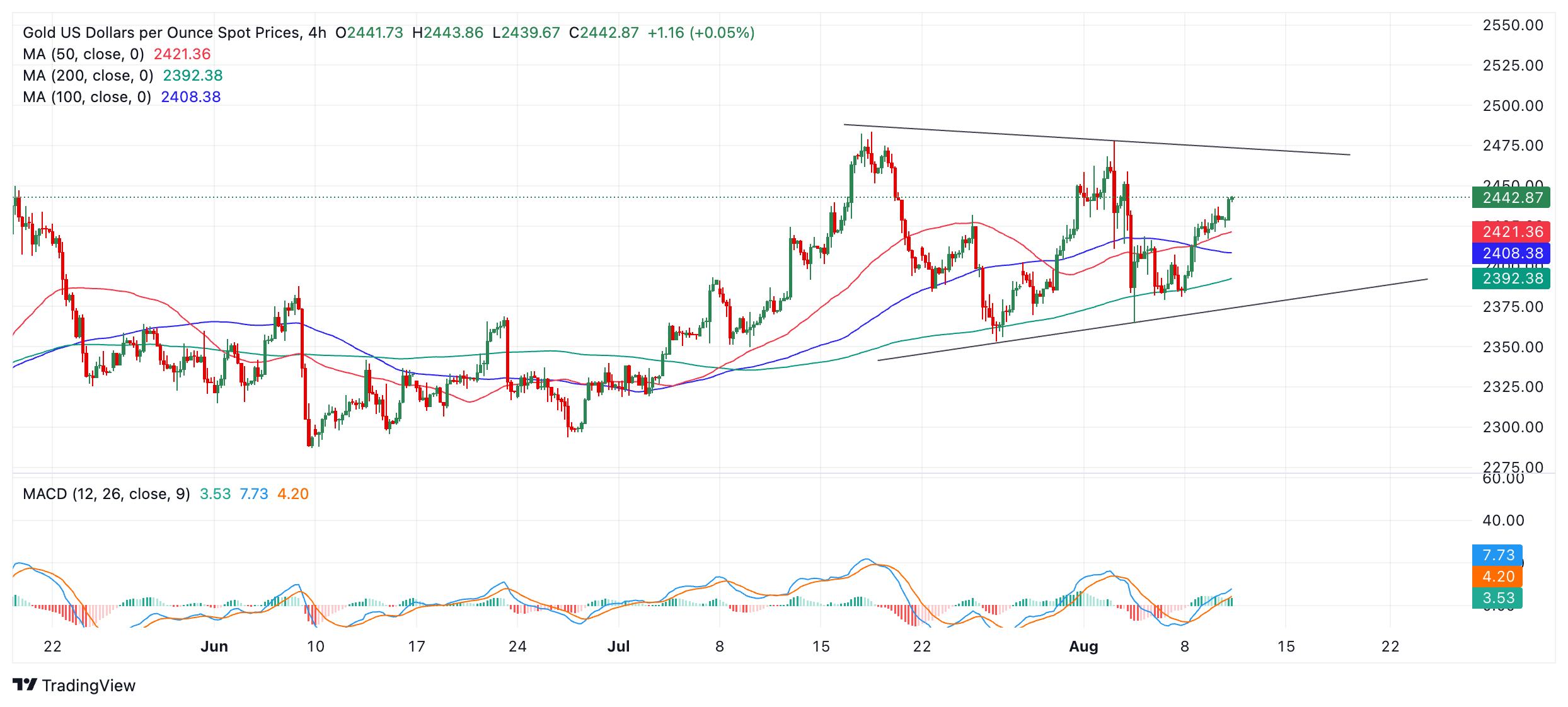
The move up within the range will probably continue until it reaches the range highs at roughly $2,475 before stalling.
A decisive break above the range ceiling would be required to indicate a more bullish trend was developing. Such a move would likely run up to at least $2,550, calculated by taking roughly the 0.618 Fibonacci ratio of the height of the range and extrapolating it higher.
A decisive break would be one characterized by a long green candle that pierced clearly through the level and closed near its high, or three green candles in a row that breached the level.
Gold FAQs
Gold has played a key role in human’s history as it has been widely used as a store of value and medium of exchange. Currently, apart from its shine and usage for jewelry, the precious metal is widely seen as a safe-haven asset, meaning that it is considered a good investment during turbulent times. Gold is also widely seen as a hedge against inflation and against depreciating currencies as it doesn’t rely on any specific issuer or government.
Central banks are the biggest Gold holders. In their aim to support their currencies in turbulent times, central banks tend to diversify their reserves and buy Gold to improve the perceived strength of the economy and the currency. High Gold reserves can be a source of trust for a country’s solvency. Central banks added 1,136 tonnes of Gold worth around $70 billion to their reserves in 2022, according to data from the World Gold Council. This is the highest yearly purchase since records began. Central banks from emerging economies such as China, India and Turkey are quickly increasing their Gold reserves.
Gold has an inverse correlation with the US Dollar and US Treasuries, which are both major reserve and safe-haven assets. When the Dollar depreciates, Gold tends to rise, enabling investors and central banks to diversify their assets in turbulent times. Gold is also inversely correlated with risk assets. A rally in the stock market tends to weaken Gold price, while sell-offs in riskier markets tend to favor the precious metal.
The price can move due to a wide range of factors. Geopolitical instability or fears of a deep recession can quickly make Gold price escalate due to its safe-haven status. As a yield-less asset, Gold tends to rise with lower interest rates, while higher cost of money usually weighs down on the yellow metal. Still, most moves depend on how the US Dollar (USD) behaves as the asset is priced in dollars (XAU/USD). A strong Dollar tends to keep the price of Gold controlled, whereas a weaker Dollar is likely to push Gold prices up.
Author
Joaquin Monfort
FXStreet
Joaquin Monfort is a financial writer and analyst with over 10 years experience writing about financial markets and alt data. He holds a degree in Anthropology from London University and a Diploma in Technical analysis.