Gold price climbs despite high US yields, eyes on ADP data
- Gold is up 0.28%, boosted by soft US Dollar and shrugging off positive US job data.
- Friday's Nonfarm Payrolls data could influence the Fed's rate decision.
- Fed officials express optimism about the economy, hinting at cautious policy recalibration ahead.


Gold prices trended up on Tuesday during the North American session. XAU/USD rose 0.28% higher despite US Treasury yields gaining ground, though the yellow metal was underpinned by overall US Dollar weakness across the board. The XAU/USD trades at $2,644.
Bullion extended its gains as traders shrugged off upbeat US jobs data from the US Department of Labor. The number of job openings in the country increased sharply, indicating that the labor market remains solid.
Ahead this week, further US jobs data for November will be revealed. Positive prints on Thursday’s Initial Jobless Claims and Friday’s Nonfarm Payrolls could prevent the Federal Reserve (Fed) from cutting interest rates at the upcoming December meeting.
The San Francisco Fed's Mary Daly said the US economy is in a good place as inflation is headed to 2% and the labor market remains solid. She stated, "We have to continue to recalibrate policy [...] whether it will be in December or sometime later."
Fed Governor Adriana Kugler commented that the labor market is solid and that she sees the economy “in a good position after making significant progress in recent years toward our dual-mandate goals of maximum employment and stable prices.” However, she didn't provide any forward guidance regarding her posture for the latest 2024 meeting.
This week, the US economic docket will feature Fed speakers, including Chair Jerome Powell, the JOLTs Job Openings for October, S&P and ISM Services PMI surveys, and Nonfarm Payroll figures.
Daily digest market movers: Gold price shrugs off high US yields
- Gold prices advance even though US real yields climbed three and a half basis points to 1.966%.
- The US 10-year Treasury bond yield rose three basis points to 4.226%.
- The US Dollar Index is virtually unchanged at 106.33 on the day.
- The October JOLTS report revealed 7.74 million job vacancies, surpassing expectations of 7.48 million and improving from September's 7.37 million.
- November's ISM Manufacturing PMI climbed to its highest level since June, reinforcing S&P Global's earlier data indicating robust US manufacturing activity and a resilient economy.
- The CME FedWatch Tool shows a 70% probability of a 25-basis-point rate cut at the Fed's December meeting, while Chicago Board of Trade data suggests 17 bps of easing by the end of 2024.
- Fed Governor Christopher Waller signaled support for a December rate cut but noted that incoming data could justify holding rates steady.
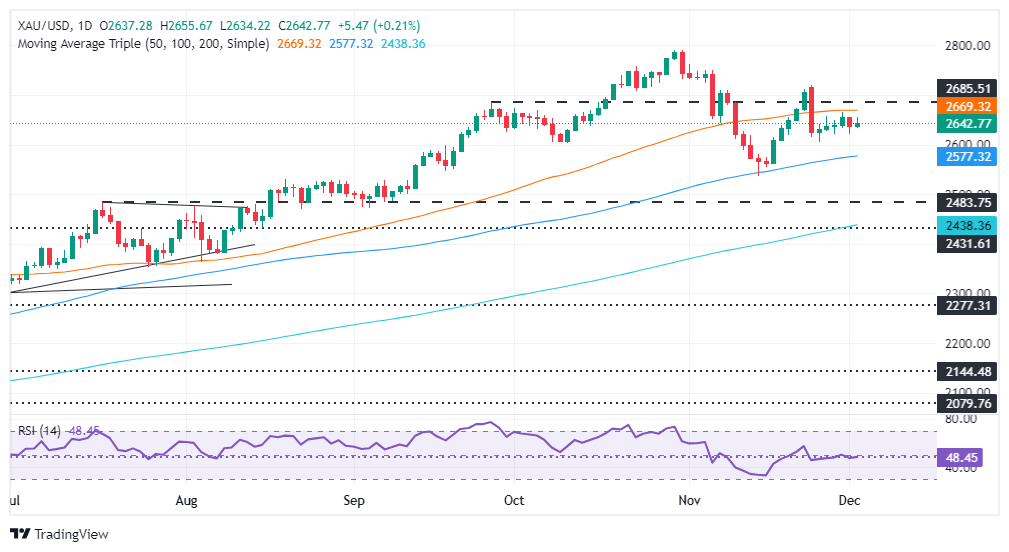
Technical outlook: Gold price consolidates within $2,600 and the 50-day SMA
Gold’s uptrend remains intact, but prices have consolidated within the $2,600-$2,650 range for the last five trading days. The non-yielding metal failed to find acceptance above the 50-day Simple Moving Average (SMA) at $2,688, which once cleared could pave the way for buyers to challenge the $2,700 figure. A breach of the latter will expose the year-to-date (YTD) peak of $2,790.
Conversely, if Gold prices tumble below the $2,600 mark, they could extend to the 100-day SMA at $2,576. On further weakness, the next support levels would be $2,550, followed by the November 14 swing low of $2,536.
Gold FAQs
Gold has played a key role in human’s history as it has been widely used as a store of value and medium of exchange. Currently, apart from its shine and usage for jewelry, the precious metal is widely seen as a safe-haven asset, meaning that it is considered a good investment during turbulent times. Gold is also widely seen as a hedge against inflation and against depreciating currencies as it doesn’t rely on any specific issuer or government.
Central banks are the biggest Gold holders. In their aim to support their currencies in turbulent times, central banks tend to diversify their reserves and buy Gold to improve the perceived strength of the economy and the currency. High Gold reserves can be a source of trust for a country’s solvency. Central banks added 1,136 tonnes of Gold worth around $70 billion to their reserves in 2022, according to data from the World Gold Council. This is the highest yearly purchase since records began. Central banks from emerging economies such as China, India and Turkey are quickly increasing their Gold reserves.
Gold has an inverse correlation with the US Dollar and US Treasuries, which are both major reserve and safe-haven assets. When the Dollar depreciates, Gold tends to rise, enabling investors and central banks to diversify their assets in turbulent times. Gold is also inversely correlated with risk assets. A rally in the stock market tends to weaken Gold price, while sell-offs in riskier markets tend to favor the precious metal.
The price can move due to a wide range of factors. Geopolitical instability or fears of a deep recession can quickly make Gold price escalate due to its safe-haven status. As a yield-less asset, Gold tends to rise with lower interest rates, while higher cost of money usually weighs down on the yellow metal. Still, most moves depend on how the US Dollar (USD) behaves as the asset is priced in dollars (XAU/USD). A strong Dollar tends to keep the price of Gold controlled, whereas a weaker Dollar is likely to push Gold prices up.
Author
Christian Borjon Valencia
FXStreet
Markets analyst, news editor, and trading instructor with over 14 years of experience across FX, commodities, US equity indices, and global macro markets.