Gold extends uptrend following US Retail Sales and CPI data
- Gold rises above the May highs after the release of lower-than-expected US CPI and Retail Sales data.
- The data hurt USD and indicates the possibility interest rates might fall more quickly than expected, aiding Gold.
- Robust central-bank demand is a key factor in keeping the precious metal bid.
- After a deep correction, XAU/USD resumes its uptrending bias and pushes higher.


Gold price (XAU/USD) trades higher on Wednesday after the release of US Consumer Price Index (CPI) and Retail Sales data for April came out lower than economists had expected. The data means the Federal Reserve (Fed) might cut interest rates sooner than had previously been thought. Lower interest rates or their expectation are positive for Gold because it reduces the opportunity cost of holding a non-yielding asset.
Gold rises after release of US data
US headline CPI rose 0.3% in April which was below expectations of 0.4% and March's 0.4%. On a year-over-year basis CPI met expectations of a 3.4% rise, which was below the 3.5% YoY of the previous month of March, according to data from the US Bureau of Labor Statistics.
US CPI ex Food and Energy came out in line with expectations, rising 0.3% MoM in April and 3.6% YoY, but this was still lower than the 0.4% and 3.8% of the prior month respectively.
US Retail Sales in April, meanwhile, came out well below expectations, registering 0.0% growth in April when 0.4% had been estimated, down from 0.6% in March, according to data from the US Census Bureau released at the same time. The fall in retail sales sounded another note of caution regarding the US economy that could further encourage Fed officials to consider cutting interest rates.
The combination of disinflation reflected in the CPI data and flatlining Retail Sales may prompt the Fed to consider cutting interest rates in the near term, a move that would weigh on the US Dollar (USD) but be bullish for Gold.
Gold price creeps higher on the back of sustained demand
Gold price also remains bid on the back of continued safe-haven demand due to geopolitical and global trade tensions.
In a speech at Stanford last week, Gita Gopinath, the First Deputy Managing Director of the International Monetary Fund (IMF), said that central banks, particularly in emerging markets, have been hoarding Gold in recent years as a hedge against the risk of, among other things, sanctions imposed by the West.
“Gold purchases by some central banks may have been driven by concerns about sanctions risk. This is consistent with a recent IMF study confirming that FX reserve managers tend to increase Gold holdings to hedge against economic uncertainty and geopolitical including sanctions risk,” said Gopinath.
The view is also backed up by data from the World Gold Council (WGC) showing strong demand in 2024 from central banks.
Given the heightened tensions in the Middle East, Ukraine and the increasingly polarized stand-off between the BRICS nations and US-led allies, the trend is expected to sustain, keeping Gold prices supported.
Technical Analysis: Gold price recovers after backslide
Gold price (XAU/USD) has recovered back up to almost the level of the May highs at $2,379, after finding support and resuming its short-term uptrend.
XAU/USD 4-hour Chart
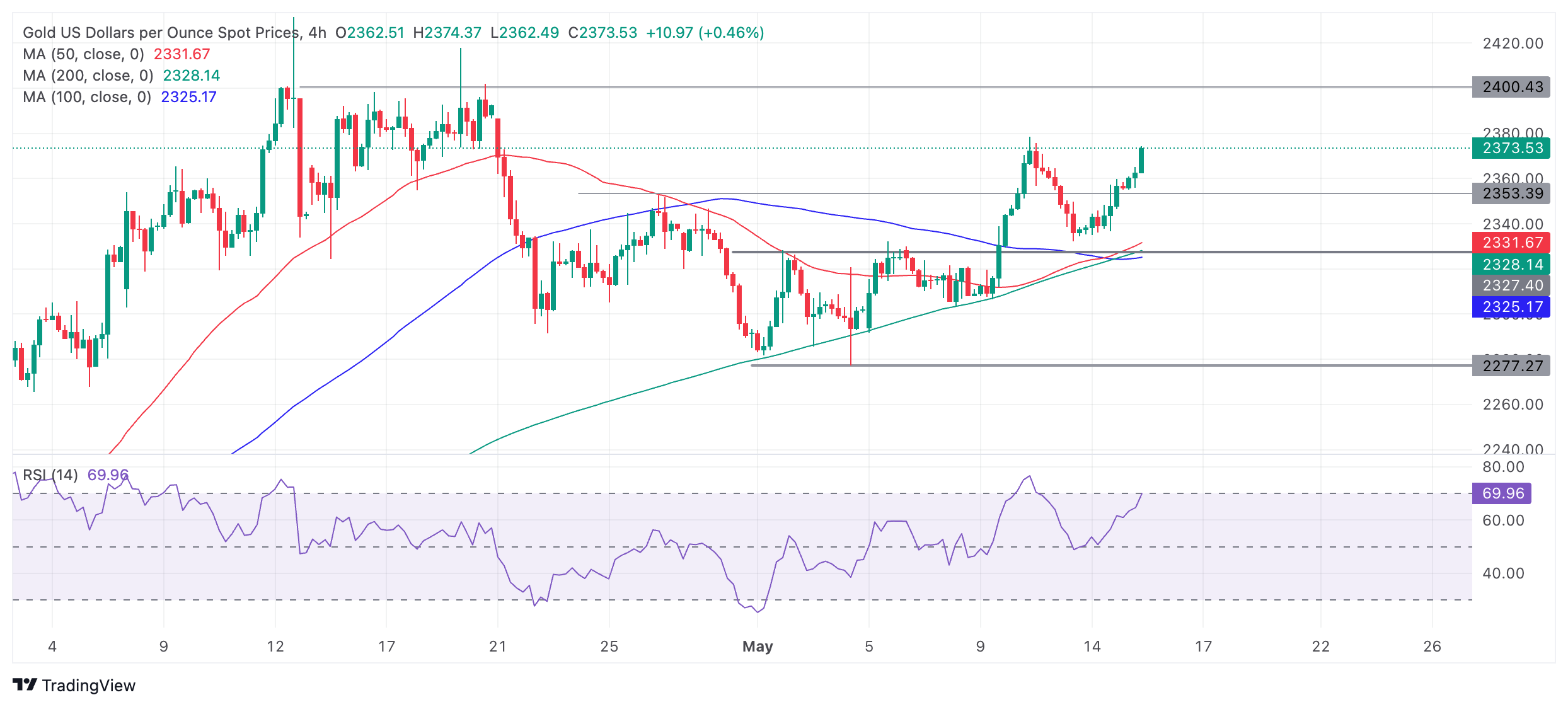
Given the old saying “the trend is your friend”, Gold is likely to continue pushing higher, with the next target at around $2,400, roughly at the April highs. A break back above the $2,378 May 10 high would provide extra confirmation.
The medium and long-term charts (daily and weekly) are also bullish, adding a supportive backdrop for Gold.
Economic Indicator
Consumer Price Index (MoM)
Inflationary or deflationary tendencies are measured by periodically summing the prices of a basket of representative goods and services and presenting the data as The Consumer Price Index (CPI). CPI data is compiled on a monthly basis and released by the US Department of Labor Statistics. The MoM figure compares the prices of goods in the reference month to the previous month.The CPI is a key indicator to measure inflation and changes in purchasing trends. Generally, a high reading is seen as bullish for the US Dollar (USD), while a low reading is seen as bearish.
Read more.Last release: Wed May 15, 2024 12:30
Frequency: Monthly
Actual: 0.3%
Consensus: 0.4%
Previous: 0.4%
Source: US Bureau of Labor Statistics
The US Federal Reserve has a dual mandate of maintaining price stability and maximum employment. According to such mandate, inflation should be at around 2% YoY and has become the weakest pillar of the central bank’s directive ever since the world suffered a pandemic, which extends to these days. Price pressures keep rising amid supply-chain issues and bottlenecks, with the Consumer Price Index (CPI) hanging at multi-decade highs. The Fed has already taken measures to tame inflation and is expected to maintain an aggressive stance in the foreseeable future.
Author
Joaquin Monfort
FXStreet
Joaquin Monfort is a financial writer and analyst with over 10 years experience writing about financial markets and alt data. He holds a degree in Anthropology from London University and a Diploma in Technical analysis.