Gold price struggles to rally after Fed call, geopolitical risks linger
- Gold drops 0.19% as the US Dollar strengthens; market assesses Powell's neutral outlook and economic updates.
- Fed predicts two rate cuts in 2025, revises growth down, and expects higher inflation and unemployment.
- Middle East tensions rise with Israeli airstrikes on Gaza; Gold does not benefit from increased risk aversion.


Gold price retreats on Thursday as bulls take a breather following the Federal Reserve's (Fed) latest monetary policy decision and an escalation of hostilities in the Middle East. The XAU/USD trades at $3,042, down over 0.19%.
Market sentiment turned negative, while the Greenback stages a recovery as depicted by the US Dollar Index (DXY), which tracks a basket of six currencies against the buck.
Gold traders failed to drive prices higher, even though the Fed held rates unchanged at the 4.25%–4.50% range for the second consecutive meeting. Officials added that they will slow down the pace of quantitative tightening (QT).
Fed policymakers acknowledged that the jobs market remains solid but added that prices remain high. Therefore, they emphasized they would monitor risks for both sides of the dual mandate.
They also updated their projections about interest rates, economic growth, the Unemployment rate and inflation. Policymakers foresee two rate cuts in 2025, revising the economy downward, and project inflation ticking higher alongside the Unemployment Rate.
Traders are also digesting Fed Chair Powell's neutral and patient stance. He said that “uncertainty around the (economic) outlook has increased,” adding that some tariff inflation has been passed on to consumers. Powell commented, "Our current policy stance is well positioned to deal with the risk and uncertainties we face.”
Powell added that some of Trump’s policies weighed on growth and increased prices.
In Gaza, Israel airstrikes continued with at least 91 Palestinians killed and dozens wounded, according to Reuters.
Daily digest market movers: Gold price poised to extend rally amid steady real yields
- The US 10-year T-note yield recovers and falls one basis point to 4.183%. At the same time, the US Dollar Index (DXY), which tracks the buck’s performance against a basket of six currencies, rises 0.34% to 103.80.
- US real yields, as measured by the US 10-year Treasury Inflation-Protected Securities (TIPS) yield that correlates inversely to Gold prices, are almost flat at 1.904%.
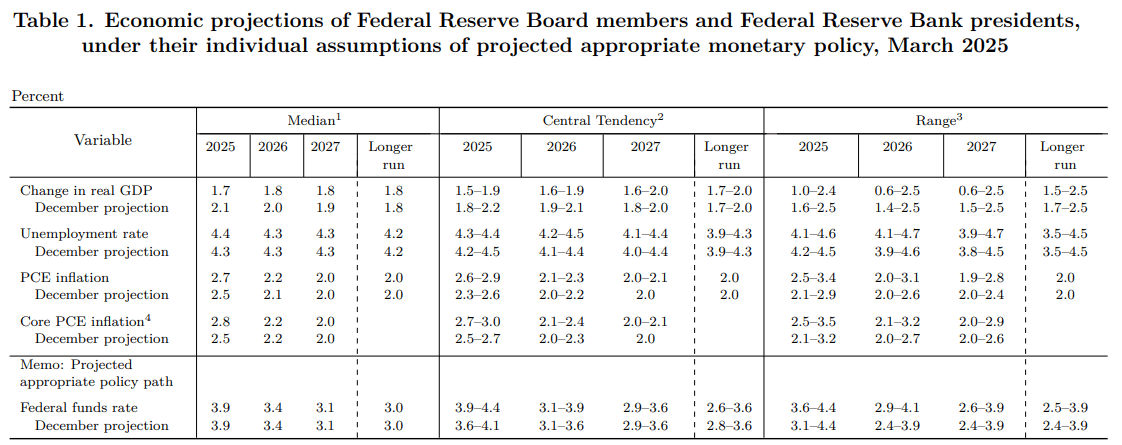
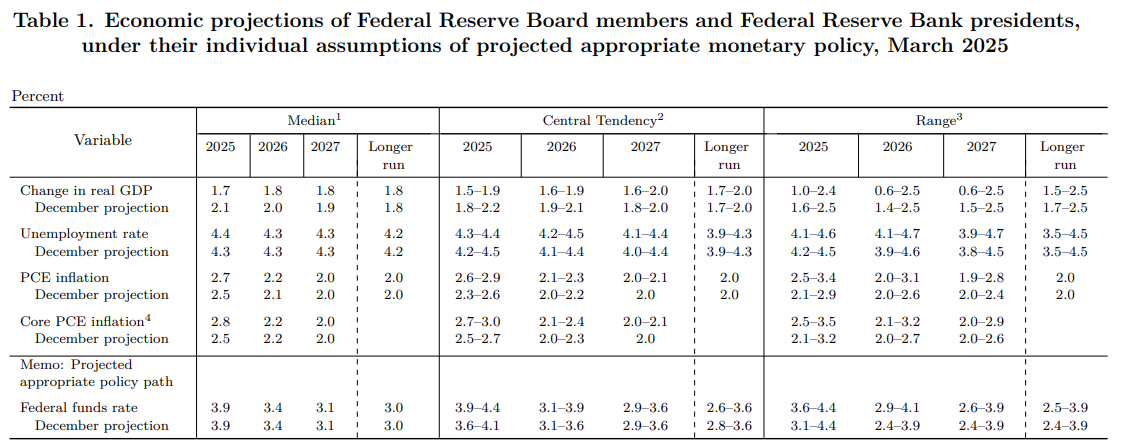
- The Summary of Economic Projections (SEP) revealed that Fed officials anticipate two rate cuts in 2025, keeping the fed funds rate forecast at 3.9%, unchanged from December’s projections. The PCE Price Index — the Fed’s preferred inflation gauge — and the Unemployment Rate were revised higher, while GDP growth is now projected to fall below 2%, signaling a slowdown linked to President Donald Trump’s trade policies.
- Source: Fed - Summary of Economic Projections
- Initial Jobless Claims for the week ending March 15 edged up slightly from 221K to 223K, but remained below the 224K forecast, indicating a still-resilient labor market.
- Meanwhile, the Philadelphia Fed Manufacturing Index declined from 18.1 to 12.5 in February, pointing to slower manufacturing activity.
- The money market has priced in 69.5 basis points of Fed easing in 2025, which has sent US Treasury yields plunging alongside the American currency.
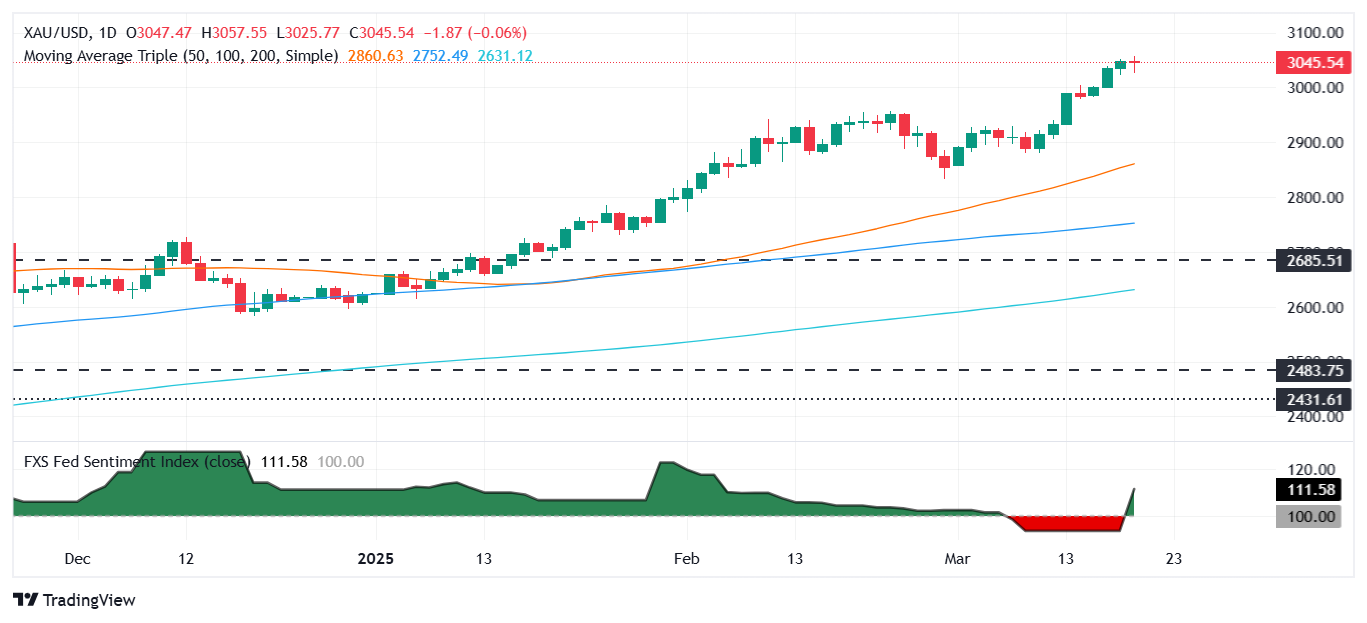
XAU/USD technical outlook: Gold price conquers $3,000 and is set to end above that level
Bullion’s trend remains upward even though today’s price action seems to be forming a Doji candlestick which could lead to a pullback before Gold resumes its rally.
The Relative Strength Index (RSI) is overbought but is set to dip to 70 as bulls take risk off the table. This means that bears are not out of the woods but could enjoy some profits on Gold’s way down.
XAU/USD’s first support would be the $3,000 mark. Once surpassed, the next stop would be the February 20 daily high at $2,954, followed by the $2,900 mark. Conversely, Gold rising above $3,050 would pave the way to challenge $3,100.
Fed FAQs
Monetary policy in the US is shaped by the Federal Reserve (Fed). The Fed has two mandates: to achieve price stability and foster full employment. Its primary tool to achieve these goals is by adjusting interest rates. When prices are rising too quickly and inflation is above the Fed’s 2% target, it raises interest rates, increasing borrowing costs throughout the economy. This results in a stronger US Dollar (USD) as it makes the US a more attractive place for international investors to park their money. When inflation falls below 2% or the Unemployment Rate is too high, the Fed may lower interest rates to encourage borrowing, which weighs on the Greenback.
The Federal Reserve (Fed) holds eight policy meetings a year, where the Federal Open Market Committee (FOMC) assesses economic conditions and makes monetary policy decisions. The FOMC is attended by twelve Fed officials – the seven members of the Board of Governors, the president of the Federal Reserve Bank of New York, and four of the remaining eleven regional Reserve Bank presidents, who serve one-year terms on a rotating basis.
In extreme situations, the Federal Reserve may resort to a policy named Quantitative Easing (QE). QE is the process by which the Fed substantially increases the flow of credit in a stuck financial system. It is a non-standard policy measure used during crises or when inflation is extremely low. It was the Fed’s weapon of choice during the Great Financial Crisis in 2008. It involves the Fed printing more Dollars and using them to buy high grade bonds from financial institutions. QE usually weakens the US Dollar.
Quantitative tightening (QT) is the reverse process of QE, whereby the Federal Reserve stops buying bonds from financial institutions and does not reinvest the principal from the bonds it holds maturing, to purchase new bonds. It is usually positive for the value of the US Dollar.
BRANDED CONTENT
Finding the right broker for trading Gold is crucial, as not all brokers offer the same advantages. Explore our list of top-performing brokers to discover the best options for seamless and cost-effective Gold trading.
Author
Christian Borjon Valencia
FXStreet
Markets analyst, news editor, and trading instructor with over 14 years of experience across FX, commodities, US equity indices, and global macro markets.