Gold price struggles to capitalize on intraday gains amid modest USD strength
- Gold attracts buyers for the second straight day amid concerns about a global trade war.
- Bets that the Fed would cut rates further lend support to the non-yielding yellow metal.
- Rebounding US bond yields and a modest USD uptick do little to cap the XAU/USD pair.


Gold price (XAU/USD) sticks to its intraday gains through the first half of the European session on Tuesday and is currently placed comfortably above the $2,900 mark. Investors remain worried about a potential escalation in global trade tensions on the back of US President Donald Trump's protectionist trade policies. Apart from this, bets that the Federal Reserve (Fed) would cut interest rates further, bolstered by the unexpected fall in US Retail Sales and mixed signals on inflation, continue to act as a tailwind for the non-yielding bullion.
Meanwhile, a delay in the implementation of Trump's reciprocal tariffs and the optimism over talks aimed at ending the Russia-Ukraine war remain supportive of a positive risk tone. Furthermore, a goodish pickup in the US Treasury bond yields assists the US Dollar (USD) to rebound from its lowest level since December 17 and keeps a lid on any further appreciating move for the Gold price. Nevertheless, the fundamental backdrop seems tilted in favor of bulls, suggesting that any corrective slide could be seen as a buying opportunity.
Gold price continues to draw support from the risk of a further escalation of global trade tensions
- US President Donald Trump threatened on Friday, saying that levies on automobiles would be coming as soon as April 2. This comes on top of Trump's reciprocal tariff plans on countries that charge duties on US imports and continues to underpin the safe-haven Gold price.
- The disappointing release of US Retail Sales figures on Friday, along with mixed signals on inflation, suggests that the Federal Reserve could possibly cut rates at the September or October policy meeting. Fed Funds Futures see the possibility of a 40 basis point rate cut in 2025.
- Philadelphia Fed President Patrick Harker said on Monday that the labor market is largely in balance and the current economy argues for a steady policy as inflation has been sticky over recent months. Future Fed rate policy choices will be data-driven, Harker added further.
- Fed Board of Governors member Michelle Bowman noted that high asset prices may have impeded progress on inflation and more certainty is needed on declining inflation before reducing rates. Bowman added that wage growth above level is consistent with the Fed inflation target.
- Fed Board of Governors member Christopher Waller said that inflation progress last year has been excruciatingly slow and that rate cuts would be appropriate in 2025 if inflation repeats the 2024 pattern. Waller expects disinflation and interest rate cuts to resume year on year.
- The US Dollar attracts some buyers and for now, seems to have snapped a three-day losing streak to its lowest level since December 17. This might hold back traders from placing aggressive bullish bets around the XAU/USD and keep a lid on any further appreciating move.
- Traders look to the release of the Empire State Manufacturing Index from the US for some impetus later during the North American session. Apart from this, speeches by influential FOMC members would drive the USD demand and produce short-term trading opportunities.
Gold price technical setup favors bullish traders; sustained move beyond the $2,925 hurdle awaited
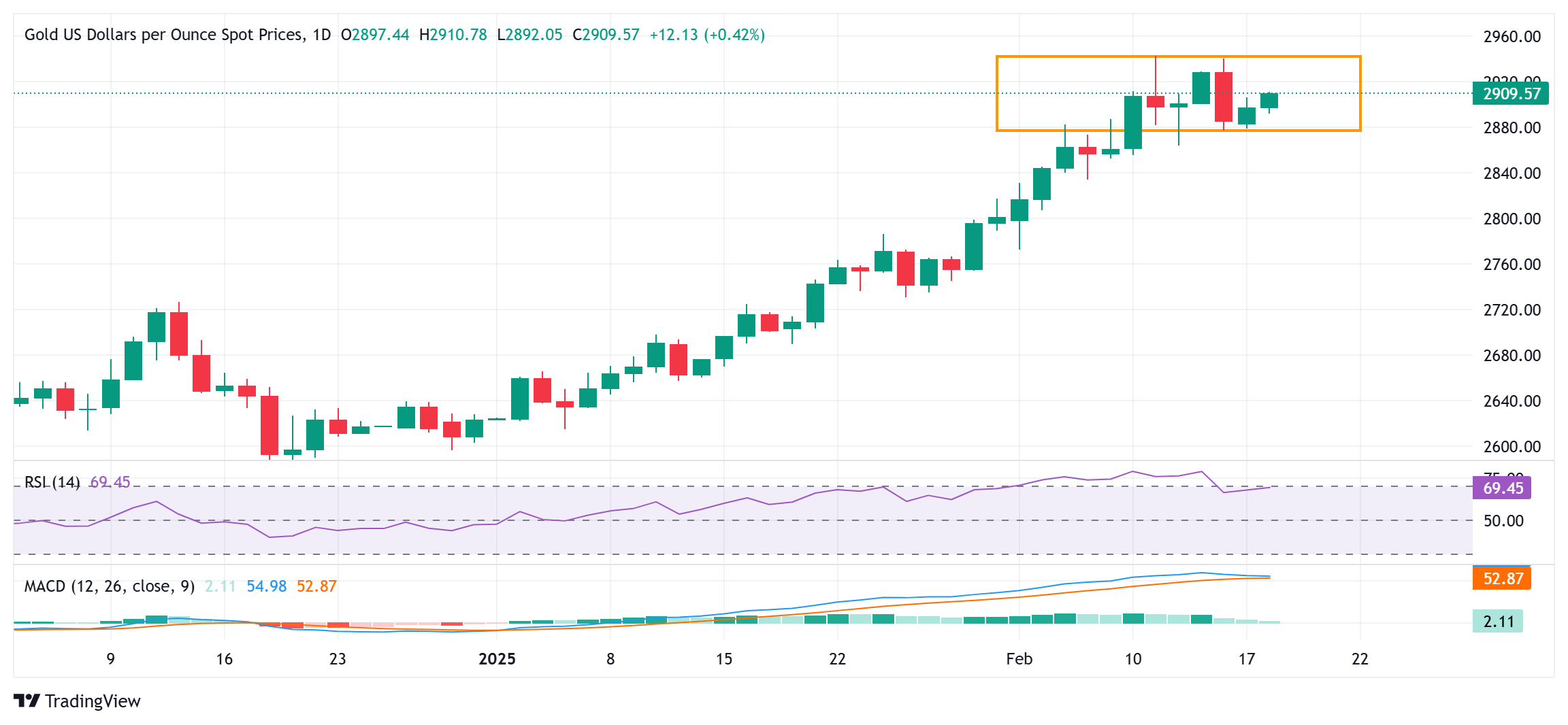
From a technical perspective, the range-bound price action witnessed over the past week or so could be categorized as a bullish consolidation phase against the backdrop of the recent rally to a record high. Moreover, oscillators on the daily chart are holding comfortably in the positive territory and suggest that the path of least resistance for the Gold price remains to the upside. That said, the daily Relative Strength Index (RSI) remains close to overbought territory. Hence, any subsequent move up is more likely to confront stiff resistance near the $2,925 horizontal zone. This is followed by the $2,942-2,943 area, or the all-time peak, which if cleared decisively will mark a fresh breakout and pave the way for an extension of a two-month-old uptrend.
On the flip side, weakness below the $2,900 mark now seems to find decent support near the $2,878-2,876 region. Any further decline towards the $2,860-2,855 area could be seen as a buying opportunity, which should help limit the downside for the Gold price near the $2,834 zone. A convincing break below the latter, however, might prompt some technical selling and drag the XAU/USD towards the $2,815 region en route to the $2,800 mark and the $2,785-2,784 support.
US Dollar FAQs
The US Dollar (USD) is the official currency of the United States of America, and the ‘de facto’ currency of a significant number of other countries where it is found in circulation alongside local notes. It is the most heavily traded currency in the world, accounting for over 88% of all global foreign exchange turnover, or an average of $6.6 trillion in transactions per day, according to data from 2022. Following the second world war, the USD took over from the British Pound as the world’s reserve currency. For most of its history, the US Dollar was backed by Gold, until the Bretton Woods Agreement in 1971 when the Gold Standard went away.
The most important single factor impacting on the value of the US Dollar is monetary policy, which is shaped by the Federal Reserve (Fed). The Fed has two mandates: to achieve price stability (control inflation) and foster full employment. Its primary tool to achieve these two goals is by adjusting interest rates. When prices are rising too quickly and inflation is above the Fed’s 2% target, the Fed will raise rates, which helps the USD value. When inflation falls below 2% or the Unemployment Rate is too high, the Fed may lower interest rates, which weighs on the Greenback.
In extreme situations, the Federal Reserve can also print more Dollars and enact quantitative easing (QE). QE is the process by which the Fed substantially increases the flow of credit in a stuck financial system. It is a non-standard policy measure used when credit has dried up because banks will not lend to each other (out of the fear of counterparty default). It is a last resort when simply lowering interest rates is unlikely to achieve the necessary result. It was the Fed’s weapon of choice to combat the credit crunch that occurred during the Great Financial Crisis in 2008. It involves the Fed printing more Dollars and using them to buy US government bonds predominantly from financial institutions. QE usually leads to a weaker US Dollar.
Quantitative tightening (QT) is the reverse process whereby the Federal Reserve stops buying bonds from financial institutions and does not reinvest the principal from the bonds it holds maturing in new purchases. It is usually positive for the US Dollar.
Tariffs FAQs
Tariffs are customs duties levied on certain merchandise imports or a category of products. Tariffs are designed to help local producers and manufacturers be more competitive in the market by providing a price advantage over similar goods that can be imported. Tariffs are widely used as tools of protectionism, along with trade barriers and import quotas.
Although tariffs and taxes both generate government revenue to fund public goods and services, they have several distinctions. Tariffs are prepaid at the port of entry, while taxes are paid at the time of purchase. Taxes are imposed on individual taxpayers and businesses, while tariffs are paid by importers.
There are two schools of thought among economists regarding the usage of tariffs. While some argue that tariffs are necessary to protect domestic industries and address trade imbalances, others see them as a harmful tool that could potentially drive prices higher over the long term and lead to a damaging trade war by encouraging tit-for-tat tariffs.
During the run-up to the presidential election in November 2024, Donald Trump made it clear that he intends to use tariffs to support the US economy and American producers. In 2024, Mexico, China and Canada accounted for 42% of total US imports. In this period, Mexico stood out as the top exporter with $466.6 billion, according to the US Census Bureau. Hence, Trump wants to focus on these three nations when imposing tariffs. He also plans to use the revenue generated through tariffs to lower personal income taxes.
Author
Haresh Menghani
FXStreet
Haresh Menghani is a detail-oriented professional with 10+ years of extensive experience in analysing the global financial markets.

















