Gold price drops as US NFP data beats estimates
- Gold price falls after the US NFP data release, which showed that the addition of fresh workers was higher than expected.
- Traders lean toward the Fed reducing interest rates by 25 basis points on December 18.
- The violation of truce terms between Israel and Hezbollah has reignited tensions in the Middle East, providing further support to Gold.


Gold price (XAU/USD) falls below $2,630 in North American trading hours on Friday after the release of the United States (US) Nonfarm Payrolls (NFP) data for November. The precious metal drops as the labor market report showed that the number of fresh workers hired was higher than expected. The report showed that the economy added 227K fresh workers, higher than estimates of 200K. The Unemployment Rate accelerated to 4.2%, as expected.
Broadly in-line growth in the labor market has boosted expectations for the Federal Reserve (Fed) to cut interest rates again in December. The probability for the Fed to cut interest rates by 25 basis points (bps) to 4.25%-4.50% this month has increased to 87% from 71%, recorded on December 5, according to the CME FedWatch tool.
The impact of the US labor market data on the Fed's likely interest rate action in the policy meeting on December 18 is expected to be significant. Fed officials became more focused on preserving labor demand when the central bank started reducing its key borrowing rates in September.
Lower interest rates are positive for Gold because they reduce the opportunity cost of holding the non-interest-paying asset.
Meanwhile, the US Average Hourly Earnings data rose steadily by 4% and 0.4% on monthly and annual basis, respectively. Economists expected a slight slowdown in the wage growth measure.
After the US NFP data, the initial reaction from the US Dollar Index (DXY) was bearish. Later, it gauges cushion near 105.50 and rebounds to near 105.75. Meanwhile, 10-year US Treasury yields slump to near 4.13%.
Gold price remains supported on renewed tensions in Middle East
- Gold price is expected to face increased volatility as traders brace for the US official labor market data. However, heightened geopolitical tensions would continue to support the Gold price downside.
- The ceasefire agreement in the Middle East region between Israel and Hezbollah appears to be shaking as tensions have reignited, with each party blaming the other for violating the truce terms. The Israeli army carried out an array of airstrikes late Monday on Hezbollah in retaliation to their attack by two projectiles on the Israeli military post near Lebanon.
- Meanwhile, the war between Russia and Ukraine also keeps the broader risk appetite on its toes. Russian foreign minister Sergey Lavrov warned that Russia is ready to use any means to prevent the West from achieving its goal of inflicting a “strategic defeat” on the country, in an interview with US journalist Tucker Carlson, ThePrint reported.
- Heightened geopolitical tensions and global uncertainty improve the appeal of safe-haven assets such as Gold.
Technical Analysis: Gold price wobbles around 20-day EMA
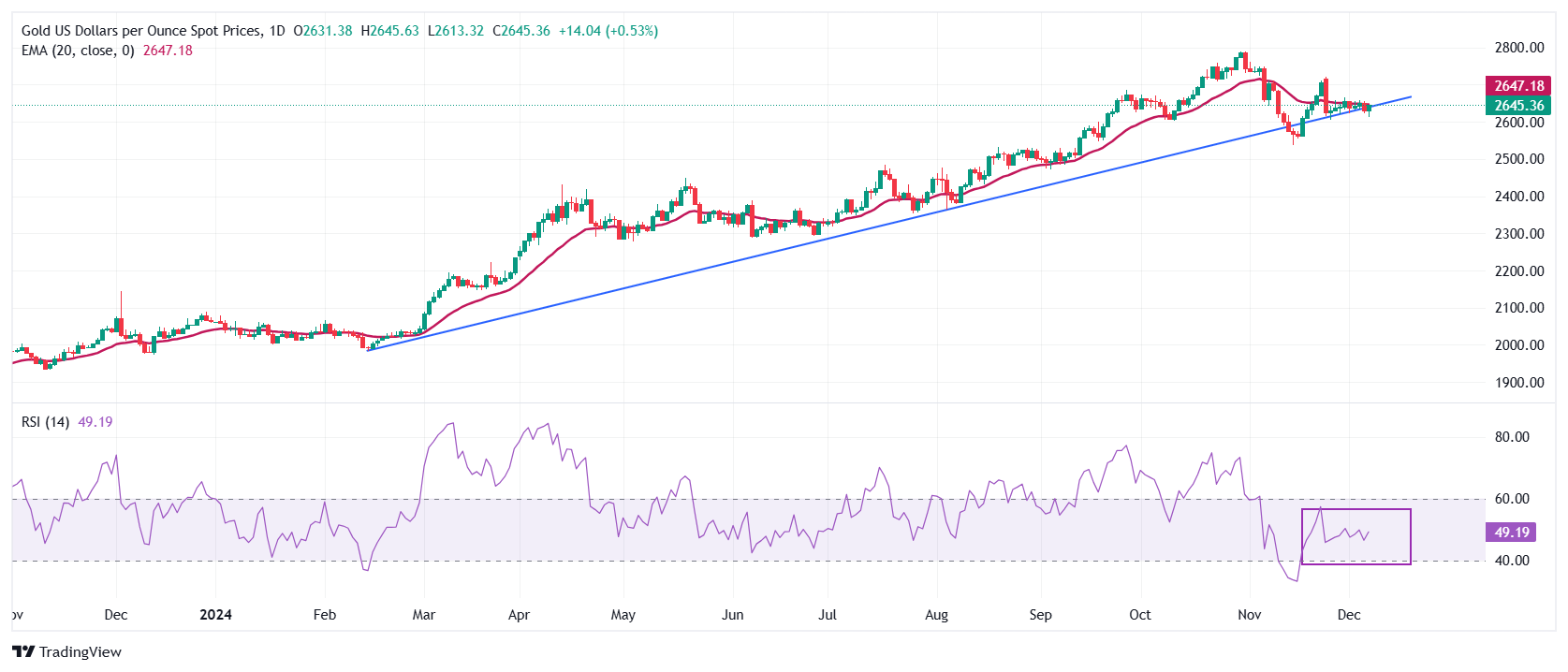
Gold price trades back and forth near the upward-sloping trendline around $2,650, which is plotted from the February low of $1,984.00 on the daily time frame. The precious metal wobbles near the 20-day Exponential Moving Average (EMA), which also trades around $2,650.
The 14-day Relative Strength Index (RSI) oscillates in the 40.00-60.00 range, very close to the neutral level of 50, suggesting a sideways trend.
Looking down, the November low of around $2,537 will be the key support for Gold price bulls. On the upside, the October and all-time high of $2,790 will act as key resistance.
Nonfarm Payrolls FAQs
Nonfarm Payrolls (NFP) are part of the US Bureau of Labor Statistics monthly jobs report. The Nonfarm Payrolls component specifically measures the change in the number of people employed in the US during the previous month, excluding the farming industry.
The Nonfarm Payrolls figure can influence the decisions of the Federal Reserve by providing a measure of how successfully the Fed is meeting its mandate of fostering full employment and 2% inflation. A relatively high NFP figure means more people are in employment, earning more money and therefore probably spending more. A relatively low Nonfarm Payrolls’ result, on the either hand, could mean people are struggling to find work. The Fed will typically raise interest rates to combat high inflation triggered by low unemployment, and lower them to stimulate a stagnant labor market.
Nonfarm Payrolls generally have a positive correlation with the US Dollar. This means when payrolls’ figures come out higher-than-expected the USD tends to rally and vice versa when they are lower. NFPs influence the US Dollar by virtue of their impact on inflation, monetary policy expectations and interest rates. A higher NFP usually means the Federal Reserve will be more tight in its monetary policy, supporting the USD.
Nonfarm Payrolls are generally negatively-correlated with the price of Gold. This means a higher-than-expected payrolls’ figure will have a depressing effect on the Gold price and vice versa. Higher NFP generally has a positive effect on the value of the USD, and like most major commodities Gold is priced in US Dollars. If the USD gains in value, therefore, it requires less Dollars to buy an ounce of Gold. Also, higher interest rates (typically helped higher NFPs) also lessen the attractiveness of Gold as an investment compared to staying in cash, where the money will at least earn interest.
Nonfarm Payrolls is only one component within a bigger jobs report and it can be overshadowed by the other components. At times, when NFP come out higher-than-forecast, but the Average Weekly Earnings is lower than expected, the market has ignored the potentially inflationary effect of the headline result and interpreted the fall in earnings as deflationary. The Participation Rate and the Average Weekly Hours components can also influence the market reaction, but only in seldom events like the “Great Resignation” or the Global Financial Crisis.
Author
Sagar Dua
FXStreet
Sagar Dua is associated with the financial markets from his college days. Along with pursuing post-graduation in Commerce in 2014, he started his markets training with chart analysis.

















