Gold price rises and clears $2,900 on trade market jitters
- XAU/USD extends gains amid geopolitical tensions despite solid US jobs data
- US tariffs on Canadian aluminum and steel imports begin on Wednesday, boosting Gold’s safe-haven appeal.
- Markets await US CPI inflation data on Wednesday and PPI on Thursday for the next Fed clues.


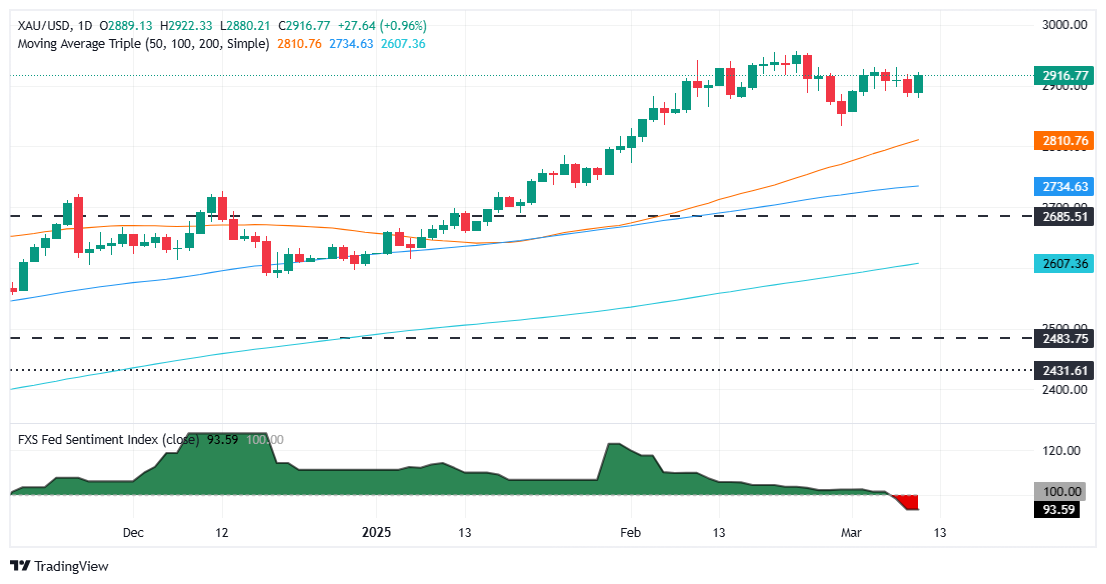
Gold (XAU) rallied on Tuesday as the trade war spurred demand for the yellow metal due to its safe-haven appeal. Upbeat United States (US) jobs data was ignored by traders, who continued to pile on Bullion. XAU/USD is trading at $2,917, up over 1%.
Sentiment has recently improved as Canada and the US de-escalated the threat of imposing tariffs. Concerns about an economic slowdown in the US exert downward pressure on US Treasury yields and the Greenback, which is a tailwind for Bullion prices.
Meanwhile, Trump’s trade tariffs on aluminum and steel imports will go into effect on Wednesday. The US Bureau of Labor Statistics (BLS) revealed that job openings rose in February.
Breaking news from Saudi Arabia revealed that Ukraine is ready to accept a ceasefire proposal, US Secretary of State Marco Rubio revealed. Ukraine’s President Volodymyr Zelenskyy added, “It is up to the US now to convince Russia to agree on a ceasefire.”
This could be a headwind for Gold prices, which tend to climb due to high geopolitical tensions and recessionary fears.
Meanwhile, XAU/USD traders eye the release of the Consumer Price Index (CPI) in the US on Wednesday, followed by the release of the Producer Price Index (PPI) on Thursday.
Daily digest market movers: Gold price unfazed by high US yields
- The US 10-year Treasury bond yield recovers and edges up six basis points to 4.282% as traders eye the Fed’s interest rate cuts.
- US real yields, as measured by the US 10-year Treasury Inflation-Protected Securities (TIPS) yield that correlates inversely to Gold prices, climb five-and-a-half basis points to 1.963%, a headwind for the non-yielding metal.
- The Atlanta Fed GDP Now model predicts the first quarter of 2025 at -2.4%, which would be the first negative print since the COVID-19 pandemic.
- The US JOLTS report showed that job openings rose to 7.740 million in January, up from 7.508 million, surpassing expectations of 7.63 million, signaling continued strength in the labor market.
- The People’s Bank of China (PBoC) continues to purchase Gold, according to the World Gold Council (WGC). The PBoC increased its holdings by 10 tonnes in the first two months of 2025. However, the largest buyer was the National Bank of Poland (NBP), which increased its reserve by 29 tonnes, its largest purchase since June 2019, when it bought 95 tonnes.
- Money market traders had priced in 77.5 basis points of easing in 2025, up from 74 bps last Friday, via data from Prime Market Terminal.
XAU/USD technical outlook: Gold price advances past $2,900
From a technical standpoint, Gold continues to trend up, but buyers need to clear last week’s peak at $2,930 on March 7 high so that buyers can challenge the psychological mark. A breach of the latter will expose the record high at $2,954, followed by the $3,000 mark.
Conversely, if XAU/USD drops below $2,900, the next support would be $2,850 ahead of the February 28 low of $2,832. Up next would be $2,800.
Risk sentiment FAQs
In the world of financial jargon the two widely used terms “risk-on” and “risk off'' refer to the level of risk that investors are willing to stomach during the period referenced. In a “risk-on” market, investors are optimistic about the future and more willing to buy risky assets. In a “risk-off” market investors start to ‘play it safe’ because they are worried about the future, and therefore buy less risky assets that are more certain of bringing a return, even if it is relatively modest.
Typically, during periods of “risk-on”, stock markets will rise, most commodities – except Gold – will also gain in value, since they benefit from a positive growth outlook. The currencies of nations that are heavy commodity exporters strengthen because of increased demand, and Cryptocurrencies rise. In a “risk-off” market, Bonds go up – especially major government Bonds – Gold shines, and safe-haven currencies such as the Japanese Yen, Swiss Franc and US Dollar all benefit.
The Australian Dollar (AUD), the Canadian Dollar (CAD), the New Zealand Dollar (NZD) and minor FX like the Ruble (RUB) and the South African Rand (ZAR), all tend to rise in markets that are “risk-on”. This is because the economies of these currencies are heavily reliant on commodity exports for growth, and commodities tend to rise in price during risk-on periods. This is because investors foresee greater demand for raw materials in the future due to heightened economic activity.
The major currencies that tend to rise during periods of “risk-off” are the US Dollar (USD), the Japanese Yen (JPY) and the Swiss Franc (CHF). The US Dollar, because it is the world’s reserve currency, and because in times of crisis investors buy US government debt, which is seen as safe because the largest economy in the world is unlikely to default. The Yen, from increased demand for Japanese government bonds, because a high proportion are held by domestic investors who are unlikely to dump them – even in a crisis. The Swiss Franc, because strict Swiss banking laws offer investors enhanced capital protection.
Author
Christian Borjon Valencia
FXStreet
Christian Borjon began his career as a retail trader in 2010, mainly focused on technical analysis and strategies around it. He started as a swing trader, as he used to work in another industry unrelated to the financial markets.