Gold price slips as USD recovers and risk appetite improves
- Gold retreats as DXY climbs 0.27%, capping bullion’s recovery despite soft US data.
- Trump hints at easing auto tariffs, boosting equities and dampening safe-haven flows.
- Traders brace for pivotal US data releases, including GDP, Core PCE and NFP figures.


Gold price retreats during the North American session on Tuesday as the Greenback stages a recovery, posting modest gains amid softer US economic data and reduced safe-haven demand. At the time of writing, XAU/USD trades at $3,323, down 0.60%.
United States (US) equity markets continued to rise as investors turned optimistic that US President Donald Trump may ease tariffs on autos, car parts and trucks and soften the US stance with China. In the meantime, a gauge of the buck’s value against six currencies, the US Dollar Index (DXY), rose 0.27% back above the 99.00 handle after hitting a yearly low of 97.92 on April 21 and capped Gold’s advance.
The US Treasury Secretary Scott Bessent delivered remarks in the White House, saying there was some advance in India and Japan trade negotiations, but failed to clarify “talks” between the US and Beijing.
Year to date, Bullion prices had struck a 25% gain sponsored by uncertainty about US trade policies and a less dovish Federal Reserve (Fed). However, the US economic schedule suggests the labor market begins to soften, while the Conference Board (CB) Consumer Confidence showed that households had grown pessimistic about the economic outlook
This week, traders are targeting the release of US economic data—mostly hard data, including Gross Domestic Product (GDP) figures for Q1 2025, the Core Personal Consumption Expenditures (PCE) Price Index and Nonfarm Payroll figures.
Daily digest market movers: Gold price retreats unfazed by the plunge in US yields
- The yield on the US 10-year Treasury note plunges three and a half basis points, reaching 4.17%.
- US real yields collapsed three bps to 1.92%, as shown by the US 10-year Treasury Inflation-Protected Securities yields.
- The US Department of Labor reported that JOLTS job openings fell to 7.192 million in March, the lowest since September. This was below expectations of 7.5 million and down from 7.48 million the previous month, signaling weaker labor demand.
- The US Conference Board’s Consumer Confidence Index plunged to 86.0 in April, its lowest level in nearly five years, down from 93.9 and below the 87.5 forecast, reflecting rising consumer pessimism.
- The risks of the global economy slipping into a recession are increasing, according to a Reuters poll.
XAU/USD technical outlook: Remains bullish but poised to test $3,200
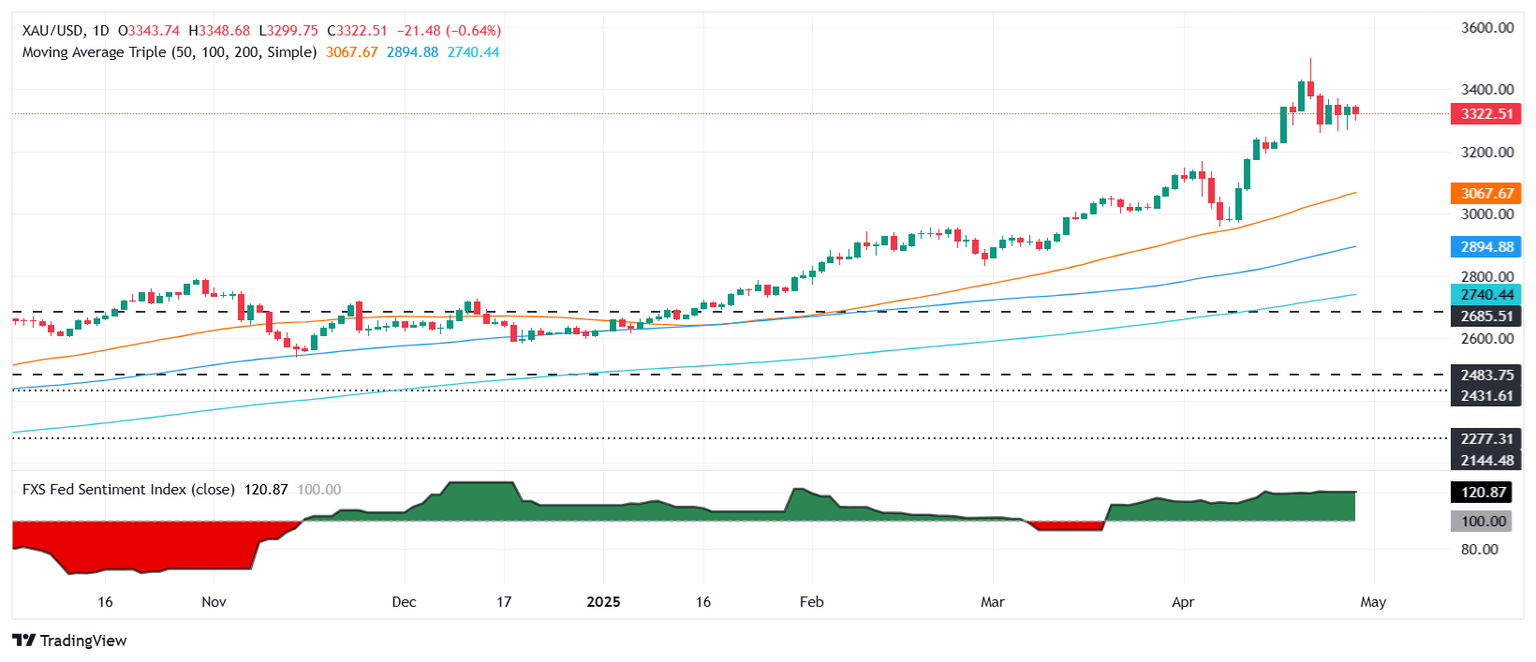
Gold price uptrend is intact, but during the last five trading days, XAU/USD consolidated within the $3,260-$3,386 range, unable to clear beneath the $3,200 figure or above the $3,400 mark.
As measured by the Relative Strength Index (RSI), momentum remains bullish, but the index’s slope is falling towards its neutral line. This signals that neither buyers nor sellers are in charge.
If XAU/USD tumbles below $3,300, the next support would be the April 23 swing low of $3,260 before diving to $3,200. Conversely, if Gold rises past $3,400, the next resistance would be $3,450 ahead of the all-time high at $3,500.
Gold FAQs
Gold has played a key role in human’s history as it has been widely used as a store of value and medium of exchange. Currently, apart from its shine and usage for jewelry, the precious metal is widely seen as a safe-haven asset, meaning that it is considered a good investment during turbulent times. Gold is also widely seen as a hedge against inflation and against depreciating currencies as it doesn’t rely on any specific issuer or government.
Central banks are the biggest Gold holders. In their aim to support their currencies in turbulent times, central banks tend to diversify their reserves and buy Gold to improve the perceived strength of the economy and the currency. High Gold reserves can be a source of trust for a country’s solvency. Central banks added 1,136 tonnes of Gold worth around $70 billion to their reserves in 2022, according to data from the World Gold Council. This is the highest yearly purchase since records began. Central banks from emerging economies such as China, India and Turkey are quickly increasing their Gold reserves.
Gold has an inverse correlation with the US Dollar and US Treasuries, which are both major reserve and safe-haven assets. When the Dollar depreciates, Gold tends to rise, enabling investors and central banks to diversify their assets in turbulent times. Gold is also inversely correlated with risk assets. A rally in the stock market tends to weaken Gold price, while sell-offs in riskier markets tend to favor the precious metal.
The price can move due to a wide range of factors. Geopolitical instability or fears of a deep recession can quickly make Gold price escalate due to its safe-haven status. As a yield-less asset, Gold tends to rise with lower interest rates, while higher cost of money usually weighs down on the yellow metal. Still, most moves depend on how the US Dollar (USD) behaves as the asset is priced in dollars (XAU/USD). A strong Dollar tends to keep the price of Gold controlled, whereas a weaker Dollar is likely to push Gold prices up.
Author
Christian Borjon Valencia
FXStreet
Markets analyst, news editor, and trading instructor with over 14 years of experience across FX, commodities, US equity indices, and global macro markets.