Gold slides as US yields rise, Middle East conflict eases
- Gold drops to a daily low of $2,604 amid truce hopes between Israel and its neighbors.
- Safe-haven demand weakens as Hezbollah supports ceasefire efforts, while rising US Treasury yields further weigh on Bullion.
- Traders adjust Fed rate cut expectations with focus shifting to upcoming US inflation data, jobless claims and consumer sentiment.

Gold prices slumped sharply on Tuesday following a strong US jobs report and newswires revealing that Hezbollah supported calls for a truce in the conflict between them and Israel. Hence, hints of a possible de-escalation of the Middle East conflict opened the door for traders to book profits. The XAU/USD trades at $2,615, down more than 1%.
US equities remain underpinned by an improvement in market mood. Bullion remained near year-to-date (YTD) highs due to fears of further escalation of the Middle East hostilities. However, signs of a possible solution to the conflict would trigger outflows from safe-haven assets to riskier ones. According to CNN, “Hezbollah supports efforts aimed at achieving a ceasefire in Lebanon, its top official said on Tuesday.”
This sponsored a sell-off in XAU/USD, which tumbled over $35 to a daily low of $2,604 before buyers lifted prices to current spot prices. Additionally, the jump in US Treasury yields weighed on the non-yielding metal. The US 10-year benchmark note rate remains unchanged above 4%, yet it’s up over six basis points this week after last Friday’s September Nonfarm Payrolls (NFP) report.
Given the backdrop, interest rate traders adjusted their expectations about the Federal Reserve’s (Fed) next move. Most Fed speakers crossing the wires adopted a gradual tone regarding easing monetary policy. However, some, like St. Louis Fed President Alberto Musalem, projected only one additional cut toward the end of the year after backing September’s 50 bps cut.
In the meantime, the Greenback clings to minimal gains as next week the US docket will feature the release of inflation data, the Fed’s last Meeting Minutes, Initial Jobless Claims, and the University of Michigan Consumer Sentiment.
Daily digest market movers: Gold price plunges on hopes of truce in Middle East
- The US Dollar Index (DXY), which tracks the buck’s value against a basket of six currencies, is at 102.52, virtually unchanged but at levels last seen in August 2024.
- Following the last US jobs report, recession fears faded. Therefore, most Wall Street banks like Citi, JP Morgan and Bank of America revised its November Fed call from a 50 to 25 bps rate cut.
- According to CME FedWatch Tool data, the odds for a 25 bps Fed rate cut are 85.3%. Meanwhile, the chances of lowering rates by 50 bps are 0%, but they increased to 14.7% for a hold.
- Meanwhile, the People’s Bank of China (PBoC) halted its Bullion purchases for the fifth month. China’s reserves were unchanged as their holdings stood at 72.8 million troy ounces at the end of last month.
XAU/USD technical analysis: Gold price slips as sellers eye support underneath $2,650
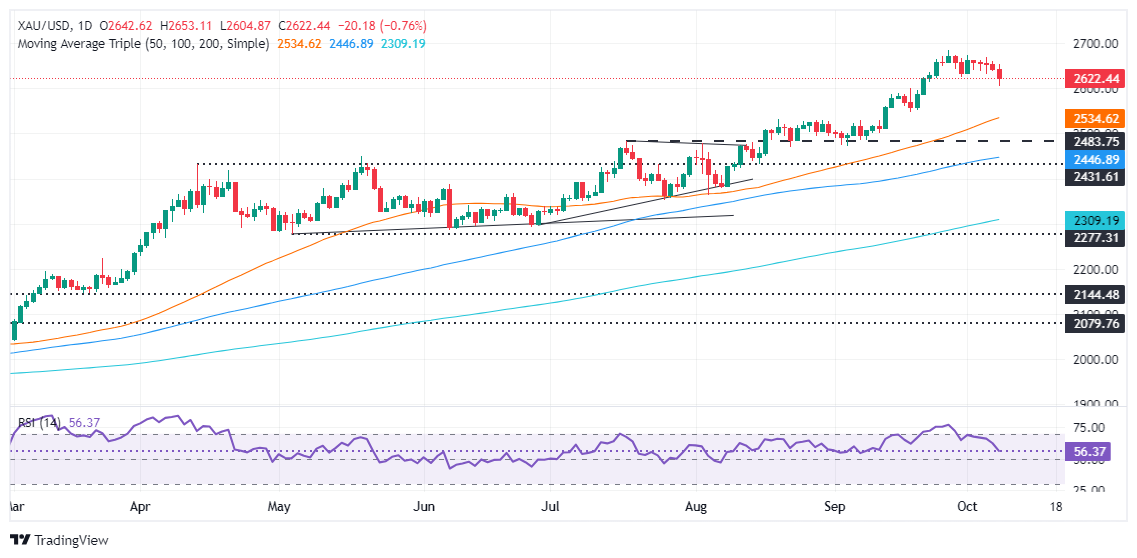
Gold prices dropped below $2,650 on Tuesday, which could open the door for a deeper pullback. After briefly testing the $2,605 area, it has recovered some ground. But so far, it has failed to gain traction to aim higher and surpass the $2,650 mark.
Momentum shows that bears are stepping up as the Relative Strength Index (RSI), despite being bullish, is aggressively aiming lower.
Once XAU/USD dropped below the September 30 low of $2,624, it sponsored a leg toward the $2,600 mark. On further weakness, the following floor will be the 50-day Simple Moving Average (SMA) at $2,534.
Conversely, if Gold prints a daily close above $2,650, the XAU/USD needs to clear $2,670 to challenge the YTD high of $2,685. Up next will be the $2,700 mark.
Gold FAQs
Gold has played a key role in human’s history as it has been widely used as a store of value and medium of exchange. Currently, apart from its shine and usage for jewelry, the precious metal is widely seen as a safe-haven asset, meaning that it is considered a good investment during turbulent times. Gold is also widely seen as a hedge against inflation and against depreciating currencies as it doesn’t rely on any specific issuer or government.
Central banks are the biggest Gold holders. In their aim to support their currencies in turbulent times, central banks tend to diversify their reserves and buy Gold to improve the perceived strength of the economy and the currency. High Gold reserves can be a source of trust for a country’s solvency. Central banks added 1,136 tonnes of Gold worth around $70 billion to their reserves in 2022, according to data from the World Gold Council. This is the highest yearly purchase since records began. Central banks from emerging economies such as China, India and Turkey are quickly increasing their Gold reserves.
Gold has an inverse correlation with the US Dollar and US Treasuries, which are both major reserve and safe-haven assets. When the Dollar depreciates, Gold tends to rise, enabling investors and central banks to diversify their assets in turbulent times. Gold is also inversely correlated with risk assets. A rally in the stock market tends to weaken Gold price, while sell-offs in riskier markets tend to favor the precious metal.
The price can move due to a wide range of factors. Geopolitical instability or fears of a deep recession can quickly make Gold price escalate due to its safe-haven status. As a yield-less asset, Gold tends to rise with lower interest rates, while higher cost of money usually weighs down on the yellow metal. Still, most moves depend on how the US Dollar (USD) behaves as the asset is priced in dollars (XAU/USD). A strong Dollar tends to keep the price of Gold controlled, whereas a weaker Dollar is likely to push Gold prices up.
Author
Christian Borjon Valencia
FXStreet
Markets analyst, news editor, and trading instructor with over 14 years of experience across FX, commodities, US equity indices, and global macro markets.