Gold price declines weighed by US yields, strong US Dollar
- Gold trades just below its record high, down 0.09%, as US Treasury yields rise over 10 basis points, reaching 4.192%.
- Safe-haven flows continue amid Middle East hostilities and US election uncertainty with polls showing a tight race between Harris and Trump.
- Fed officials hint at gradual rate cuts, but a 25 bps cut at the November meeting remains heavily priced in.

Gold prices hit another record high during Monday’s North American session, yet it paused its advance amid elevated US Treasury bond yields and a strong US Dollar. Tensions in the Middle East and uncertainty around the presidential election in the United States (US) increased flows toward safe-haven assets during the last five trading days. At the time of writing, XAU/USD trades at $2,718, slightly down 0.09%.
Market sentiment shifted negatively amid a close race in the US election. Reuters revealed that Vice President Kamala Harris leads former President Donald Trump 45% to 42% in the popular vote. However, the winner will be determined by the state-by-state results of the Electoral College.
“Polls have shown Harris and Trump are neck and neck in those battleground states, with many results within the margins of error,” via Reuters.
In the meantime, US Treasury bond yields soared over ten basis points higher, with the 10-year T-note yielding 4.192%. Consequently, the US Dollar Index (DXY), which tracks the buck’s value against a basket of six currencies, has risen 0.50%, hitting a new two-month peak at 104.01.
Hostilities in the Middle East continued as Israel revealed that a projectile from Lebanon hit an open area in central Israel. Meanwhile, Iran’s envoy to the United Nations said that Biden's remarks in Berlin on Israel’s plan to attack the country are “inflammatory.”
Federal Reserve (Fed) officials crossed the wires. Dallas Fed President Lorie Logan said they need to be nimble with monetary policy, adding to the chorus of gradually lowering borrowing costs.
Minneapolis Fed President Neel Kashkari has echoed Logan’s comments, saying that he sees modest cuts over the next quarters while adding that evidence of weakness in the labor market could spark faster rate cuts. He added that the Fed “definitely” wants to avoid a recession.
Despite that, the Fed is heavily expected to lower interest rates by 25 basis points at the November meeting. Odds remained at 87%, according to CME FedWatch Tool data.
Daily digest market movers: Gold price climbs, ignoring upbeat US data
- US Initial Jobless Claims for the week ending October 19 are expected to rise from 241K to 247K.
- US business activity in October is projected to improve in the manufacturing sector, according to S&P Global, while the Services PMI is expected to dip slightly from 55.2 to 55.
- Data from the Chicago Board of Trade, based on the December Fed funds rate futures contract, indicates that investors estimate 46 basis points (bps) of Fed easing by the end of the year, which is slightly lower compared to a week ago.
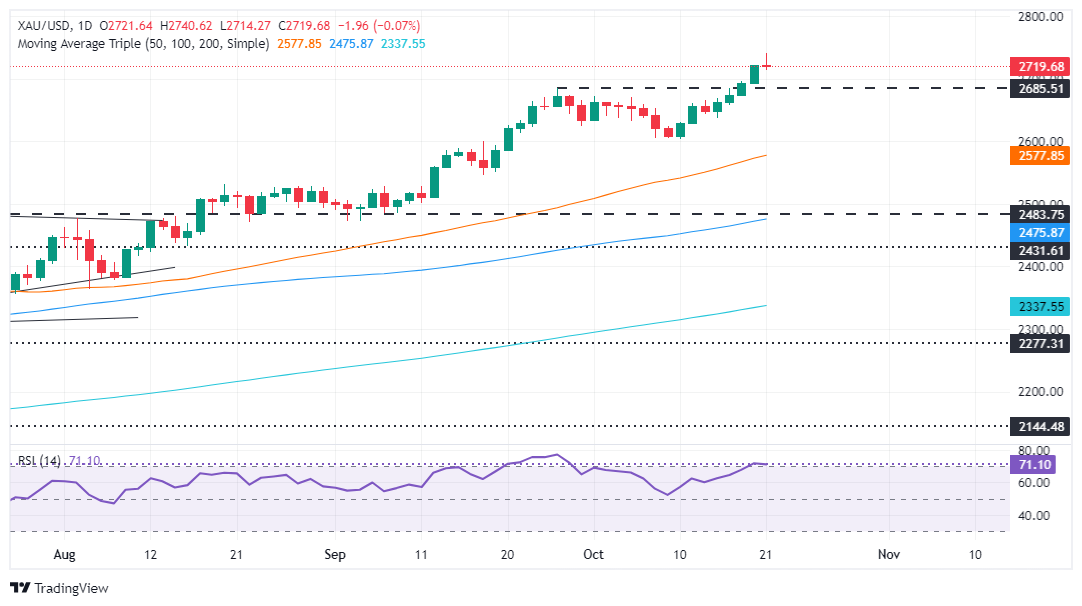
XAU/USD technical outlook: Gold price retraces below $2,720
Gold prices are set to extend the gains, though the formation of a ‘gravestone doji’ could open the door for a pullback.
Momentum shows signs that buyers remain in charge but are losing some steam as depicted by the Relative Strength Index (RSI). The RSI, despite being bullish, has shifted flat.
If XAU/USD clears the October 21 high at $2,740, the next stop would be $2,750, followed by $2,800.
Conversely, if XAU/USD retreats from record highs below $2,700, it could pave the way for a pullback. The first support would be the October 17 high at $2,696, followed by the October 4 high at $2,670.
Gold FAQs
Gold has played a key role in human’s history as it has been widely used as a store of value and medium of exchange. Currently, apart from its shine and usage for jewelry, the precious metal is widely seen as a safe-haven asset, meaning that it is considered a good investment during turbulent times. Gold is also widely seen as a hedge against inflation and against depreciating currencies as it doesn’t rely on any specific issuer or government.
Central banks are the biggest Gold holders. In their aim to support their currencies in turbulent times, central banks tend to diversify their reserves and buy Gold to improve the perceived strength of the economy and the currency. High Gold reserves can be a source of trust for a country’s solvency. Central banks added 1,136 tonnes of Gold worth around $70 billion to their reserves in 2022, according to data from the World Gold Council. This is the highest yearly purchase since records began. Central banks from emerging economies such as China, India and Turkey are quickly increasing their Gold reserves.
Gold has an inverse correlation with the US Dollar and US Treasuries, which are both major reserve and safe-haven assets. When the Dollar depreciates, Gold tends to rise, enabling investors and central banks to diversify their assets in turbulent times. Gold is also inversely correlated with risk assets. A rally in the stock market tends to weaken Gold price, while sell-offs in riskier markets tend to favor the precious metal.
The price can move due to a wide range of factors. Geopolitical instability or fears of a deep recession can quickly make Gold price escalate due to its safe-haven status. As a yield-less asset, Gold tends to rise with lower interest rates, while higher cost of money usually weighs down on the yellow metal. Still, most moves depend on how the US Dollar (USD) behaves as the asset is priced in dollars (XAU/USD). A strong Dollar tends to keep the price of Gold controlled, whereas a weaker Dollar is likely to push Gold prices up.
Author
Christian Borjon Valencia
FXStreet
Markets analyst, news editor, and trading instructor with over 14 years of experience across FX, commodities, US equity indices, and global macro markets.

















