Gold price drops as US Dollar rebounds after hot US core PCE Inflation data
- Gold price faces selling pressure near $2,350 as US Dollar rebounds.
- Higher US core PCE inflation data has prompted the US Dollar's recovery.
- Market expectations for the Fed delaying rate cuts remain firm.

Gold price (XAU/USD) falls from $2,350 in Friday’s early New York session as the United States annual core Personal Consumption Expenditure Price Index (PCE) data for March has remained above estimates. The annual underlying inflation data rose at a higher pace of 2.7% from the estimates of 2.6% but decelerated from 2.8% recorded in February.
Higher-than-expected figures weigh on Gold’s appeal as it lighten hopes of Federal Reserve (Fed) rate cuts in the September monetary policy meeting. The monthly underlying inflation data grew in line with expectations and the prior reading of 0.3%. The scenario bodes well for bond yields and the US Dollar.
10-year US bond yields are slightly down at 4.69% but are still close to a five-month high. Yields remain firm as stalling progress in inflation declining to the 2% target will strengthen prospects for the Fed delaying rate cuts to later this year.
Meanwhile, The US Dollar Index (DXY), which tracks the Greenback's value against six major currencies, rebounds to 105.80 after hotter-than-expected inflation data. The US Dollar fell on Thursday after weak US Q1 GDP growth raised doubts over the economy’s ability to maintain its strength in upcoming quarters.
Daily digest market movers: Gold price drops while US Dollar rebounds
- Gold price struggles to sustain near $2,350 as the US Dollar rebounds after hotter-than-expected US core PCE Inflation data for March.
- Earlier, the US Dollar suffered from a weaker-than-expected US economic growth rate for Q1. The US economy grew at an annualized pace of 1.6%, lower than the consensus of 2.5% and the former reading of 3.4%. This has raised concerns over the US economic outlook.
- Generally, a sharp decline in GDP growth could be the consequence of one or more factors such as weak household spending, limited monetary stimulus or less government spending. In theory, weaker-than-expected GDP growth should have boosted expectations for the Federal Reserve (Fed) to roll back its restrictive monetary policy stance, which it is maintaining since the strong stimulus due to the Covid-19 pandemic prompted inflationary pressures to historic levels.
- Traders continue to pare back Fed rate cut bets due to stubbornly higher GDP Price Index and stubborn core PCE Price Index data. GDP Price Index rose to 3.1% from the prior reading of 1.7%. The CME Fedwatch tool shows there is a 59% chance of a rate cut in September, down from the 69% recorded a week ago.
- Meanwhile, investors shift focus to the US core PCE Price Index data for March, which could provide more cues about when the Fed could start reducing interest rates. The underlying inflation data will also influence the Fed’s interest rate outlook ahead of the monetary policy meeting on May 1, in which the US central bank is widely anticipated to keep interest rates unchanged in the range of 5.25%-5.50%.
Technical Analysis: Gold price faces selling pressure near $2,350
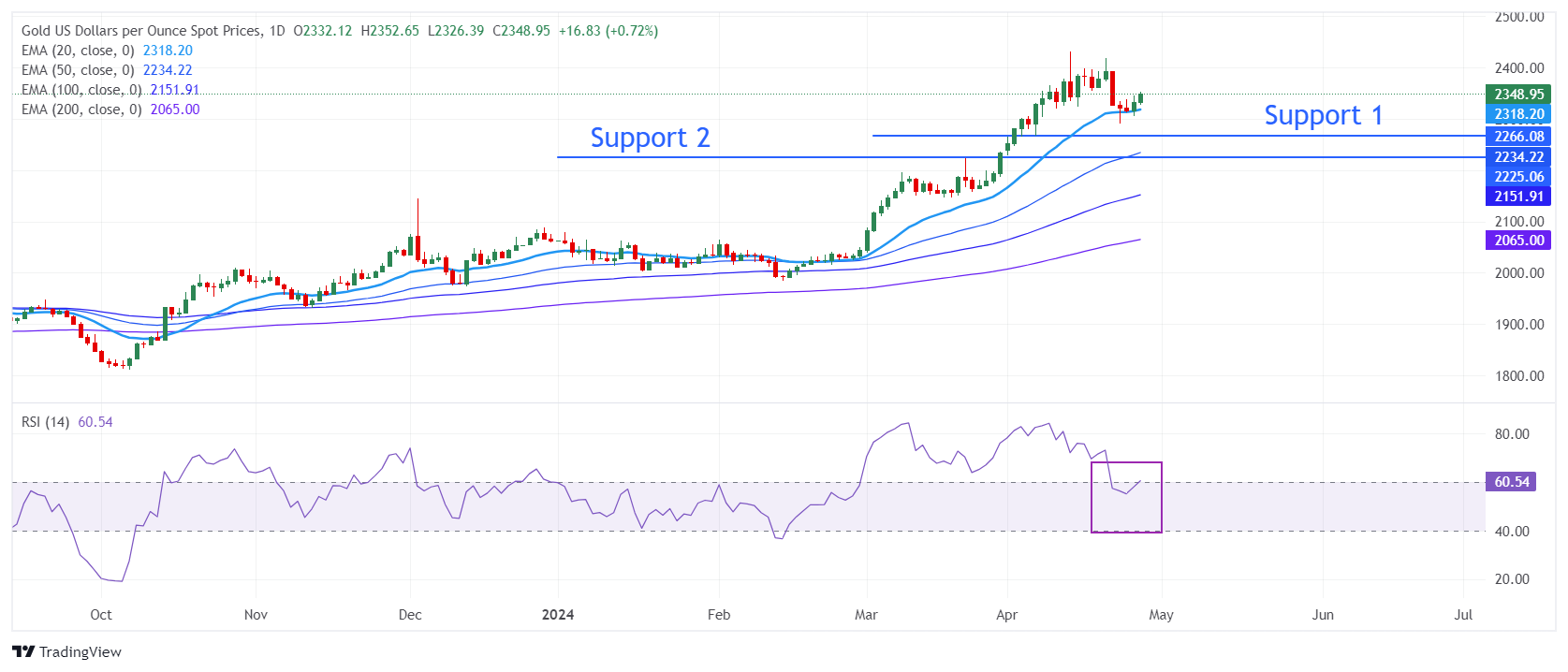
Gold price rebounds after discovering buying interest near the 20-day Exponential Moving Average (EMA), which trades around $2,315. The near-to-long-term appeal remains strong as Exponential Moving Averages (EMAs) for short to longer terms are sloping higher.
On the downside, a three-week low near $2,265 and March 21 high at $2,223 will be major support zones for the Gold price.
The 14-period Relative Strength Index (RSI) falls below 60.00, suggesting that bullish momentum has come to an end at least for now. However, the long-term upside bias is intact as long as the RSI sustains above 40.00.
Inflation FAQs
Inflation measures the rise in the price of a representative basket of goods and services. Headline inflation is usually expressed as a percentage change on a month-on-month (MoM) and year-on-year (YoY) basis. Core inflation excludes more volatile elements such as food and fuel which can fluctuate because of geopolitical and seasonal factors. Core inflation is the figure economists focus on and is the level targeted by central banks, which are mandated to keep inflation at a manageable level, usually around 2%.
The Consumer Price Index (CPI) measures the change in prices of a basket of goods and services over a period of time. It is usually expressed as a percentage change on a month-on-month (MoM) and year-on-year (YoY) basis. Core CPI is the figure targeted by central banks as it excludes volatile food and fuel inputs. When Core CPI rises above 2% it usually results in higher interest rates and vice versa when it falls below 2%. Since higher interest rates are positive for a currency, higher inflation usually results in a stronger currency. The opposite is true when inflation falls.
Although it may seem counter-intuitive, high inflation in a country pushes up the value of its currency and vice versa for lower inflation. This is because the central bank will normally raise interest rates to combat the higher inflation, which attract more global capital inflows from investors looking for a lucrative place to park their money.
Formerly, Gold was the asset investors turned to in times of high inflation because it preserved its value, and whilst investors will often still buy Gold for its safe-haven properties in times of extreme market turmoil, this is not the case most of the time. This is because when inflation is high, central banks will put up interest rates to combat it. Higher interest rates are negative for Gold because they increase the opportunity-cost of holding Gold vis-a-vis an interest-bearing asset or placing the money in a cash deposit account. On the flipside, lower inflation tends to be positive for Gold as it brings interest rates down, making the bright metal a more viable investment alternative.
Author
Sagar Dua
FXStreet
Sagar Dua is associated with the financial markets from his college days. Along with pursuing post-graduation in Commerce in 2014, he started his markets training with chart analysis.