Gold price hangs above $3,265-3,260 support amid receding safe-haven demand and mildly positive USD
- Gold price meets with a fresh supply on Monday amid the US-China trade deal optimism.
- A fall in China’s gold consumption and a modest USD uptick also weigh on the commodity.
- Trade-related uncertainties and Fed rate cut bets warrant caution for the XAU/USD bears.


Gold price (XAU/USD) sticks to its bearish bias for the second successive day on Monday and trades just above the $3,265-3,260 pivotal support during the first half of the European session. Despite mixed signals from the US and China, the optimism over the potential de-escalation of trade tensions between the world's two largest economies turns out to be a key factor undermining the safe-haven precious metal. Apart from this, a fall in China's gold consumption in the first quarter of 2025 and a modest US Dollar (USD) uptick further contribute to driving flows away from the commodity.
The upside for the USD, however, seems limited in the wake of rising bets that the Federal Reserve (Fed) will resume its rate-cutting cycle soon, which could offer some support to the non-yielding Gold price. Meanwhile, US President Donald Trump's rapidly shifting stance continues to fuel uncertainty in the markets. Moreover, the geopolitical risk premium remains in play amid the protracted Russia-Ukraine war, which should contribute to limiting the downside for the safe-haven XAU/USD pair. This, in turn, warrants some caution for aggressive bearish traders and before positioning for further losses.
Daily Digest Market Movers: Gold price remains depressed as easing US-China trade tensions dent safe-haven demand
- China has exempted some U.S. imports from its 125% tariffs imposed earlier this month in response to the 145% US tariffs on Chinese imports. This comes on top of US President Donald Trump's reassertion that trade talks were underway with China and fuels hopes for a quick de-escalation of trade war between the world's two largest economies.
- China has yet to confirm any exemptions and denies ongoing tariff talks. Meanwhile, Trump's shifting announcements and global recession fears sustain demand for the safe-haven Gold price.
- The China Gold Association said on Monday that the country's gold consumption fell 5.96% year-on-year to 290.492 tonnes in the first quarter of 2025. Moreover, high prices continued to curb demand for gold jewelry, which slumped 26.85% year-on-year to 134.531 tonnes. Meanwhile, consumption of gold bars and coins surged 29.81% to 138.018 tonnes.
- The US Dollar preserves last week's recovery gains, though it lacks follow-through amid bets that the Federal Reserve will resume its rate-cutting cycle in June and lower borrowing costs by one full percentage point in 2025. Moreover, geopolitical risk remains in play amid the protracted Russia-Ukraine war, which limits losses for the precious metal.
- North Korea has confirmed for the first time that it has sent troops to fight in the Russia-Ukraine conflict. Trump urged Russia on Sunday to stop its attacks in Ukraine while US Secretary of State Marco Rubio said that the US might walk away from peace efforts if it does not see progress. This, in turn, warrants some caution for the XAU/USD bears.
- Investors this week will confront the release of key US macro data, including the JOLTS job openings report on Tuesday, US Personal Consumption Expenditures on Wednesday, and the non-farm payrolls (NFP) report on Friday. The data may provide more insight into the Fed's policy outlook and provide some meaningful impetus to the commodity.
Gold price bears look to seize near-term control; sustained break below the $3,265-3,260 pivotal support awaited
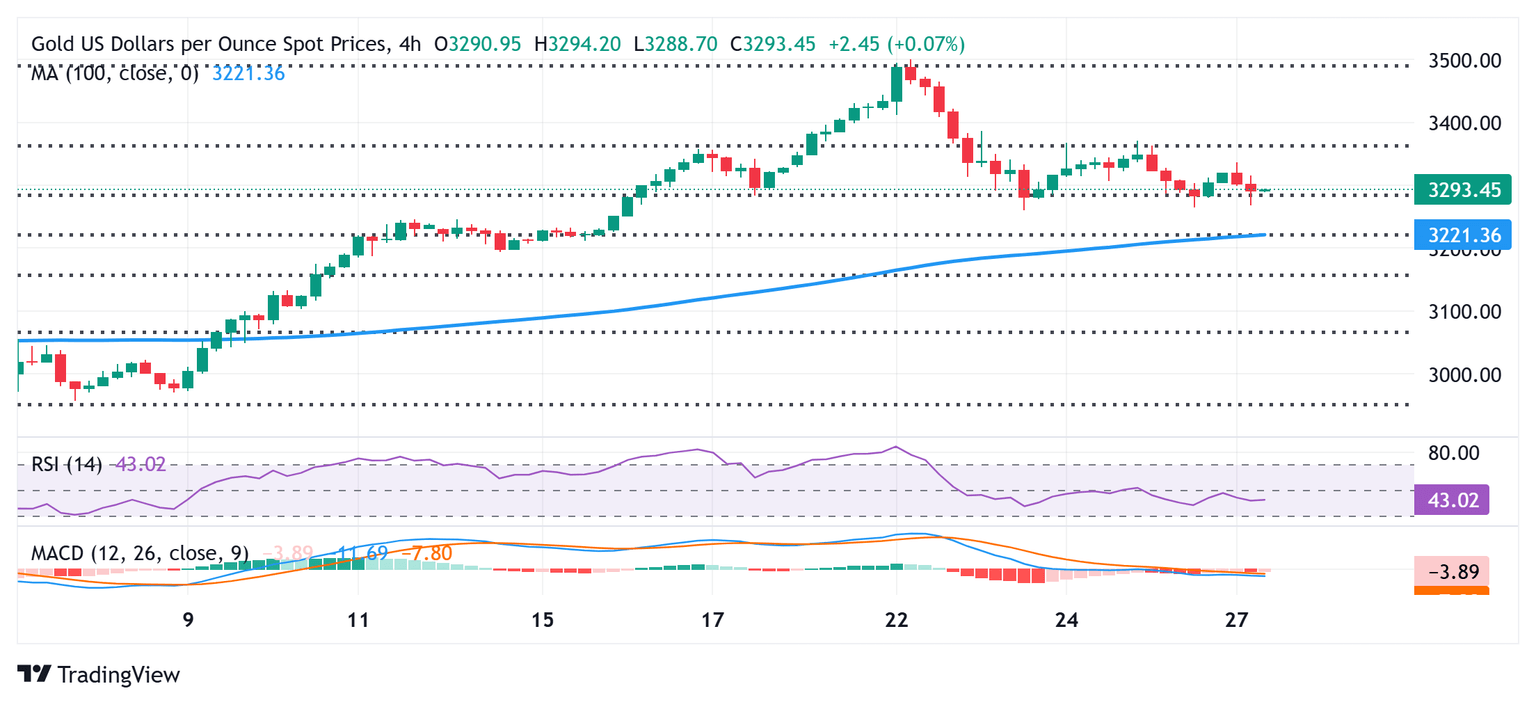
From a technical perspective, bearish traders need to wait for acceptance below the 38.2% Fibonacci retracement level of the latest leg up from the vicinity of mid-$2,900s, or the monthly swing low before placing fresh bets. Some follow-through selling below the $3,265-3,260 immediate support will confirm a breakdown and make the Gold price vulnerable to extend its recent corrective decline from the $3,500 psychological mark, or the all-time peak. The subsequent downfall could drag the precious metal to the 50% retracement level, around the $3,225 region, en route to the $3,200 mark. A convincing break below the latter will suggest that the commodity has topped out in the near term.
On the flip side, attempted recovery back above the $3,300 mark might confront some resistance near the Asian session high, around the $3,331-3,332 region. Any further move up might still be seen as a selling opportunity and remain capped near the $3,366-3,368 supply zone. The latter should act as a key pivotal point, which if cleared decisively should allow the Gold price to reclaim the $3,400 mark. The momentum could extend further toward the $3,425-3,427 intermediate hurdle before bulls make a fresh attempt to conquer the $3,500 psychological mark.
US Dollar FAQs
The US Dollar (USD) is the official currency of the United States of America, and the ‘de facto’ currency of a significant number of other countries where it is found in circulation alongside local notes. It is the most heavily traded currency in the world, accounting for over 88% of all global foreign exchange turnover, or an average of $6.6 trillion in transactions per day, according to data from 2022. Following the second world war, the USD took over from the British Pound as the world’s reserve currency. For most of its history, the US Dollar was backed by Gold, until the Bretton Woods Agreement in 1971 when the Gold Standard went away.
The most important single factor impacting on the value of the US Dollar is monetary policy, which is shaped by the Federal Reserve (Fed). The Fed has two mandates: to achieve price stability (control inflation) and foster full employment. Its primary tool to achieve these two goals is by adjusting interest rates. When prices are rising too quickly and inflation is above the Fed’s 2% target, the Fed will raise rates, which helps the USD value. When inflation falls below 2% or the Unemployment Rate is too high, the Fed may lower interest rates, which weighs on the Greenback.
In extreme situations, the Federal Reserve can also print more Dollars and enact quantitative easing (QE). QE is the process by which the Fed substantially increases the flow of credit in a stuck financial system. It is a non-standard policy measure used when credit has dried up because banks will not lend to each other (out of the fear of counterparty default). It is a last resort when simply lowering interest rates is unlikely to achieve the necessary result. It was the Fed’s weapon of choice to combat the credit crunch that occurred during the Great Financial Crisis in 2008. It involves the Fed printing more Dollars and using them to buy US government bonds predominantly from financial institutions. QE usually leads to a weaker US Dollar.
Quantitative tightening (QT) is the reverse process whereby the Federal Reserve stops buying bonds from financial institutions and does not reinvest the principal from the bonds it holds maturing in new purchases. It is usually positive for the US Dollar.
Author
Haresh Menghani
FXStreet
Haresh Menghani is a detail-oriented professional with 10+ years of extensive experience in analysing the global financial markets.