Gold price clings to gains, focus is on US Inflation data
- Gold price clings to all-time highs and awaits US Inflation data for further action.
- The US CPI data will indicate whether the Fed gets confident that price stability is ensured.
- The US NFP report keeps hopes of a Fed rate cut in June alive.


Gold price (XAU/USD) rally hit a pause in Monday’s early New York session as investors await the United States Consumer Price Index (CPI) data for February, which will be published on Tuesday. The precious metal takes a breather as the inflation data will provide cues about the US interest rate outlook.
The Gold price remains near all-time highs as yields on interest-bearing government bonds were hit hard after the Nonfarm Payrolls (NFP) report indicated that the labor market conditions are cooling. The 10-year US Treasury yields drop to 4.07%. The US Dollar Index (DXY) also exhibits a subdued performance, trading at around 102.73. On Friday, the USD Index recovered after printing a fresh seven-week low near 102.35.
The near-term outlook for Gold remains bullish. The NFP report for February, released on Friday, and last week’s Federal Reserve (Fed) Chair Jerome Powell’s Congressional testimony kept hopes alive for the central bank reducing interest rates in the June policy meeting. Fed Powell said the central bank is not far from gaining confidence that inflation will return to the 2% target. He recognized the need to dial back the restrictive monetary policy stance to avoid the economy falling into a recession.
Daily digest market movers: Gold price trades inside Friday’s trading range
- Gold price turns sideways around $2,180 after refreshing all-time highs ahead of the United States CPI data for February. The inflation data will provide fresh guidance on interest rates and influence investors’ expectations for rate cuts by the Federal Reserve (Fed) in the June policy meeting.
- Monthly headline inflation is forecasted to have risen by 0.4% from 0.3% in January. In the same period, core inflation, which strips off volatile food and oil prices, is anticipated to have grown at a slower pace of 0.3% against the prior reading of 0.4%. For annual figures, economists expect that the headline CPI will remain sticky at 3.1% and the core inflation will decelerate to 3.7% from 3.9% in January.
- Federal Reserve policymakers want to confirm that inflation will sustainably come down to the 2% target before rolling back the restrictive monetary policy stance. A sticky inflation report would allow the Fed to not rush towards interest-rate cuts and may dampen hopes of the Fed reducing interest rates in June.
- Currently, the CME FedWatch tool shows that expectations for the Fed pivoting to rate cuts in June by 25 basis points (bps) are firm at 57%. Traders may not have elevated bets for a rate cut in June as the impact of a higher Unemployment Rate and soft Average Hourly Earnings was offset by higher Nonfarm Payrolls.
- The jobless rate rose to 3.9% from expectations and the prior reading of 3.7%. The monthly Average Hourly Earnings increased by a meager 0.1% on the month while investors projected growth of 0.3%. In January, wages grew by 0.5%, downwardly revised from 0.6%. Fresh payrolls were at 275K, against expectations of 200K and the prior reading of 229K, downwardly revised from 353K.
Technical Analysis: Gold price hovers near all-time highs around $2,180
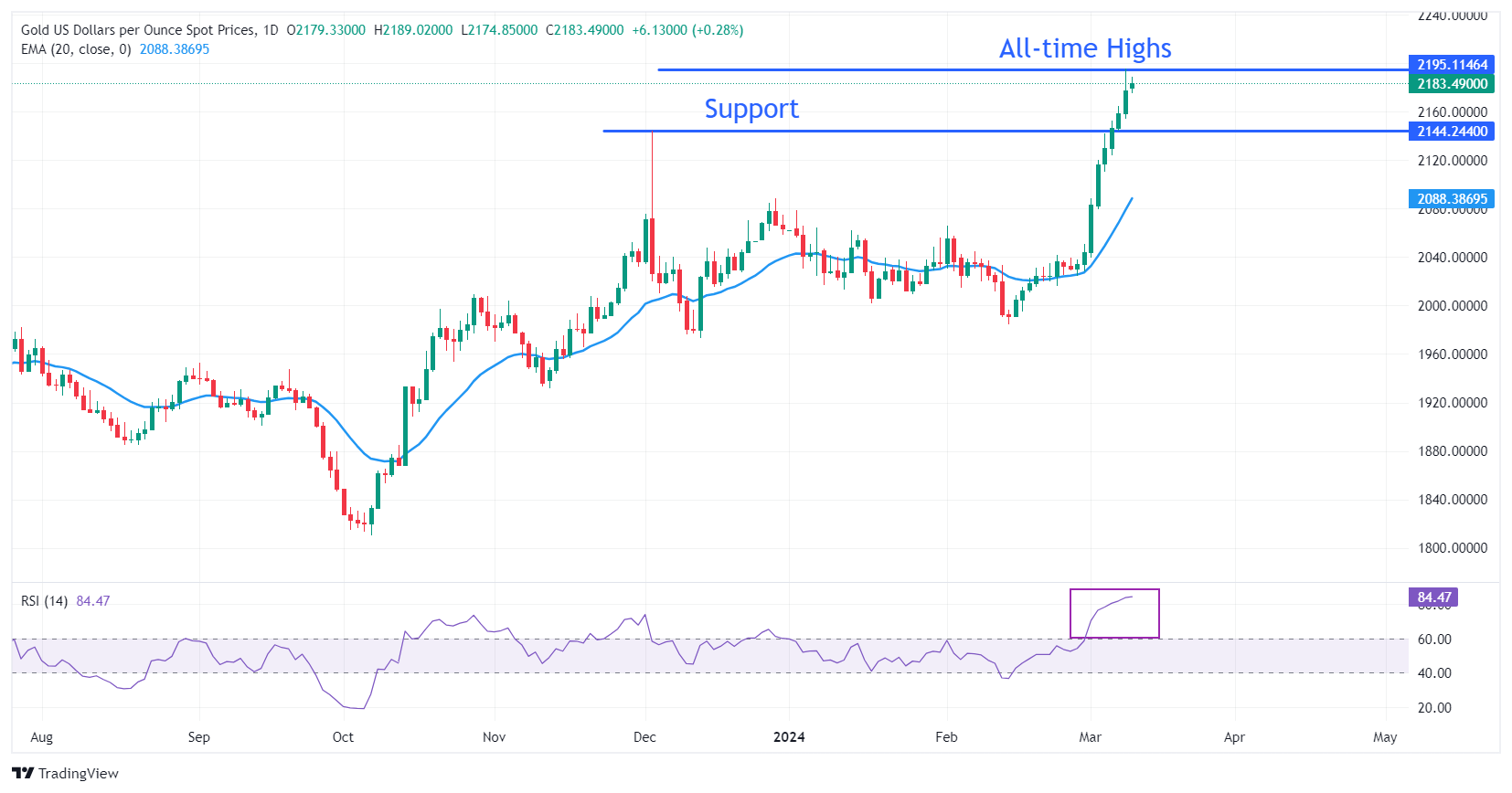
Gold price struggles to extend its winning spell for the ninth trading session on Monday. The precious metal refreshes its all-time high around $2,195 and is expected to capture the round-level resistance of $2,200. On the downside, December 4 high near $2,145 and December 28 high at $2,088 will act as major support levels.
The 14-period Relative Strength Index (RSI) reaches overbought territory at 84.00, pointing to the chances of some correction ahead.
Fed FAQs
Monetary policy in the US is shaped by the Federal Reserve (Fed). The Fed has two mandates: to achieve price stability and foster full employment. Its primary tool to achieve these goals is by adjusting interest rates. When prices are rising too quickly and inflation is above the Fed’s 2% target, it raises interest rates, increasing borrowing costs throughout the economy. This results in a stronger US Dollar (USD) as it makes the US a more attractive place for international investors to park their money. When inflation falls below 2% or the Unemployment Rate is too high, the Fed may lower interest rates to encourage borrowing, which weighs on the Greenback.
The Federal Reserve (Fed) holds eight policy meetings a year, where the Federal Open Market Committee (FOMC) assesses economic conditions and makes monetary policy decisions. The FOMC is attended by twelve Fed officials – the seven members of the Board of Governors, the president of the Federal Reserve Bank of New York, and four of the remaining eleven regional Reserve Bank presidents, who serve one-year terms on a rotating basis.
In extreme situations, the Federal Reserve may resort to a policy named Quantitative Easing (QE). QE is the process by which the Fed substantially increases the flow of credit in a stuck financial system. It is a non-standard policy measure used during crises or when inflation is extremely low. It was the Fed’s weapon of choice during the Great Financial Crisis in 2008. It involves the Fed printing more Dollars and using them to buy high grade bonds from financial institutions. QE usually weakens the US Dollar.
Quantitative tightening (QT) is the reverse process of QE, whereby the Federal Reserve stops buying bonds from financial institutions and does not reinvest the principal from the bonds it holds maturing, to purchase new bonds. It is usually positive for the value of the US Dollar.
Author
Sagar Dua
FXStreet
Sagar Dua is associated with the financial markets from his college days. Along with pursuing post-graduation in Commerce in 2014, he started his markets training with chart analysis.

















