Gold tumbles as traders await Federal Reserve's decision
- Gold price refreshes new weekly low following strong US Retail Sales figures that dim expectations for aggressive Fed easing next year.
- Despite a drop in Treasury yields, a resilient US Dollar limits Gold's upward momentum.
- Investors eye the Fed's policy announcement and the core PCE Price Index release.


Gold price dropped to a new weekly low of $2,633 on Tuesday following the release of strong Retail Sales data in the United States. This weighed on investors' expectations of the Federal Reserve (Fed), which is expected to adopt a gradual approach to easing in 2025. At the time of writing, the XAU/USD trades at $2,637, down 0.57%.
The Fed has begun its two-day meeting in Washington, DC, and is expected to lower interest rates by 25 basis points (bps) on Wednesday. The markets have already priced in the decision, but participants are looking for the Summary of Economic Projections (SEP) and the Dot Plot. This will provide investors with the Fed rate path for 2025.
The US economic docket witnessed a strong Retail Sales report in November. Later, the Fed announced that Industrial Production for the same period plunged in monthly and annual figures, an indication that business activity continued to suffer from higher interest rates.
Bullion prices remain pressured even though US Treasury bond yields and real yields retreated. Nevertheless, the steady US Dollar keeps the non-yielding metal from extending its gains.
Lower interest rates the Fed sets are usually a tailwind for Gold prices. Speculation that Trump’s upcoming administration would implement expansionary fiscal policies that put upward pressure on inflation could trigger a change among the Federal Open Market Committee (FOMC) members.
Ahead this week, the US economic docket will feature the FOMC policy decision and the release of the core Personal Consumption Expenditures (PCE) Price Index.
Daily digest market movers: Gold price slips below $2,650, extends losses
- Gold prices plunged as US real yields are pressured, falling two basis points to 2.059%, a tailwind for the precious metal.
- The US 10-year Treasury bond yield drops two and a half basis points to 4.379%.
- The US Dollar Index rose 0.07% to 107.01.
- US Retail Sales in November rose by 0.7% MoM, up from 0.5% in October, above estimates. Yearly, sales jumped from 2.9% to 3.8%.
- Industrial Production in November improved compared to October yet dipped to -0.1% MoM, up from -0.4% and below estimates of 0.3%
- US business activity remains robust in the services segment, according to S&P Global.
- The CME FedWatch Tool suggests that traders had priced in a 99% chance of a quarter-point rate cut on Wednesday.
- For 2025, investors are betting that the Fed will lower rates by 100 basis points.
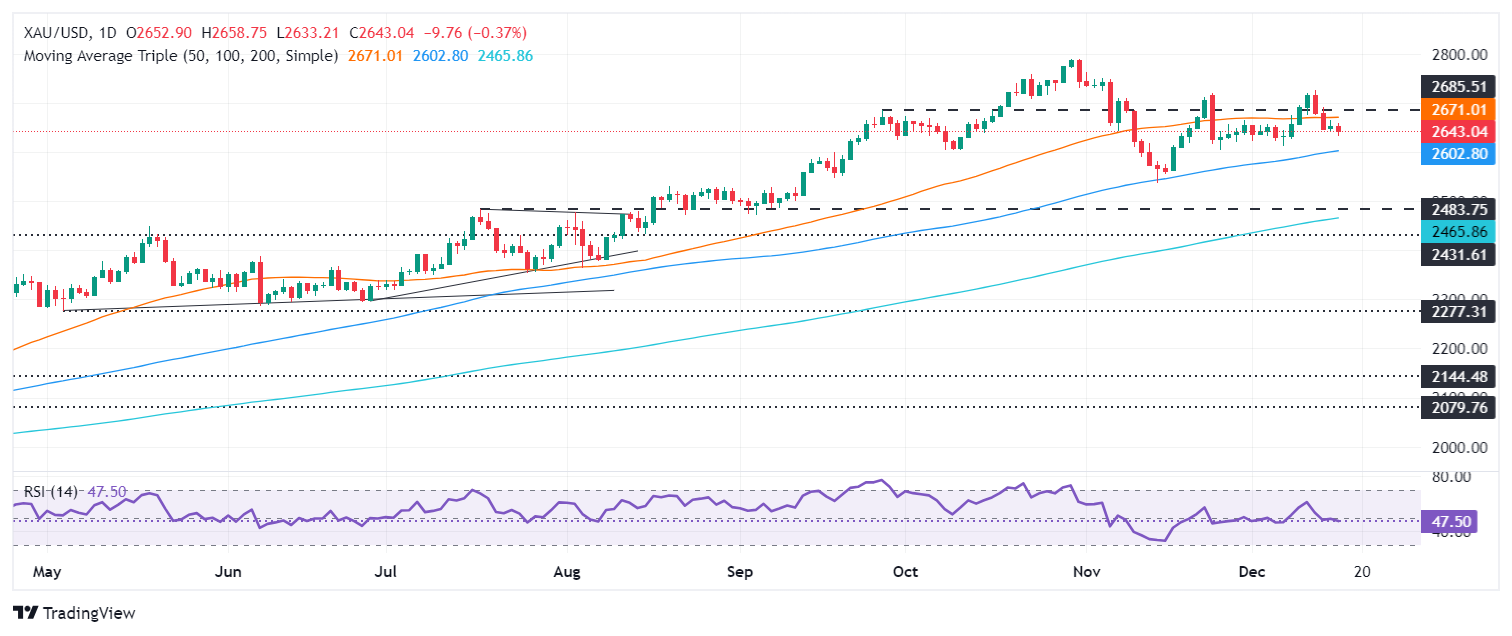
Technical outlook: Gold price retreats, sellers eye 100-day SMA
Gold uptrend remains intact, yet in the near term it is slightly skewed to the downside. The golden metal has been accepted within the $2,602-$2,670 area, capped by the 100 and 50-day Simple Moving Averages (SMAs), respectively.
If Gold drops below the 100-day SMA, the next support would be $2,600. If the price slips, the next support would be the November 14 swing low of $2,536, before challenging the August 20 peak at $2,531. Conversely, if XAU/USD rallies past $2,650, the next resistance would be the 50-day SMA at $2,670, ahead of $2,700.
Gold FAQs
Gold has played a key role in human’s history as it has been widely used as a store of value and medium of exchange. Currently, apart from its shine and usage for jewelry, the precious metal is widely seen as a safe-haven asset, meaning that it is considered a good investment during turbulent times. Gold is also widely seen as a hedge against inflation and against depreciating currencies as it doesn’t rely on any specific issuer or government.
Central banks are the biggest Gold holders. In their aim to support their currencies in turbulent times, central banks tend to diversify their reserves and buy Gold to improve the perceived strength of the economy and the currency. High Gold reserves can be a source of trust for a country’s solvency. Central banks added 1,136 tonnes of Gold worth around $70 billion to their reserves in 2022, according to data from the World Gold Council. This is the highest yearly purchase since records began. Central banks from emerging economies such as China, India and Turkey are quickly increasing their Gold reserves.
Gold has an inverse correlation with the US Dollar and US Treasuries, which are both major reserve and safe-haven assets. When the Dollar depreciates, Gold tends to rise, enabling investors and central banks to diversify their assets in turbulent times. Gold is also inversely correlated with risk assets. A rally in the stock market tends to weaken Gold price, while sell-offs in riskier markets tend to favor the precious metal.
The price can move due to a wide range of factors. Geopolitical instability or fears of a deep recession can quickly make Gold price escalate due to its safe-haven status. As a yield-less asset, Gold tends to rise with lower interest rates, while higher cost of money usually weighs down on the yellow metal. Still, most moves depend on how the US Dollar (USD) behaves as the asset is priced in dollars (XAU/USD). A strong Dollar tends to keep the price of Gold controlled, whereas a weaker Dollar is likely to push Gold prices up.
Author
Christian Borjon Valencia
FXStreet
Markets analyst, news editor, and trading instructor with over 14 years of experience across FX, commodities, US equity indices, and global macro markets.