Gold firms above $3,000 after Trump's tariff headlines
- Gold price struggles to gain traction as USD recovers despite firm support above $3,000 and cautious Fed tone.
- The US Dollar rebounds following reports of Trump auto tariff announcement.
- Solid Durable Goods data, Fed comments on sticky inflation limit upside for Bullion bulls.


Gold price has flat-lined late in the North American session, capped by the recovery of the US Dollar Index (DXY), which fell to a low of 104.18 before staging a recovery. The move was sponsored by the White House, which said that President Donald Trump would announce automobile tariffs at around 22:00 GMT. At the time of writing, XAU/USD trades at $3,019, virtually unchanged.
Bullion traders failed to gain traction on headlines that Trump is considering announcing limited tariff plans and automotive tariffs, according to The Wall Street Journal. In the meantime, the US Dollar Index (DXY), which tracks the performance of the Greenback against six currencies, rises 0.32% to 104.55.
Even though the Gold price has remained mildly, downwardly pressured, the precious metal remains firmly above the $3,000 support level, which keeps buyers hopeful of achieving higher prices.
In the data space, US Durable Goods Orders were solid in February, according to the US Department of Commerce. Aside from this, Federal Reserve (Fed) officials continued to grab the headlines with comments from the St. Louis Fed’s Alberto Mussalem and the Minneapolis Fed’s Neel Kashkari.
Musalem said that the labor market is close to full employment and underscored that current policy is appropriate, given that inflation is above target. He added that the risks of inflation stalling above 2% or rising further had increased, while stating that he doesn’t foresee a recession.
Earlier, Minneapolis Fed President Neel Kashkari stated that the Fed has made notable progress in curbing inflation. However, more work remains, Kashkari said, acknowledging that policy dynamics are making the Fed’s job more complex. Nevertheless, he expressed confidence that within the next year or two the central bank should be able to begin reducing interest rates.
Meanwhile, money markets have priced in 64.5 basis points of Fed easing in 2025, according to Prime Market Terminal interest rate probabilities.
Ahead this week, traders are eyeing the release of the Fed’s preferred inflation gauge, the core Personal Consumption Expenditures (PCE) Price Index.
Daily digest market movers: Gold price trades firm near $3,000, unfazed by Trump’s comments
- The US 10-year T-note yield is almost flat, up one basis point at 4.338%. US real yields edges down one bp to 1.973%, according to US 10-year Treasury Inflation-Protected Securities (TIPS) yields.
- US Durable Goods Orders posted a solid performance in February, rising 0.9% MoM, defying expectations of a 1% decline.
- Core Durable Goods Orders, which exclude transportation, also impressed — climbing 0.7% MoM, up from 0.1% in January and well above the 0.2% forecast, signaling resilient business investment.
- On Monday, Atlanta Fed President Raphael Bostic stated that he supports only one rate cut this year and doesn’t expect inflation to return to target until around 2027.
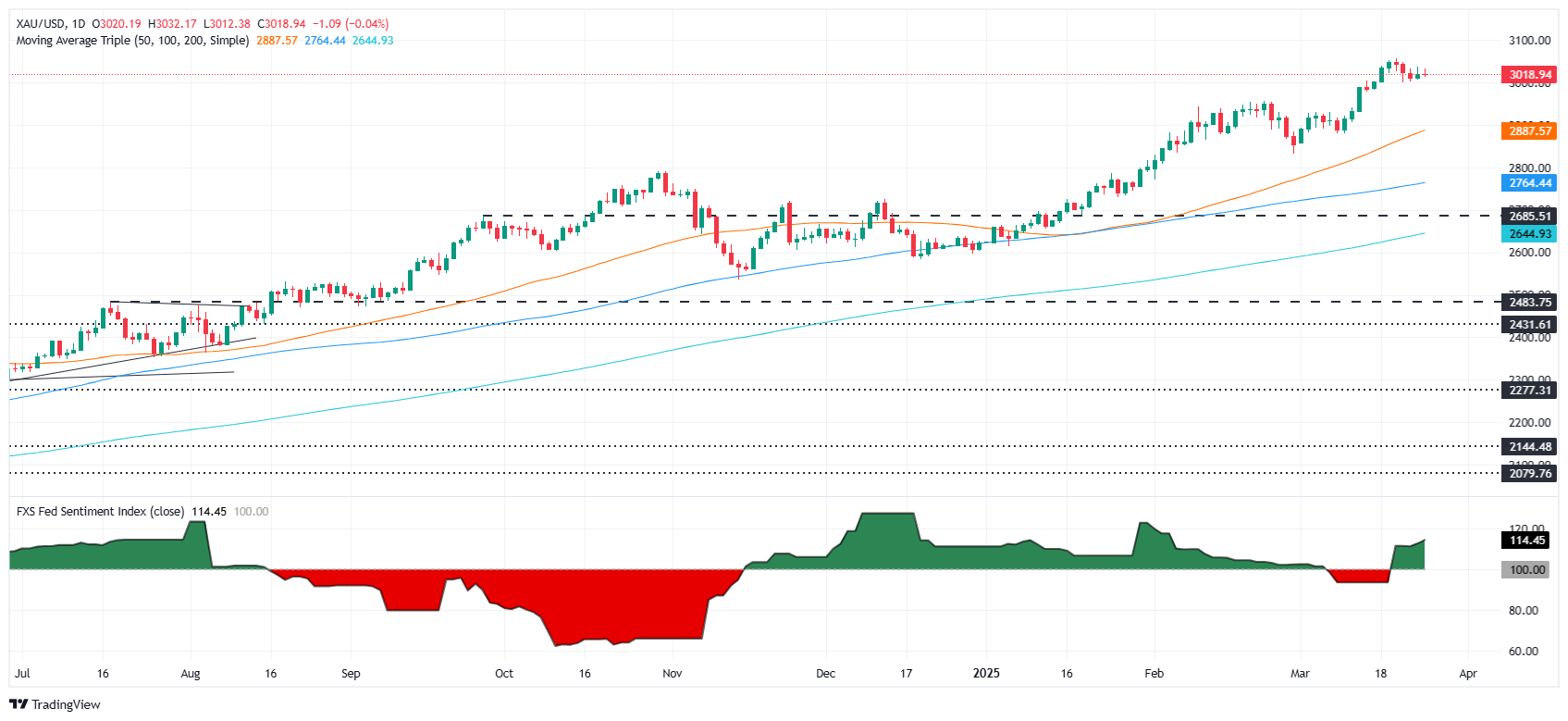
XAU/USD technical outlook: Gold price hovers near $3,020
Gold price trades choppy on Wednesday with the market awaiting a fresh catalyst that could push prices toward record highs or break the strong floor at $3,000. The Relative Strength Index (RSI) is bullish but turned flat after edging lower in back-to-back days, an indication that sellers lost strength.
That said, if XAU/USD clears the current week’s high of $3,036, that could exacerbate a test of the record high price at $3,057. A breach of the latter will pave the way for testing $3,100. Conversely, if Gold slumps beneath $3,000, this will expose the February 24 swing high at $2,956, followed by the $2,900 mark and the 50-day Simple Moving Average (SMA) at $2,887.
Risk sentiment FAQs
In the world of financial jargon the two widely used terms “risk-on” and “risk off'' refer to the level of risk that investors are willing to stomach during the period referenced. In a “risk-on” market, investors are optimistic about the future and more willing to buy risky assets. In a “risk-off” market investors start to ‘play it safe’ because they are worried about the future, and therefore buy less risky assets that are more certain of bringing a return, even if it is relatively modest.
Typically, during periods of “risk-on”, stock markets will rise, most commodities – except Gold – will also gain in value, since they benefit from a positive growth outlook. The currencies of nations that are heavy commodity exporters strengthen because of increased demand, and Cryptocurrencies rise. In a “risk-off” market, Bonds go up – especially major government Bonds – Gold shines, and safe-haven currencies such as the Japanese Yen, Swiss Franc and US Dollar all benefit.
The Australian Dollar (AUD), the Canadian Dollar (CAD), the New Zealand Dollar (NZD) and minor FX like the Ruble (RUB) and the South African Rand (ZAR), all tend to rise in markets that are “risk-on”. This is because the economies of these currencies are heavily reliant on commodity exports for growth, and commodities tend to rise in price during risk-on periods. This is because investors foresee greater demand for raw materials in the future due to heightened economic activity.
The major currencies that tend to rise during periods of “risk-off” are the US Dollar (USD), the Japanese Yen (JPY) and the Swiss Franc (CHF). The US Dollar, because it is the world’s reserve currency, and because in times of crisis investors buy US government debt, which is seen as safe because the largest economy in the world is unlikely to default. The Yen, from increased demand for Japanese government bonds, because a high proportion are held by domestic investors who are unlikely to dump them – even in a crisis. The Swiss Franc, because strict Swiss banking laws offer investors enhanced capital protection.
Author
Christian Borjon Valencia
FXStreet
Christian Borjon began his career as a retail trader in 2010, mainly focused on technical analysis and strategies around it. He started as a swing trader, as he used to work in another industry unrelated to the financial markets.