Gold price holds losses despite safe-haven demand amid market caution
- Gold price declines despite safe-haven demand as traders anticipate signals regarding the US economy.
- The non-yielding Gold received support amid increased chances of more Fed rate cuts following US PCE inflation data.
- The safe-haven metal could gain ground due to increased geopolitical tensions.

Gold price (XAU/USD) edges lower amid thin trading following the Christmas holiday, trading near $2,630 during the Asian session on Friday. However, the safe-haven asset could find upward support as markets anticipate signals regarding the United States (US) economy under the incoming Trump administration and the Federal Reserve’s (Fed) interest rate outlook for 2025.
Gold, a non-yielding asset, gains traction as moderate US PCE inflation data challenges expectations of limited Fed rate cuts next year, hinting at the possibility of more reductions. The safe-haven appeal is bolstered by heightened geopolitical risks stemming from the prolonged Russia-Ukraine conflict and ongoing tensions in the Middle East.
The precious metal is on track to close the year with an impressive 27% gain, marking its best annual performance since 2010. This surge has been fueled by central bank purchases, escalating geopolitical uncertainties, and monetary easing by major central banks.
Gold price receives downward pressure as US Dollar edges higher
- The US Dollar Index (DXY), which measures the value of the US Dollar (USD) against its six major peers, trades above 108.00, slightly below its highest level since November 2022. Any further strengthening of the Greenback could limit the upside of the dollar-denominated precious commodities like Gold, as a stronger USD makes these assets more expensive for holders of other currencies.
- However, the non-interest-bearing Gold may receive support as US Treasury bond yields remain subdued on Friday. 2-year and 10-year yields stand at 4.33% and 4.58%, respectively, at the time of writing.
- On Thursday, Russia's Federal Security Service announced that it had thwarted multiple assassination plots by Ukrainian intelligence targeting high-ranking Russian officers and their families in Moscow. The agency stated that the attacks were planned using bombs disguised as power banks or document folders, according to Reuters.
- Meanwhile, Gaza authorities reported that an Israeli airstrike killed five Palestinian journalists. However, the Israeli military claimed that the individuals were members of Islamic Jihad posing as media workers. Medics reported that the five were among at least 31 people killed in Israeli airstrikes across the Palestinian enclave.
- Last week, the Federal Reserve signaled a more cautious outlook for additional rate cuts in 2025, marking a shift in its monetary policy stance. This development highlights uncertainties surrounding future policy adjustments amid the anticipated economic strategies of the incoming Trump administration.
Gold price remains below $2,650 with testing 14- and nine-day EMAs
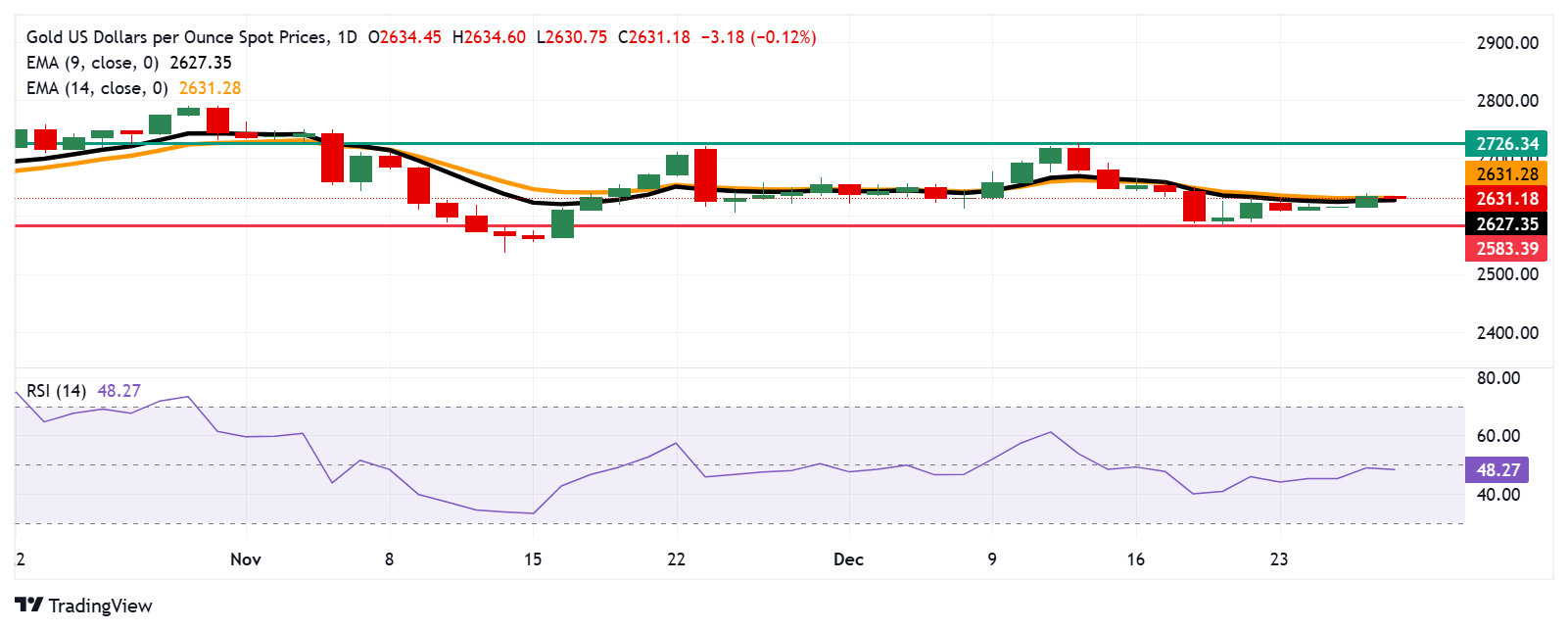
Gold price trades above $2,630.00 on Friday, with the daily chart indicating a consolidation phase as the metal moves sideways near the nine- and 14-day Exponential Moving Averages (EMAs). The 14-day Relative Strength Index (RSI) hovers just below the 50 mark, reflecting a neutral sentiment. A decisive move above 50 could signal increased buying interest in the commodity.
On the upside, the XAU/USD pair may target the psychological level of $2,700.00, with the next resistance at its monthly high of $2,726.34.
The 14- and nine-day EMAs at $2,631.40 and $2,627.44, respectively, act as the immediate support for the XAU/USD pair. A break below these levels could increase selling pressure, potentially pushing Gold toward its monthly low of $2,583.39.
XAU/USD: Daily Chart
Gold FAQs
Gold has played a key role in human’s history as it has been widely used as a store of value and medium of exchange. Currently, apart from its shine and usage for jewelry, the precious metal is widely seen as a safe-haven asset, meaning that it is considered a good investment during turbulent times. Gold is also widely seen as a hedge against inflation and against depreciating currencies as it doesn’t rely on any specific issuer or government.
Central banks are the biggest Gold holders. In their aim to support their currencies in turbulent times, central banks tend to diversify their reserves and buy Gold to improve the perceived strength of the economy and the currency. High Gold reserves can be a source of trust for a country’s solvency. Central banks added 1,136 tonnes of Gold worth around $70 billion to their reserves in 2022, according to data from the World Gold Council. This is the highest yearly purchase since records began. Central banks from emerging economies such as China, India and Turkey are quickly increasing their Gold reserves.
Gold has an inverse correlation with the US Dollar and US Treasuries, which are both major reserve and safe-haven assets. When the Dollar depreciates, Gold tends to rise, enabling investors and central banks to diversify their assets in turbulent times. Gold is also inversely correlated with risk assets. A rally in the stock market tends to weaken Gold price, while sell-offs in riskier markets tend to favor the precious metal.
The price can move due to a wide range of factors. Geopolitical instability or fears of a deep recession can quickly make Gold price escalate due to its safe-haven status. As a yield-less asset, Gold tends to rise with lower interest rates, while higher cost of money usually weighs down on the yellow metal. Still, most moves depend on how the US Dollar (USD) behaves as the asset is priced in dollars (XAU/USD). A strong Dollar tends to keep the price of Gold controlled, whereas a weaker Dollar is likely to push Gold prices up.
Author
Akhtar Faruqui
FXStreet
Akhtar Faruqui is a Forex Analyst based in New Delhi, India. With a keen eye for market trends and a passion for dissecting complex financial dynamics, he is dedicated to delivering accurate and insightful Forex news and analysis.