Gold price sits near record high; $3,400 remains in sight amid US tariff woes and weaker USD
- Gold price continues to attract safe-haven flows on Monday amid trade-related uncertainties.
- The USD dived to a two-year low amid recession fears that further benefit the XAU/USD pair.
- Overbought conditions on the daily chart warrant caution before placing fresh bullish bets.


Gold price (XAU/USD) maintains its strong bid tone through the first half of the European session on Monday and currently trades near the all-time peak, just below the $3,400 mark. The severe nature of US President Donald Trump’s international trade policies has raised the possibility of a US recession, which continues to weigh on investors' sentiment and benefits the safe-haven precious metal.
Meanwhile, trump's back-and-forth tariff announcements have dented confidence in the world’s largest economy. This, along with the prospects for more aggressive policy easing, drags the US Dollar (USD) to its lowest level since April 2022 and further underpins the non-yielding Gold price. The XAU/USD bulls, however, might pause for a breather amid overstretched conditions on short-term charts.
Daily Digest Market Movers: Gold price bulls retain control as US tariffs uncertainty continue to weigh on the USD
- Investors remain worried about the potential economic fallout from US President Donald Trump's trade tariffs and the rapidly escalating US-China trade war, pushing the safe-haven Gold price to a fresh all-time peak on Monday. In fact, Trump recently imposed tariffs of up to 145% on certain Chinese goods, with some duties reportedly reaching 245%. In retaliation, China has levied tariffs of 125% on US products.
- Meanwhile, Trump's aggressive trade policies could hurt the world trade order and trigger a recession in the US. This, in turn, drags the US Dollar to its lowest level since April 2022 and further benefits the precious metal. The USD bulls shrugged off Federal Reserve Chair Jerome Powell's hawkish comments, saying that the central bank is well-positioned to wait for more clarity before making any changes to the policy stance.
- Furthermore, market participants are still pricing in the possibility that the Fed will resume its rate-cutting cycle in June and lower borrowing costs by a full percentage point by the end of this year. This turns out to be another factor that contributes to driving flows towards the non-yielding yellow metal, amid thin trading conditions on the back of the Easter Monday holiday and despite overbought conditions on the daily chart.
- Iran and the US agreed on Saturday to commence expert-level discussions to design a framework for a potential nuclear deal. Moreover, Russian President Vladimir Putin's one-day ceasefire in Ukraine on Saturday sparked hopes that tensions could de-escalate. This, however, does little to boost investors' confidence or dent demand for traditional safe-haven assets, supporting prospects for a further appreciation for the XAU/USD pair.
- There isn't any relevant market-moving economic data due for release from the US on Monday, though a scheduled speech from Chicago Fed President Austan Goolsbee might influence the USD. Apart from this, trade-related developments should provide some impetus to the commodity. The market focus will then shift to the release of flash PMIs on Wednesday, which should offer a fresh insight into the global economic health.
Gold price buying remains unabated despite overbought RSI on short-term charts
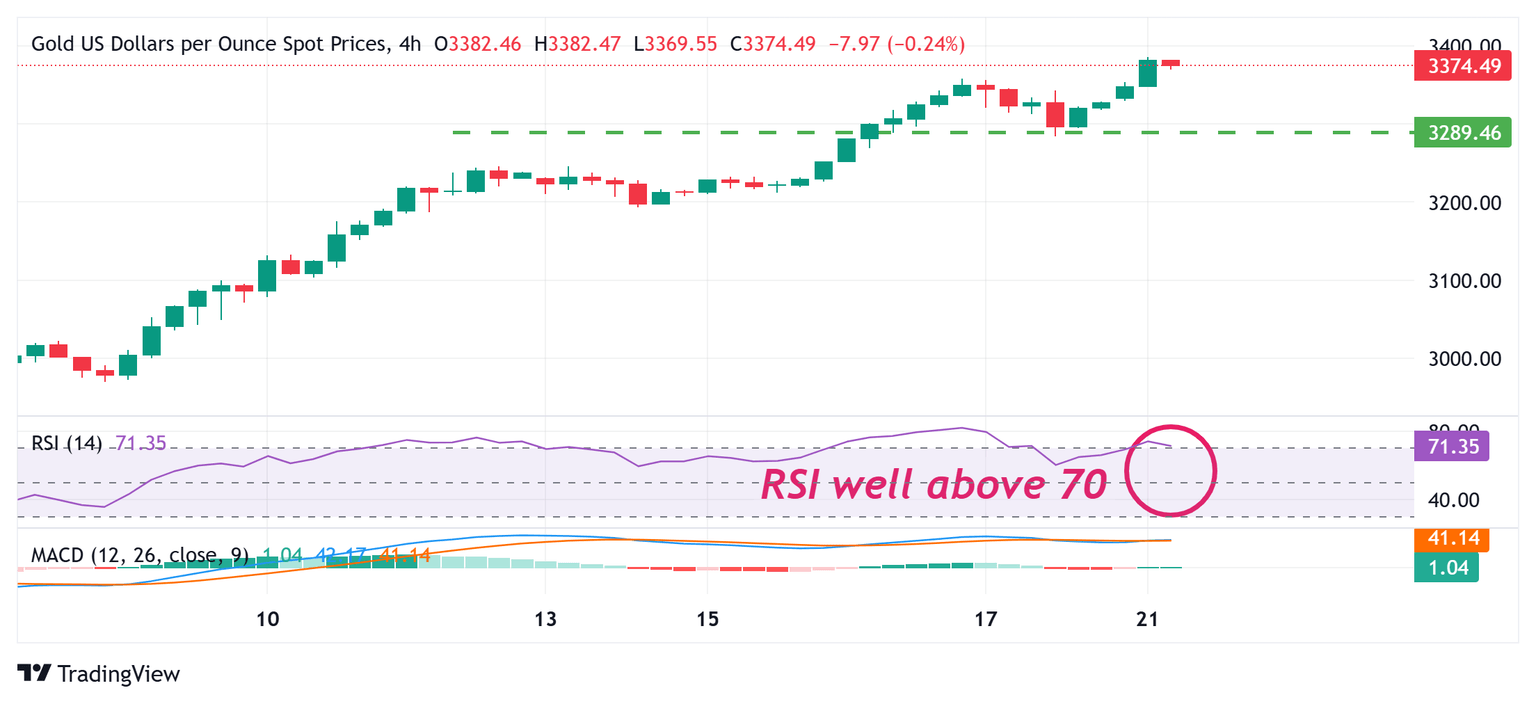
From a technical perspective, the relentless buying validates the near-term positive outlook for the Gold price. However, the daily Relative Strength Index (RSI) is holding well above the 70 mark and might force bullish traders to pause for a breather. Hence, it will be prudent to wait for some near-term consolidation or a modest pullback before positioning for an extension of a multi-month-old uptrend.
In the meantime, any corrective slide might now find some support near the $3,350 zone. This is followed by the Asian session low, around the $3,329-3,328 region, below which the Gold price could accelerate the fall towards the $3,300 round figure en route to Friday's swing low, around the $3,284 area. The latter should act as a key pivotal point, which if broken decisively could pave the way for deeper losses.
Fed FAQs
Monetary policy in the US is shaped by the Federal Reserve (Fed). The Fed has two mandates: to achieve price stability and foster full employment. Its primary tool to achieve these goals is by adjusting interest rates. When prices are rising too quickly and inflation is above the Fed’s 2% target, it raises interest rates, increasing borrowing costs throughout the economy. This results in a stronger US Dollar (USD) as it makes the US a more attractive place for international investors to park their money. When inflation falls below 2% or the Unemployment Rate is too high, the Fed may lower interest rates to encourage borrowing, which weighs on the Greenback.
The Federal Reserve (Fed) holds eight policy meetings a year, where the Federal Open Market Committee (FOMC) assesses economic conditions and makes monetary policy decisions. The FOMC is attended by twelve Fed officials – the seven members of the Board of Governors, the president of the Federal Reserve Bank of New York, and four of the remaining eleven regional Reserve Bank presidents, who serve one-year terms on a rotating basis.
In extreme situations, the Federal Reserve may resort to a policy named Quantitative Easing (QE). QE is the process by which the Fed substantially increases the flow of credit in a stuck financial system. It is a non-standard policy measure used during crises or when inflation is extremely low. It was the Fed’s weapon of choice during the Great Financial Crisis in 2008. It involves the Fed printing more Dollars and using them to buy high grade bonds from financial institutions. QE usually weakens the US Dollar.
Quantitative tightening (QT) is the reverse process of QE, whereby the Federal Reserve stops buying bonds from financial institutions and does not reinvest the principal from the bonds it holds maturing, to purchase new bonds. It is usually positive for the value of the US Dollar.
Author
Haresh Menghani
FXStreet
Haresh Menghani is a detail-oriented professional with 10+ years of extensive experience in analysing the global financial markets.