Gold price rises as trade war tensions remain elevated
- Gold gains as traders react to President Trump's threat of new reciprocal tariffs, enhancing its safe-haven status.
- US Nonfarm Payrolls fall short of expectations, yet a declining Unemployment Rate suggests a resilient labor market.
- PBoC’s increased Gold reserves and cautious comments from Fed officials contribute to the metal's price dynamics.


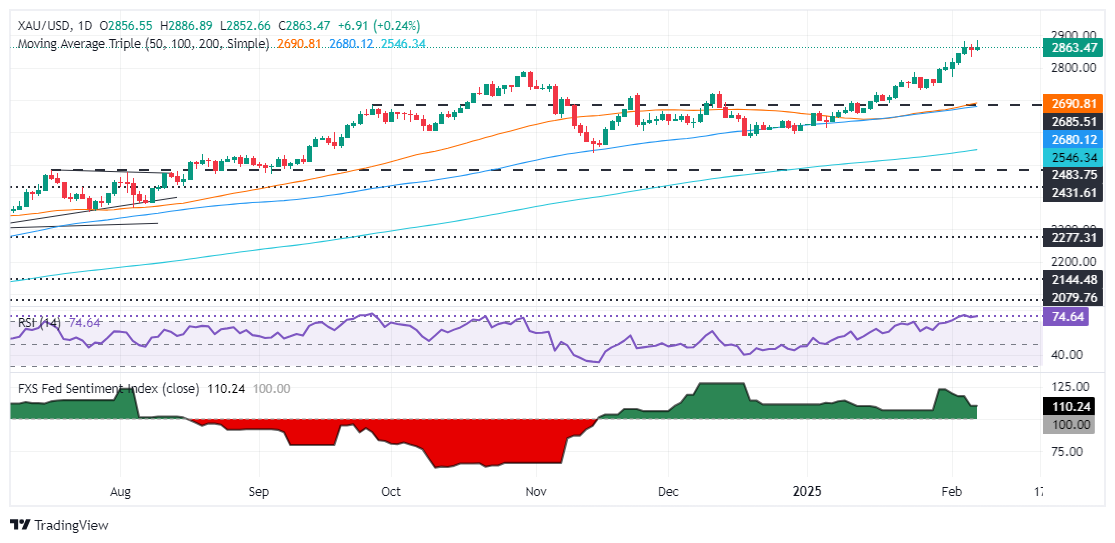
Gold resumed its uptrend on Friday amid the escalation of the trade war between the US and China and a mixed US employment report. The XAU/USD trades at $2,862, up 0.24%.
US President Donald Trump's plans to announce reciprocal tariffs on many countries next week lent a lifeline to Bullion traders as the yellow metal rose on those remarks. Therefore, tensions over the weekend could increase flows to Gold’s safe-haven appeal.
US data revealed that Nonfarm Payrolls in January missed the mark, but the Unemployment Rate dipped compared to estimates and December’s reading. The data suggests the labor market remains strong, which might prevent the Federal Reserve (Fed) from easing policy.
Following the data, Bullion prices jumped to the session's highs of $2,886, but once the dust settled, Gold retraced to its previous level.
Earlier, reports emerged that the People’s Bank of China (PBoC) resumed buying Gold with reserves increasing from 73.29 million ounces to 73.65 million ounces.
Meanwhile, Fed speakers crossed the newswires, continuing with their patient rhetoric.
Minneapolis Fed President Kashkari sees the policy rate “modestly lower.” Chicago Fed President Goolsbee said recently that NFP data was solid and that rates would be lower, but the pace “will be slower with more fogginess.”
Fed Governor Adriana Kugler said the inflation rate “has gone sideways,” adding that “it makes sense to hold the policy rate where it is.”
Daily digest market movers: Gold price climbs alongside the US Dollar
- The US Dollar Index (DXY) edges up 0.32% and sits at 108.04 after hitting a daily low of 107.51.
- The US 10-year Treasury bond yield rises five basis points to 4.487%.
- US real yields, which correlate inversely to Bullion prices, climbed three basis points to 2.062%, a headwind for XAU/USD.
- US Nonfarm Payrolls in January dipped from 256K to 143K, missing the mark of 170K. The Unemployment Rate slid from 4.1% to 4%.
- Money market fed funds rate futures are pricing in 39 basis points of easing by the Federal Reserve in 2025.
XAU/USD technical outlook: Gold prices set to challenge $2,900
Gold’s trend is up yet bulls have failed to clear the $2,900 figure. The Relative Strength Index (RSI) is in overbought territory, while XAU/USD’s price action shows signs of exhaustion.
If Gold drops below $2,800, the next support would be the psychological $2,750 area, followed by the January 27 swing low of $2,730. Conversely, if the yellow metal rises above $2,900, the next key resistance would be the psychological $2,950, followed by $3,000.
Fed FAQs
Monetary policy in the US is shaped by the Federal Reserve (Fed). The Fed has two mandates: to achieve price stability and foster full employment. Its primary tool to achieve these goals is by adjusting interest rates. When prices are rising too quickly and inflation is above the Fed’s 2% target, it raises interest rates, increasing borrowing costs throughout the economy. This results in a stronger US Dollar (USD) as it makes the US a more attractive place for international investors to park their money. When inflation falls below 2% or the Unemployment Rate is too high, the Fed may lower interest rates to encourage borrowing, which weighs on the Greenback.
The Federal Reserve (Fed) holds eight policy meetings a year, where the Federal Open Market Committee (FOMC) assesses economic conditions and makes monetary policy decisions. The FOMC is attended by twelve Fed officials – the seven members of the Board of Governors, the president of the Federal Reserve Bank of New York, and four of the remaining eleven regional Reserve Bank presidents, who serve one-year terms on a rotating basis.
In extreme situations, the Federal Reserve may resort to a policy named Quantitative Easing (QE). QE is the process by which the Fed substantially increases the flow of credit in a stuck financial system. It is a non-standard policy measure used during crises or when inflation is extremely low. It was the Fed’s weapon of choice during the Great Financial Crisis in 2008. It involves the Fed printing more Dollars and using them to buy high grade bonds from financial institutions. QE usually weakens the US Dollar.
Quantitative tightening (QT) is the reverse process of QE, whereby the Federal Reserve stops buying bonds from financial institutions and does not reinvest the principal from the bonds it holds maturing, to purchase new bonds. It is usually positive for the value of the US Dollar.
Author
Christian Borjon Valencia
FXStreet
Christian Borjon began his career as a retail trader in 2010, mainly focused on technical analysis and strategies around it. He started as a swing trader, as he used to work in another industry unrelated to the financial markets.