Gold drops as Trump pulls back from Iran strike as hostilities continue
- Gold trades flat near $3,369, on track for a weekly loss of nearly 1.90%.
- Trump backs off immediate Iran action, boosting risk sentiment and denting safe-haven demand.
- Fed officials split on rate outlook; Waller eyes July cut, Barkin stays cautious.


Gold price trades flat on Friday and is poised to end the week with a nearly 1.90% loss, after US President Donald Trump delayed taking military action against Iran, opting instead for a diplomatic solution. At the time of writing, XAU/USD trades at $3,369, down 0.11%.
Sentiment turned sour outside of geopolitical events, related to “US may revoke waivers for allies with semiconductor plants in China,” as Bloomberg reported. Trump’s decision on Iran boosted risk appetite, a headwind for Gold prices.
Meanwhile, Israel and Iran continued to exchange blows. Reuters reported that an Iranian senior official stated they’re ready to discuss limitations on uranium enrichment. However, they said “zero enrichment will undoubtedly be rejected by Tehran, especially now, under Israel's strikes.”
In the meantime, Federal Reserve (Fed) officials began to cross the wires after the central bank decided to hold rates unchanged, adopting a slightly hawkish stance. Fed Governor Christopher Waller turned uber dovish, eyeing the first rate cut at the July meeting.
In opposition to him, the Fed revealed its Monetary Policy Report, in which it mentioned that policy “is well positioned for what lies ahead,” amid geopolitical and tariff uncertainty. Alongside this, Richmond Fed President Thomas Barkin said he is in no rush to cut rates.
Although Gold has dipped this week, it is typically sought during periods of geopolitical tensions and lower interest rates However,the Fed’s restrictive tilt may prompt investors to turn toward other currencies alongside the US Dollar.
Next week, the US economic docket will feature Fed speeches, S&P Global Flash PMIs, housing and inflation data, alongside Gross Domestic Product (GDP) figures.
Daily digest market movers: Gold stays firm, hoovering near $3,370 on risk-off mood
- The US 10-year Treasury note yield is flat at 4.391%. US real yields, which are inversely correlated with Gold prices, are also unchanged at 2.081%.
- The US Dollar Index (DXY), which tracks the US Dollar’s value against six currencies, is poised to end the week with a 0.50% gain, at 98.65.
- Data in the United States (US) revealed that the economy is slowing down, as indicated by the latest Philadelphia Fed Manufacturing Index in June, which dropped to -4, unchanged from May but worse than the estimated -1 contraction.
- The Fed's Monetary Policy Report recently revealed that there are early signs that tariffs are contributing to higher inflation. However, their full impact has yet to be reflected in the data. The report added that the current policy is well-positioned and that financial stability is resilient amid high uncertainty.
- Fed Chair Powell commented that the effects of tariffs will depend on the level, adding that “Increases this year will likely weigh on economic activity and push up inflation.” Powell said that “As long as we have the kind of labor market we have and inflation coming down, the right thing to do is hold rates.”
- Money markets suggest that traders are pricing in 46 basis points of easing toward the end of the year, according to Prime Market Terminal data.
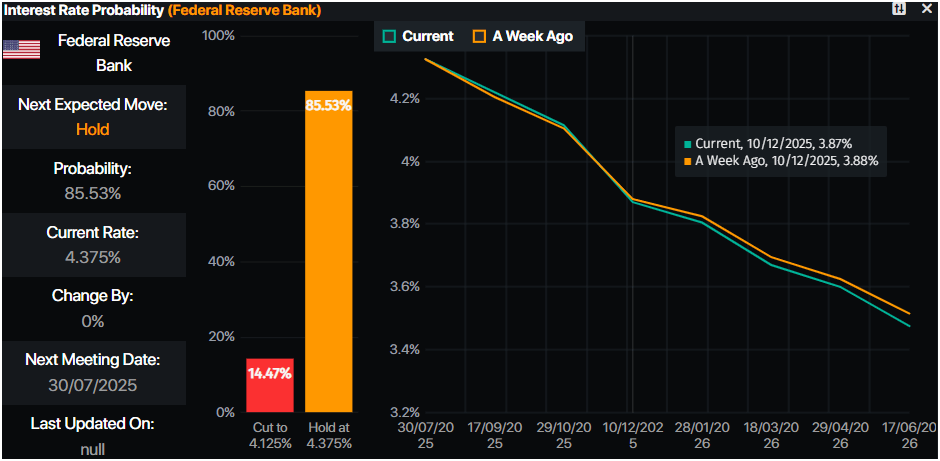
Source: Prime Market Terminal
XAU/USD technical outlook: Gold price to remain pressured below $3,400
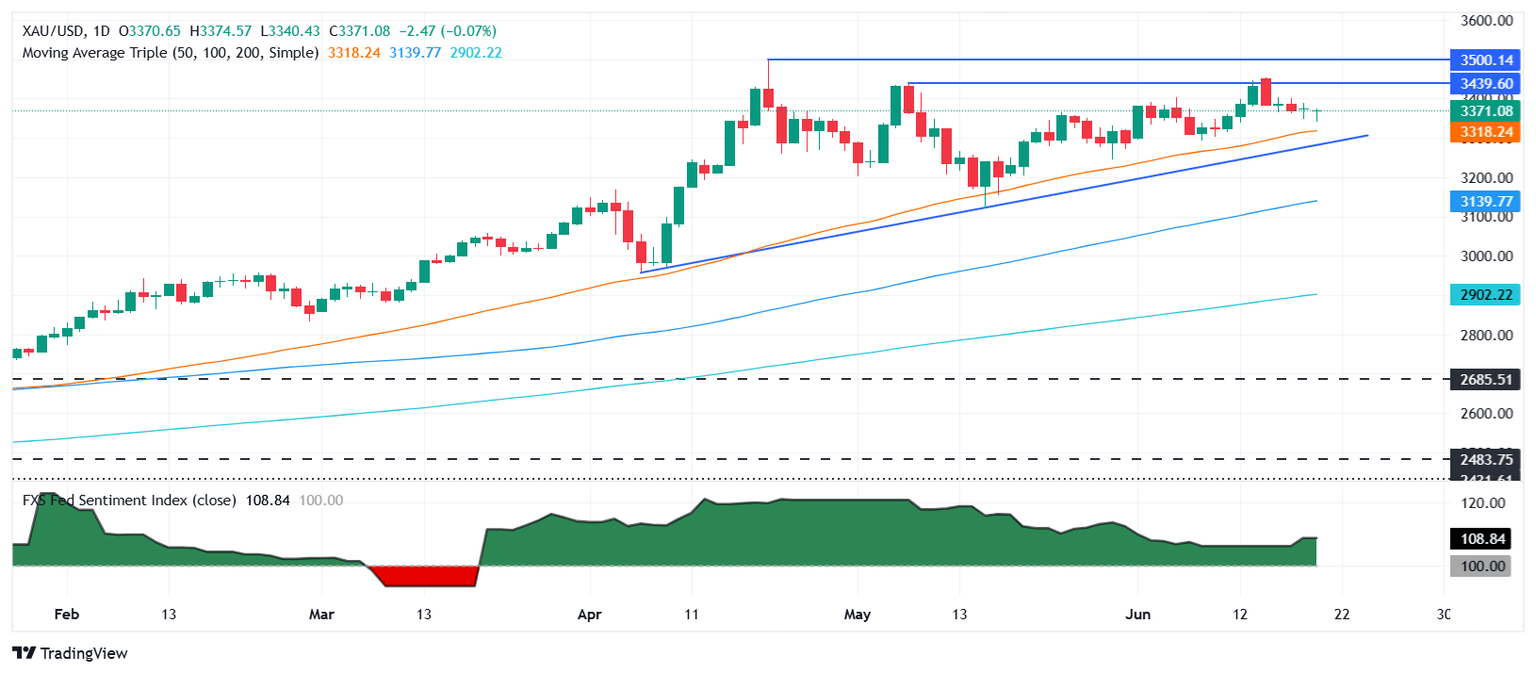
Gold price uptrend remains intact, but as of writing, it has dipped below $3,375. On its way down, XAU/USD hit a five-day low of $3,340 before bouncing off those lows as buyers lifted the spot price.
The Relative Strength Index (RSI) is bullish, despite turning flat. That said, further sideways action is likely in the near term.
For a bullish resumption, XAU/USD must clear $3,400. Once hurdled, the following key resistance levels, such as the $3,450 mark and the record high of $3,500, lie ahead. Otherwise, if Bullion drops below $3,370, the pullback could extend toward the $3,350 mark and to the 50-day Simple Moving Average (SMA) at $3,308. Further losses are seen once cleared, at the April 3 high-turned-support at $3,167.
Risk sentiment FAQs
In the world of financial jargon the two widely used terms “risk-on” and “risk off'' refer to the level of risk that investors are willing to stomach during the period referenced. In a “risk-on” market, investors are optimistic about the future and more willing to buy risky assets. In a “risk-off” market investors start to ‘play it safe’ because they are worried about the future, and therefore buy less risky assets that are more certain of bringing a return, even if it is relatively modest.
Typically, during periods of “risk-on”, stock markets will rise, most commodities – except Gold – will also gain in value, since they benefit from a positive growth outlook. The currencies of nations that are heavy commodity exporters strengthen because of increased demand, and Cryptocurrencies rise. In a “risk-off” market, Bonds go up – especially major government Bonds – Gold shines, and safe-haven currencies such as the Japanese Yen, Swiss Franc and US Dollar all benefit.
The Australian Dollar (AUD), the Canadian Dollar (CAD), the New Zealand Dollar (NZD) and minor FX like the Ruble (RUB) and the South African Rand (ZAR), all tend to rise in markets that are “risk-on”. This is because the economies of these currencies are heavily reliant on commodity exports for growth, and commodities tend to rise in price during risk-on periods. This is because investors foresee greater demand for raw materials in the future due to heightened economic activity.
The major currencies that tend to rise during periods of “risk-off” are the US Dollar (USD), the Japanese Yen (JPY) and the Swiss Franc (CHF). The US Dollar, because it is the world’s reserve currency, and because in times of crisis investors buy US government debt, which is seen as safe because the largest economy in the world is unlikely to default. The Yen, from increased demand for Japanese government bonds, because a high proportion are held by domestic investors who are unlikely to dump them – even in a crisis. The Swiss Franc, because strict Swiss banking laws offer investors enhanced capital protection.
Author
Christian Borjon Valencia
FXStreet
Markets analyst, news editor, and trading instructor with over 14 years of experience across FX, commodities, US equity indices, and global macro markets.