Gold skyrockets and holds above $2,100 as traders brace for Powell testimony
- Gold prices reach a new record of $2,141.59, driven by mounting expectations of forthcoming Fed policy easing.
- Reports of slowing business activity in the US services sector contribute to the rally as XAU/USD now trades at $2,133.50.
- A decline in US Treasury yields supports the surge in Gold prices.


Gold prices rallied sharply on Tuesday with the XAU/USD spot reaching an all-time high of $2,141.59 via Reuters. Growing speculation that the US Federal Reserve (Fed) could begin to ease policy increased following two reports highlighting an economic slowdown in the services sector. The XAU/USD trades at $2,133.50, up more than 2.40%.
S&P Global revealed that business activity is slowing down. February’s data was softer than last month, although the S&P Global Composite Index exceeded forecasts. Meanwhile, the Institute for Supply Management (ISM) was weaker than expected, while the US Department of Commerce revealed that Factory Orders plunged.
After the data, XAU/USD edged higher from close to $2,120, pushing toward the all-time high before settling in. US Treasury yields along the short and long end of the curve plummeted as seen on the 10-year benchmark note rate at 4.135%, down eight basis points (bps).
Daily digest market movers: Gold price skyrockets as US economy slows, sponsored by weak PMIs
- The S&P Global Services PMI experienced a slight decrease to 52.3, falling from January's 52.5, while the Composite PMI, which includes both manufacturing and service sectors, registered at 53.8. This figure did not meet expectations and was lower than the previous reading of 54.2.
- Additionally, the ISM Services PMI reported a decline to 52.6 from 53.4, coming in below the anticipated consensus of 53. This resulted in a negative impact on the US Dollar.
- Factory Orders in January fell more than expected, from 0.2% to -3.6% MoM.
- Following the data, interest rate probabilities measured by the CME FedWatch Tool suggest traders are expecting the first cut in June, with odds increasing to 55% from 49.7% a week ago.
- Gold prices remain supported by strong central bank buying in emerging markets.
- The near-term demand for Gold will be influenced by Fed Chair Jerome Powell’s testimony before Congress on Wednesday and an array of United States economic data released later this week.
- Jerome Powell is expected to reiterate that there is no urgency for rate cuts due to resilient economic growth. The Fed isn’t likely to shift from its hawkish stance toward policy normalization until it gets convinced that inflation will sustainably return to the 2% target. The Fed wants to see inflation declining further before considering rate cuts.
- On Monday, Atlanta Fed Bank President Raphael Bostic said a strong labor market and decent economic growth have bought time for the Federal Open Market Committee (FOMC) to decide on when rate cuts will be optimal. Bostic added that the Fed is having a “rebounding success” as inflation slowly returns to the desired target without hurting labor demand.
- The US Dollar Index (DXY), which gauges the Greenback’s value against six major currencies, fell 0.03% to 103.80.
Technical analysis: Gold soars to all-time highs amid soft US data
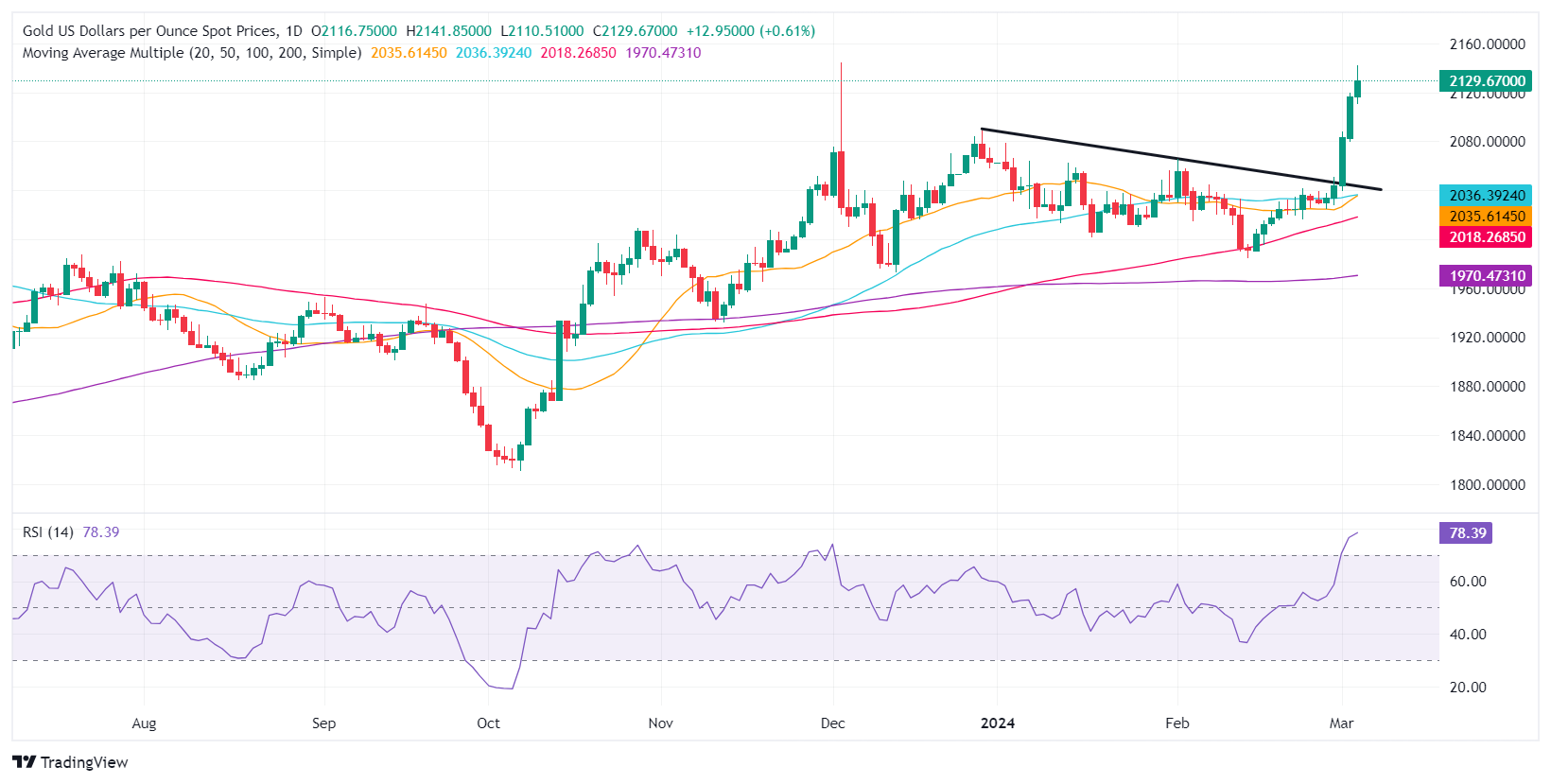
Gold is skyrocketing, though it has retreated from ATH seen at $2,141.59, which could open the door for a pullback. In that event, XAU/USD’s first support would be the $2,100.00 mark, followed by the December 28 high at $2,088.48 and the February 1 high at $2,065.60.
On the flip side, XAU/USD’s next resistance would be $2,150.00, followed by the $2,200.00 mark.
Gold FAQs
Gold has played a key role in human’s history as it has been widely used as a store of value and medium of exchange. Currently, apart from its shine and usage for jewelry, the precious metal is widely seen as a safe-haven asset, meaning that it is considered a good investment during turbulent times. Gold is also widely seen as a hedge against inflation and against depreciating currencies as it doesn’t rely on any specific issuer or government.
Central banks are the biggest Gold holders. In their aim to support their currencies in turbulent times, central banks tend to diversify their reserves and buy Gold to improve the perceived strength of the economy and the currency. High Gold reserves can be a source of trust for a country’s solvency. Central banks added 1,136 tonnes of Gold worth around $70 billion to their reserves in 2022, according to data from the World Gold Council. This is the highest yearly purchase since records began. Central banks from emerging economies such as China, India and Turkey are quickly increasing their Gold reserves.
Gold has an inverse correlation with the US Dollar and US Treasuries, which are both major reserve and safe-haven assets. When the Dollar depreciates, Gold tends to rise, enabling investors and central banks to diversify their assets in turbulent times. Gold is also inversely correlated with risk assets. A rally in the stock market tends to weaken Gold price, while sell-offs in riskier markets tend to favor the precious metal.
The price can move due to a wide range of factors. Geopolitical instability or fears of a deep recession can quickly make Gold price escalate due to its safe-haven status. As a yield-less asset, Gold tends to rise with lower interest rates, while higher cost of money usually weighs down on the yellow metal. Still, most moves depend on how the US Dollar (USD) behaves as the asset is priced in dollars (XAU/USD). A strong Dollar tends to keep the price of Gold controlled, whereas a weaker Dollar is likely to push Gold prices up.
Author
Christian Borjon Valencia
FXStreet
Markets analyst, news editor, and trading instructor with over 14 years of experience across FX, commodities, US equity indices, and global macro markets.