Gold ends week higher despite Powell's pushback, trade uncertainty lingers
- Gold rallies $90 this week as the US Dollar weakens amid rising trade tensions and geopolitical risks.
- Fed’s Daly says policy is still restrictive; neutral rate may be rising, echoing Powell’s hawkish tone.
- Traders focus on key US data next week: Flash PMIs, Durable Goods, and final Consumer Sentiment.


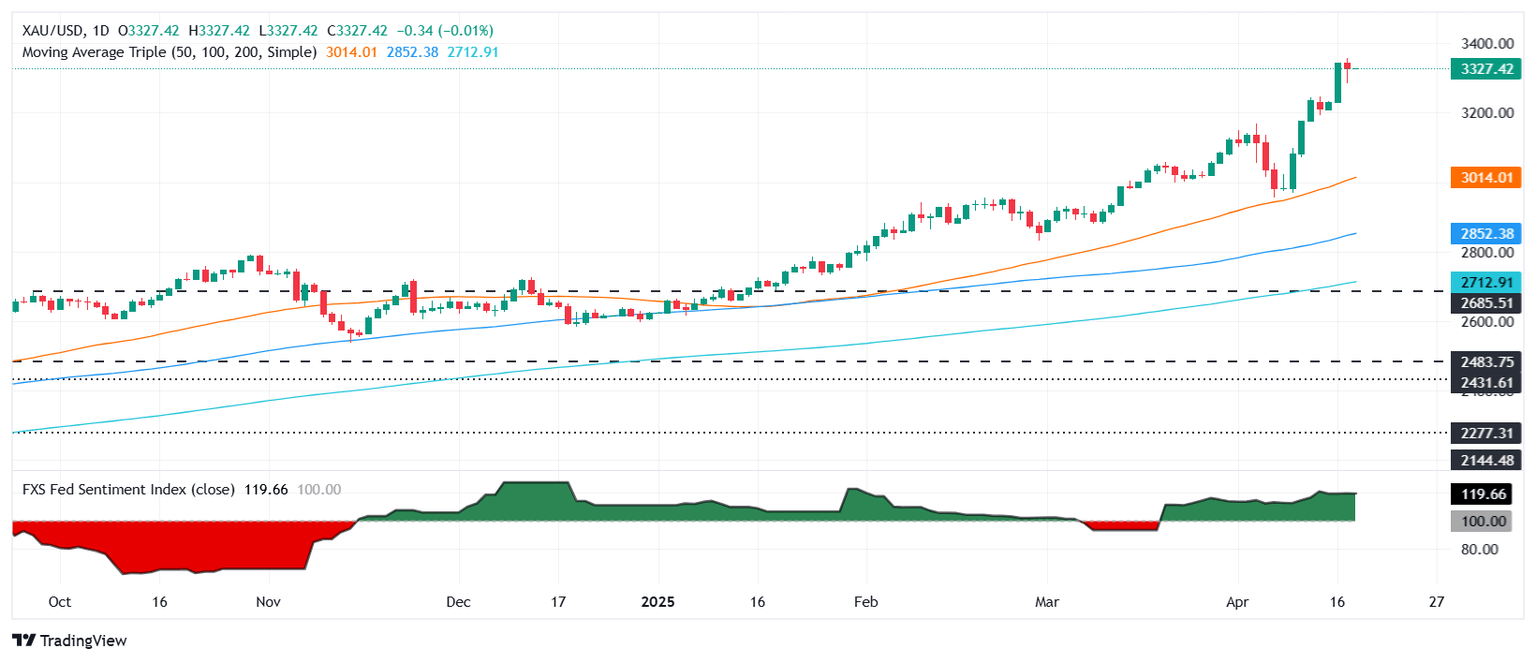
Gold prices are set to end the week on a positive note, up by over 2.79% as the precious metal enjoyed a $90 US Dollar (USD) rally due to the latter weakness sponsored by uncertainty about global trade. At the time of writing, XAU/USD trades at $3,326.
XAU/USD holds at $3,326 after hitting ATH of $3,358; real yields rise but long weekend profit-taking caps rally
European and US markets are closed due to a long Easter weekend, so news flows are light. San Francisco Federal Reserve (Fed) President Mary Daly crossed the wires and said that the economy is in a good place, though some sectors are slowing down. She added that policy remains restrictive in good place, exerting downward pressure on inflation, and added that neutral rates “may be rising.”
Bullion prices dropped after hitting an all-time high (ATH) of $3,358 as traders booked profits due to the long weekend. Wednesday’s hawkish speech by Fed Chair Jerome Powell capped the precious metal advance, even though uncertainty over US trade policies and geopolitical risks may underpin Gold prices.
Yields rose, with the US 10-year T-note yield rising five basis points to 4.333%. US real yields, which are calculated by the yield of the nominal note minus inflation expectations, climb five bps to 2.163%, a headwind for Gold prices.
Next week, the US economic docket will be packed by a flurry of Fed speakers, S&P Global Flash PMIs, Durable Goods Orders and the University of Michigan Consumer Sentiment final reading.
XAU/USD Price Forecast: Technical outlook
Gold's uptrend remains intact despite Thursday’s pullback below the $3,330 mark. As prices recover some earlier losses, the lack of downside follow-through suggests limited acceptance of lower levels, keeping the door open for further gains.
Momentum-wise, the Relative Strength Index (RSI) remains overbought but not yet at the extreme 80 level. However, a mean-reversion move could be on the horizon with the RSI turning lower.
In that case, initial support lies at $3,300, followed by the April 16 low at $3,229. On the upside, a break above $3,350 could set up a test of the year-to-date (YTD) high, with the next target at $3,400.
Gold FAQs
Gold has played a key role in human’s history as it has been widely used as a store of value and medium of exchange. Currently, apart from its shine and usage for jewelry, the precious metal is widely seen as a safe-haven asset, meaning that it is considered a good investment during turbulent times. Gold is also widely seen as a hedge against inflation and against depreciating currencies as it doesn’t rely on any specific issuer or government.
Central banks are the biggest Gold holders. In their aim to support their currencies in turbulent times, central banks tend to diversify their reserves and buy Gold to improve the perceived strength of the economy and the currency. High Gold reserves can be a source of trust for a country’s solvency. Central banks added 1,136 tonnes of Gold worth around $70 billion to their reserves in 2022, according to data from the World Gold Council. This is the highest yearly purchase since records began. Central banks from emerging economies such as China, India and Turkey are quickly increasing their Gold reserves.
Gold has an inverse correlation with the US Dollar and US Treasuries, which are both major reserve and safe-haven assets. When the Dollar depreciates, Gold tends to rise, enabling investors and central banks to diversify their assets in turbulent times. Gold is also inversely correlated with risk assets. A rally in the stock market tends to weaken Gold price, while sell-offs in riskier markets tend to favor the precious metal.
The price can move due to a wide range of factors. Geopolitical instability or fears of a deep recession can quickly make Gold price escalate due to its safe-haven status. As a yield-less asset, Gold tends to rise with lower interest rates, while higher cost of money usually weighs down on the yellow metal. Still, most moves depend on how the US Dollar (USD) behaves as the asset is priced in dollars (XAU/USD). A strong Dollar tends to keep the price of Gold controlled, whereas a weaker Dollar is likely to push Gold prices up.
Author
Christian Borjon Valencia
FXStreet
Markets analyst, news editor, and trading instructor with over 14 years of experience across FX, commodities, US equity indices, and global macro markets.

















