Gold sticks to a 0.50% profit with US officials meeting Russian officials in Moskou
- Gold higher on the back of tailwinds fueled by tariff headlines.
- US yields hit a five-day high after a drop in inflation triggers flight to equities.
- Traders have to deal with challenges from trade wars and knee-jerk reactions.


Gold’s price (XAU/USD) is nearing the $2,950 marker and has good hopes for a new all-time highs after the United States (US) Consumer Price Index (CPI) data came in softer than expected on Wednesday, which triggered a sigh of relief in US markets with odds for a recession or stagflation being trimmed. This in turn caused an outflow in US bonds and an inflow in US equities, with the sell-off in bonds sparking a boost in yields. The precious metal trades around $2,950 at the time of writing on Thursday.
Meanwhile, traders are still trying to oversee the amount of geopolitical headlines taking place. US President Donald Trump commented on Wednesday that the US will impose reciprocal tariffs on Europe coming into effect on April 2. On the other hand, US diplomats have just arrived in Russia at the time or writing to negotiate a ceasefire deal that already got support from Ukraine and bears US military support for the country.
Daily digest market movers: Talks underway
- US Consumer Price Index figures for February rose at the slowest pace in four months, and traders are fully pricing in another quarter-point interest-rate cut by the Federal Reserve in June’s meeting. Lower borrowing costs tend to benefit Gold, as the precious metal doesn’t pay interest, Bloomberg reports.
- Gold is set to push to a record above $3,100 in the second quarter of 2025 on rising economic uncertainty due to US President Donald Trump’s tariff policies, according to BNP Paribas SA, Reuters reports.
- A worsening US budget outlook is signaling inflation could increase, which would benefit Gold as a hedge, according to Macquarie Bank, which calls for a $3,500 level by the third quarter of 2025, Bloomberg reports.
- The CME Fedwatch Tool sees a 97.0% chance for no interest rate changes in the upcoming Fed meeting on March 19. The chances of a rate cut at the May 7 meeting currently stand at 39.5%.
Technical Analysis: More effort needed to hit a new all-time high
Gold is currently knocking on the door of the intraday R1 resistance level at $2,947 at the time of writing on Thursday. The move comes in a bit contradictory, seeing that US yields rallied higher on Wednesday after a softer US CPI release. The move can be explained by the fact that equities saw inflows from the outflow in US bonds, which pushed yields higher. The sigh of relief is quickly fading on Thursday, with markets focusing again on tariffs, Ukraine, and a possible recession or stagflation in the US.
Gold is heading to $2,950, roughly coinciding with the R1 resistance at $2,947. Once through there, the intraday R2 resistance at $2,961 comes into focus, meaning that the previous all-time high of $2,956 is broken.
On the downside, the daily Pivot Point stands at $2,927. In case that level breaks, look at the S1 support around $2,913. Further down, the S2 support stands at $2,892, though the $2,900 big figure should be strong enough to catch any corrections.
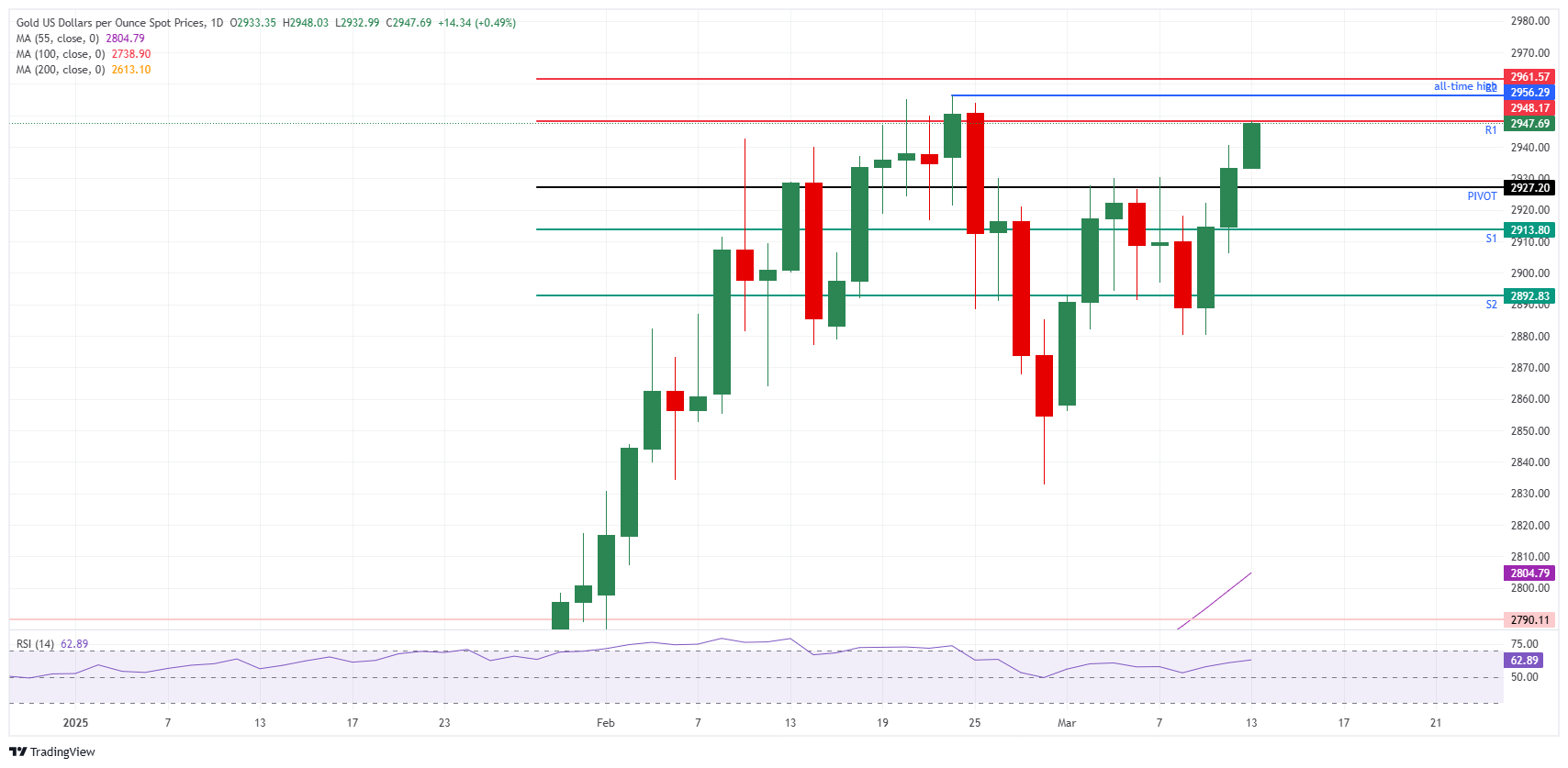
XAU/USD: Daily Chart
Inflation FAQs
Inflation measures the rise in the price of a representative basket of goods and services. Headline inflation is usually expressed as a percentage change on a month-on-month (MoM) and year-on-year (YoY) basis. Core inflation excludes more volatile elements such as food and fuel which can fluctuate because of geopolitical and seasonal factors. Core inflation is the figure economists focus on and is the level targeted by central banks, which are mandated to keep inflation at a manageable level, usually around 2%.
The Consumer Price Index (CPI) measures the change in prices of a basket of goods and services over a period of time. It is usually expressed as a percentage change on a month-on-month (MoM) and year-on-year (YoY) basis. Core CPI is the figure targeted by central banks as it excludes volatile food and fuel inputs. When Core CPI rises above 2% it usually results in higher interest rates and vice versa when it falls below 2%. Since higher interest rates are positive for a currency, higher inflation usually results in a stronger currency. The opposite is true when inflation falls.
Although it may seem counter-intuitive, high inflation in a country pushes up the value of its currency and vice versa for lower inflation. This is because the central bank will normally raise interest rates to combat the higher inflation, which attract more global capital inflows from investors looking for a lucrative place to park their money.
Formerly, Gold was the asset investors turned to in times of high inflation because it preserved its value, and whilst investors will often still buy Gold for its safe-haven properties in times of extreme market turmoil, this is not the case most of the time. This is because when inflation is high, central banks will put up interest rates to combat it. Higher interest rates are negative for Gold because they increase the opportunity-cost of holding Gold vis-a-vis an interest-bearing asset or placing the money in a cash deposit account. On the flipside, lower inflation tends to be positive for Gold as it brings interest rates down, making the bright metal a more viable investment alternative.
Author
Filip Lagaart
FXStreet
Filip Lagaart is a former sales/trader with over 15 years of financial markets expertise under its belt.