GBP/USD tumbles below 1.2400, extends its losses
- GBP/USD edges down after Trump's new tariffs on aluminum and steel, hinting at further measures.
- Market eyes key events: Fed Chair Powell's testimony and upcoming US inflation data.
- BoE's Catherine Mann speech eyed after shifting from hawkish to favoring substantial rate cuts.


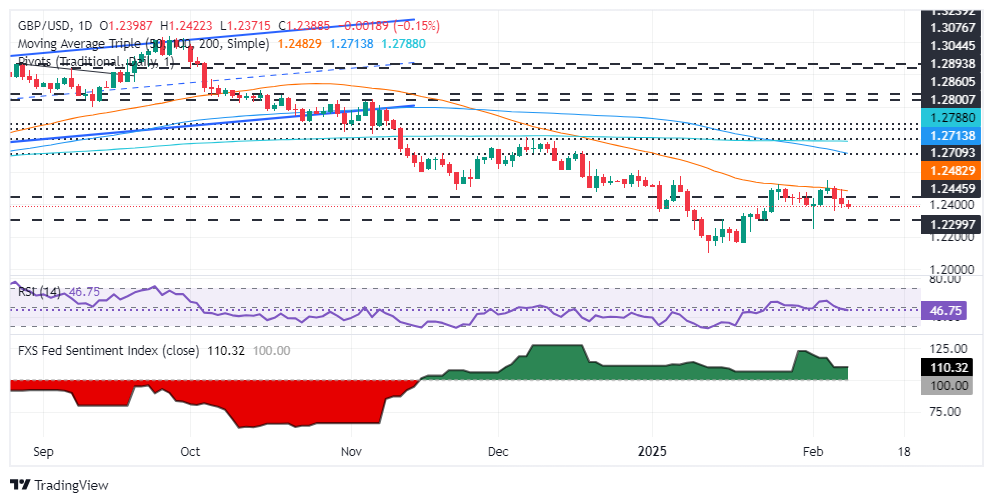
The British Pound (GBP) retreats during the North American session as the Greenback post solid gains after United States (US) President Donald Trump said he would impose tariffs on base metals. The GBP/USD pair trades at 1.2385. down 0.16%.
British Pound drops after new US tariff announcements, central bank speeches up next
Market sentiment is upbeat despite Trump’s tariff rhetoric, who said on Sunday that they would impose 25% tariffs on aluminum and steel. Furthermore, he added that reciprocal tariffs could be levied as soon as Tuesday or Wednesday.
An absent economic docket leaves traders adrift to comments of central bank speakers like Catherine Mann of the Bank of England (BoE) on Tuesday. Mann voted for a 50-basis points (bps) interest rate cut last week after being one of the most hawkish members of the BoE.
Across the pond, traders are eyeing Federal Reserve (Fed) Chair Jerome Powell's testimony at the US Congress on Tuesday. In addition, US inflation figures are expected to remain near the 3% threshold, while Retail Sales are expected to show a minimal contraction in January.
GBP/USD Price Analysis: Technical outlook
From a technical standpoint, GBP/USD remains biased downward after the pair hit a daily high of 1.2421; buyers failed to cling to gains above 1.2400. On further weakness, the pair might test the February 6 low of 1.2359, followed by the February 3 daily low of 1.2249.
Conversely, a daily close above 1.2400 could allow the 50-day Simple Moving Average (SMA) to test at 1.2486 ahead of the 1.2500 mark.
Pound Sterling FAQs
The Pound Sterling (GBP) is the oldest currency in the world (886 AD) and the official currency of the United Kingdom. It is the fourth most traded unit for foreign exchange (FX) in the world, accounting for 12% of all transactions, averaging $630 billion a day, according to 2022 data. Its key trading pairs are GBP/USD, also known as ‘Cable’, which accounts for 11% of FX, GBP/JPY, or the ‘Dragon’ as it is known by traders (3%), and EUR/GBP (2%). The Pound Sterling is issued by the Bank of England (BoE).
The single most important factor influencing the value of the Pound Sterling is monetary policy decided by the Bank of England. The BoE bases its decisions on whether it has achieved its primary goal of “price stability” – a steady inflation rate of around 2%. Its primary tool for achieving this is the adjustment of interest rates. When inflation is too high, the BoE will try to rein it in by raising interest rates, making it more expensive for people and businesses to access credit. This is generally positive for GBP, as higher interest rates make the UK a more attractive place for global investors to park their money. When inflation falls too low it is a sign economic growth is slowing. In this scenario, the BoE will consider lowering interest rates to cheapen credit so businesses will borrow more to invest in growth-generating projects.
Data releases gauge the health of the economy and can impact the value of the Pound Sterling. Indicators such as GDP, Manufacturing and Services PMIs, and employment can all influence the direction of the GBP. A strong economy is good for Sterling. Not only does it attract more foreign investment but it may encourage the BoE to put up interest rates, which will directly strengthen GBP. Otherwise, if economic data is weak, the Pound Sterling is likely to fall.
Another significant data release for the Pound Sterling is the Trade Balance. This indicator measures the difference between what a country earns from its exports and what it spends on imports over a given period. If a country produces highly sought-after exports, its currency will benefit purely from the extra demand created from foreign buyers seeking to purchase these goods. Therefore, a positive net Trade Balance strengthens a currency and vice versa for a negative balance.
Author
Christian Borjon Valencia
FXStreet
Markets analyst, news editor, and trading instructor with over 14 years of experience across FX, commodities, US equity indices, and global macro markets.