GBP/USD rallies on rate cut hopes, NFP Friday in the barrel
- GBP/USD found room to move on the high end on Thursday.
- BoE Governor Bailey gave a head nod to further rate cuts in 2025.
- Market sentiment is tilting into the risk-on side ahead of Friday’s US NFP jobs print.
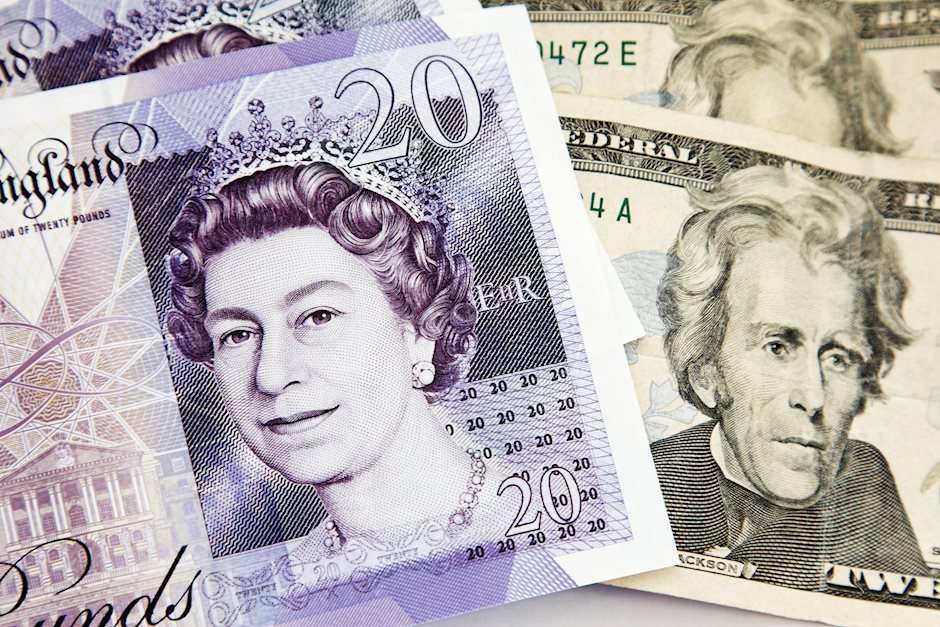

GBP/USD climbed on Tuesday, bolstered by Bank of England (BoE) Governor Andrew Bailey tipping his hand and revealing a path forward to further rate cuts in 2025. Broad-market investor sentiment remains on the high side, although a fresh round of key US Nonfarm Payrolls (NFM) jobs figures are looming just ahead on Friday.
Four rate cuts from the BoE in 2025, maybe
BoE Governor Bailey noted earlier Thursday that he sees around four rate cuts in 2025, which briefly sent the Pound stumbling during the London market session, but GBP traders quickly recovered their footing and pushed Cable back into the high end for the day. The head of the UK central bank reiterated cautious talking points and reaffirmed a data-dependent stance, helping to keep market expectations on-balance that the BoE will leave rates unchanged on December 19.
Initial Jobless Claims for the week ended November 29 rose to a six-week high of 224K, missing the expected print of 215K and stepping above the previous week’s revised 215K. Challenger Job Cuts in November also rose to 57.727K, but the batch of mid-tier labor data pales in comparison to Friday’s upcoming NFP print. Investors are expecting November’s NFP net jobs additions to rebound to 200K after the previous month’s stumble to 12K. October’s shockingly low print was attributed to layoffs from hurricanes and labor strikes, and investors are hoping for a healthy rebound in job gains.
GBP/USD price forecast
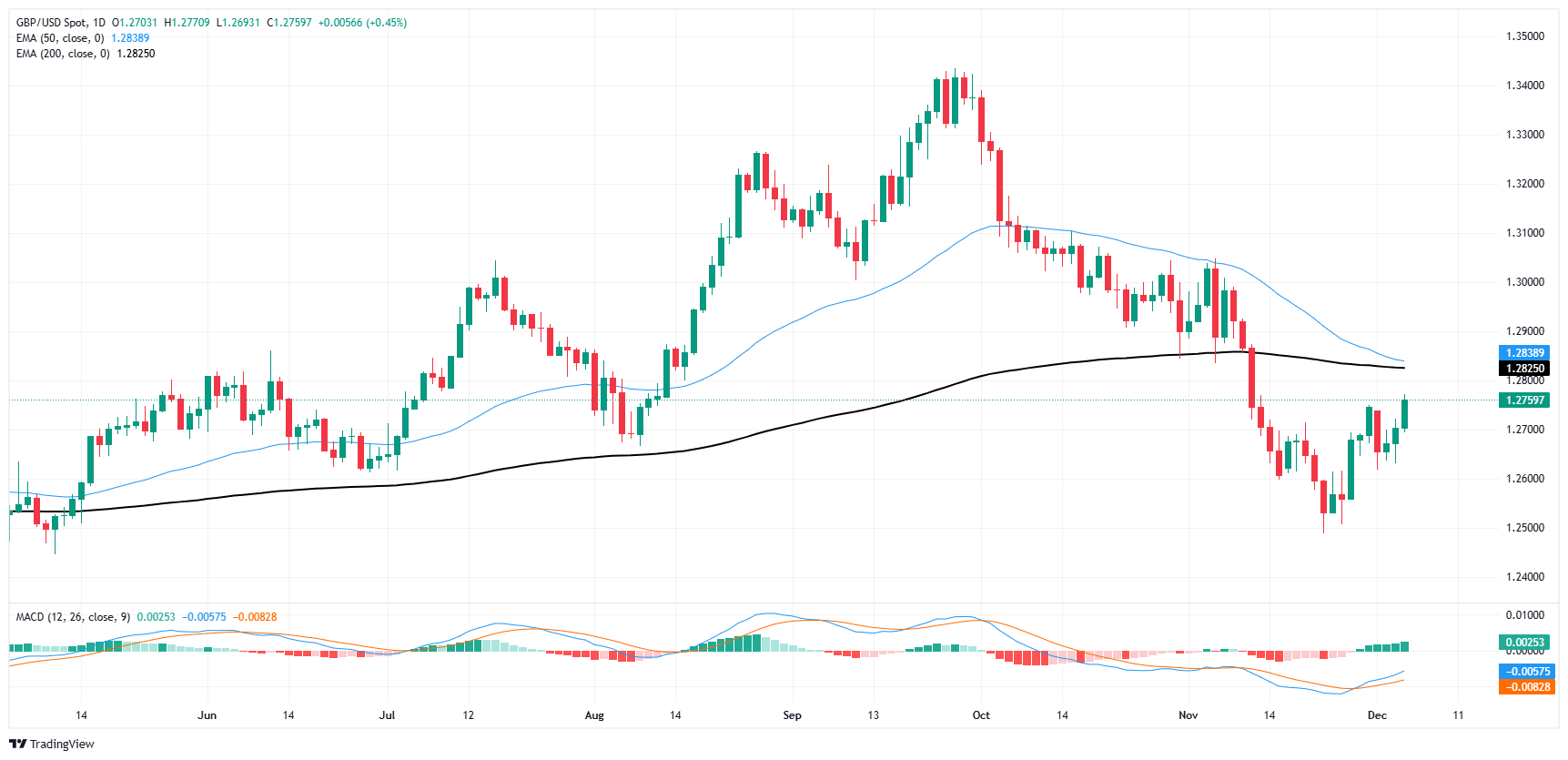
The GBP/USD daily chart shows the pair trading at 1.2758, attempting to recover after a significant downtrend that began in late July. The pair peaked near 1.3140 in early September, forming a notable resistance level, before selling off sharply to a low around 1.2520 in early November. This bearish momentum was fueled by a breakdown below the 200-day EMA, currently positioned at 1.2836, signaling a shift in sentiment. However, recent price action reveals a rebound, as GBP/USD managed to reclaim the 1.2700 handle and is challenging key technical zones.
The 50-day EMA at 1.2884 and the 200-day EMA overhead act as dynamic resistance, with the pair needing to decisively breach these levels to resume a sustainable bullish trend. On the upside, the 1.2900 area is a critical hurdle, aligning closely with the October swing high. If GBP/USD clears this zone, it may signal a medium-term trend reversal and open the door for a retest of September's highs near 1.3140. Conversely, failure to maintain recent gains could see the pair revisiting the 1.2600 support or even the recent lows near 1.2520.
The MACD indicator underscores this pivotal moment, with the MACD line crossing above the signal line, suggesting growing bullish momentum. However, the histogram remains subdued, pointing to a lack of conviction. Traders should monitor whether this recovery gathers pace, especially with upcoming fundamental catalysts likely to shape the next directional move. A sustained close above the 200-day EMA is critical for bulls, while bears would aim to defend the 1.2900 resistance and push the pair back below 1.2700.
GBP/USD daily chart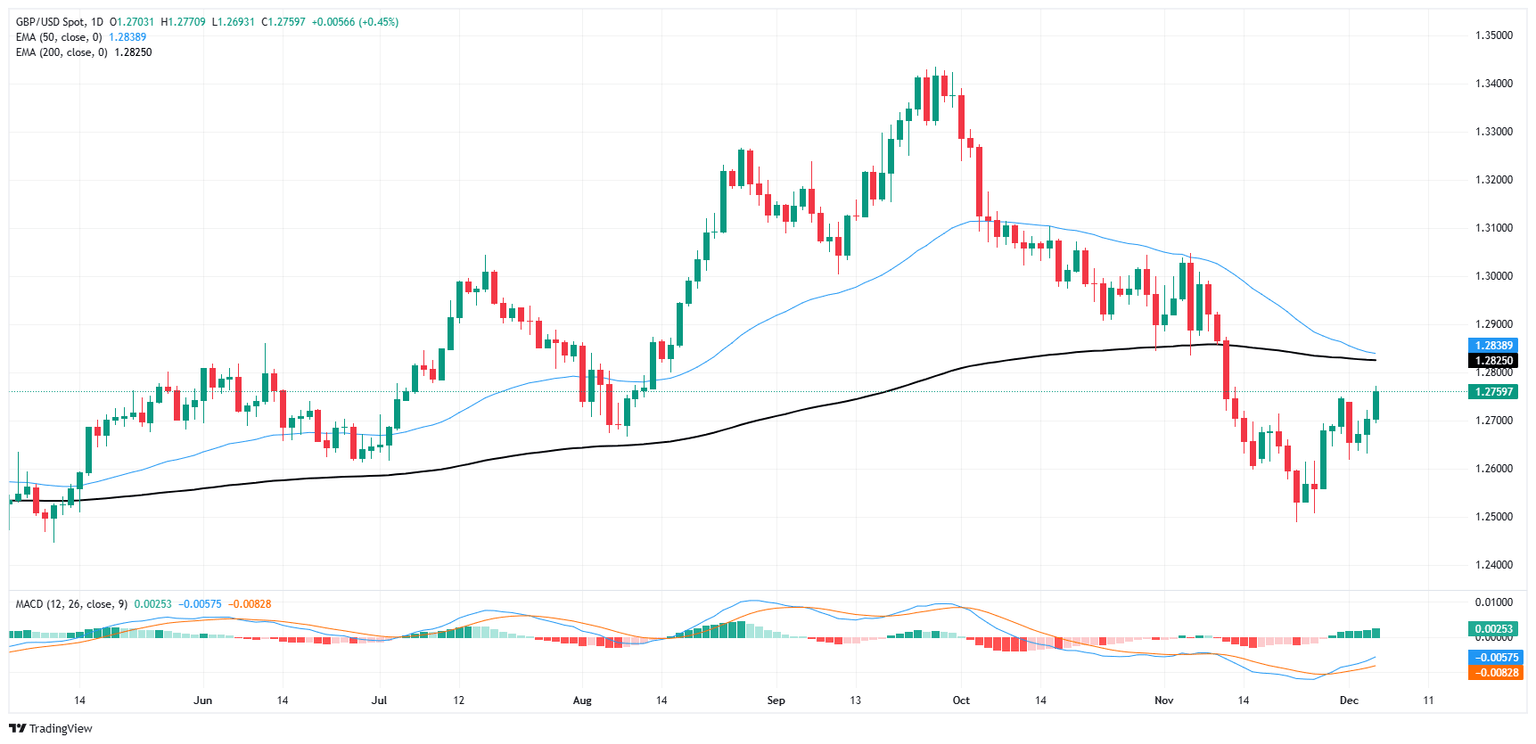
Pound Sterling FAQs
The Pound Sterling (GBP) is the oldest currency in the world (886 AD) and the official currency of the United Kingdom. It is the fourth most traded unit for foreign exchange (FX) in the world, accounting for 12% of all transactions, averaging $630 billion a day, according to 2022 data. Its key trading pairs are GBP/USD, also known as ‘Cable’, which accounts for 11% of FX, GBP/JPY, or the ‘Dragon’ as it is known by traders (3%), and EUR/GBP (2%). The Pound Sterling is issued by the Bank of England (BoE).
The single most important factor influencing the value of the Pound Sterling is monetary policy decided by the Bank of England. The BoE bases its decisions on whether it has achieved its primary goal of “price stability” – a steady inflation rate of around 2%. Its primary tool for achieving this is the adjustment of interest rates. When inflation is too high, the BoE will try to rein it in by raising interest rates, making it more expensive for people and businesses to access credit. This is generally positive for GBP, as higher interest rates make the UK a more attractive place for global investors to park their money. When inflation falls too low it is a sign economic growth is slowing. In this scenario, the BoE will consider lowering interest rates to cheapen credit so businesses will borrow more to invest in growth-generating projects.
Data releases gauge the health of the economy and can impact the value of the Pound Sterling. Indicators such as GDP, Manufacturing and Services PMIs, and employment can all influence the direction of the GBP. A strong economy is good for Sterling. Not only does it attract more foreign investment but it may encourage the BoE to put up interest rates, which will directly strengthen GBP. Otherwise, if economic data is weak, the Pound Sterling is likely to fall.
Another significant data release for the Pound Sterling is the Trade Balance. This indicator measures the difference between what a country earns from its exports and what it spends on imports over a given period. If a country produces highly sought-after exports, its currency will benefit purely from the extra demand created from foreign buyers seeking to purchase these goods. Therefore, a positive net Trade Balance strengthens a currency and vice versa for a negative balance.
Author
Joshua Gibson
FXStreet
Joshua joins the FXStreet team as an Economics and Finance double major from Vancouver Island University with twelve years' experience as an independent trader focusing on technical analysis.