GBP/USD found thin gains on quiet Monday
- GBP/USD remains buoyed above 1.3100 on the holiday market start to the trading week.
- UK data remains thin this week, Pound Sterling to rise and fall at the mercy of market flows.
- One last key US NFP print looms on Friday before upcoming Fed rate call.

GBP/USD turned into the midrange on Monday, plagued by a thin economic calendar on the UK side and shuttered US markets for the Labor Day holiday. Despite a middling open to the trading week, Cable looks poised to continue a near-term pullback, assuming markets aren’t thrown into a tailspin by US jobs figures due later in the week.
The UK is poorly represented on the economic calendar throughout the week, with only low-tier prints on the offer for GBP traders. US Purchasing Managers Index (PMI) figures are dotted throughout the week, but US labor figures will be the key prints on both Thursday and Friday. US ADP Employment Change slated for Thursday represents the first hurdle on the road to Friday’s US NFP jobs data dump. This week represents the last major labor update for the US economy before the Fed delivers its hotly-anticipated rate call on September 18.
Before both of those, however, US JOLTS job openings due on Wednesday are expected to hold steady near 8.1M in July, in line with the previous month’s 8.184M.
GBP/USD price forecast
Cable has backslid from multi-month highs above 1.3250 back below the 1.3150 level as Greenback selling pressure cools, but the pair is stubbornly sticking to recent highs after vaulting to a peak 29-month bid in August. Price action is still tilted firmly into the bullish side above the 200-day Exponential Moving Average (EMA) at 1.2725, while the immediate downside technical target for shorts will be the 50-day EMA just above the 1.2900 handle.
GBP/USD daily chart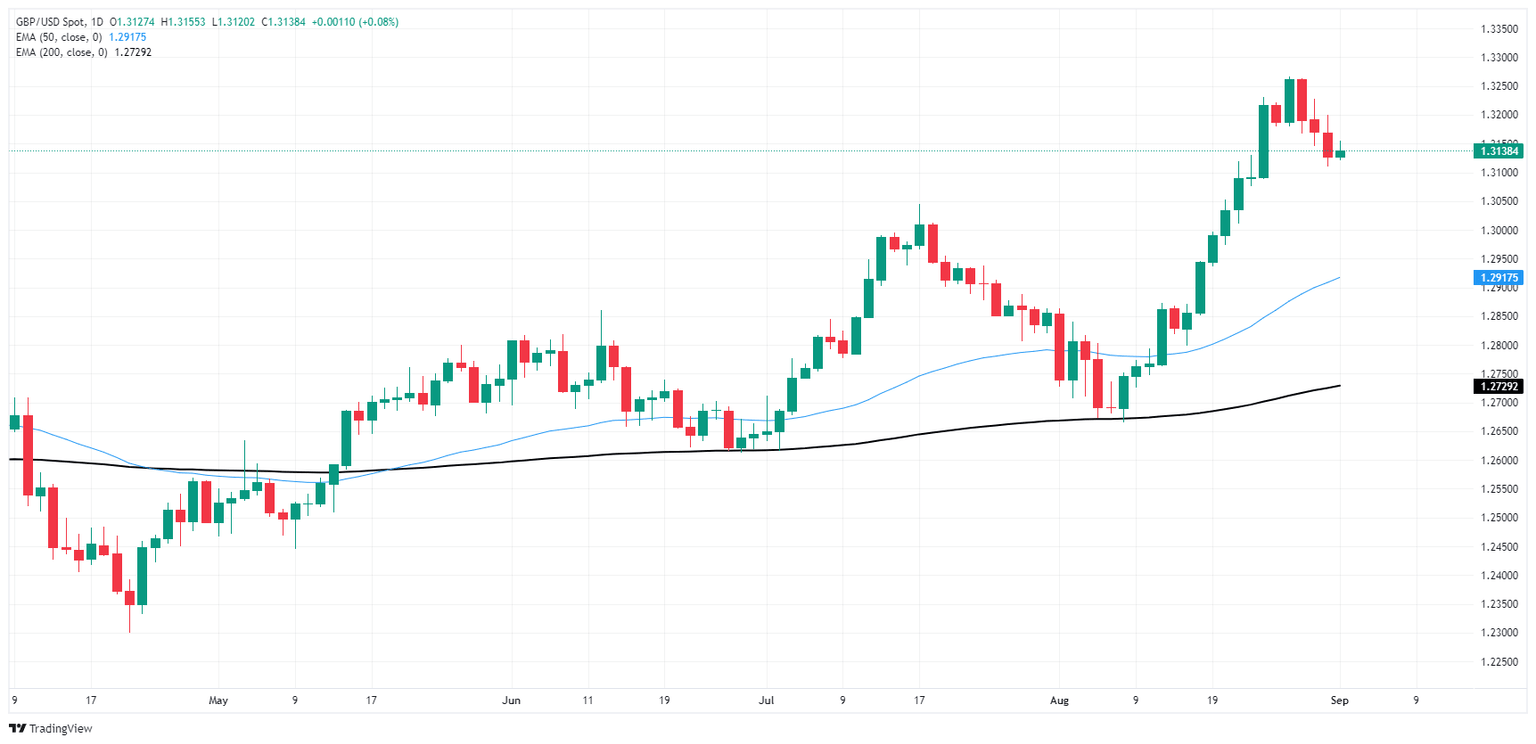
Pound Sterling FAQs
The Pound Sterling (GBP) is the oldest currency in the world (886 AD) and the official currency of the United Kingdom. It is the fourth most traded unit for foreign exchange (FX) in the world, accounting for 12% of all transactions, averaging $630 billion a day, according to 2022 data. Its key trading pairs are GBP/USD, aka ‘Cable’, which accounts for 11% of FX, GBP/JPY, or the ‘Dragon’ as it is known by traders (3%), and EUR/GBP (2%). The Pound Sterling is issued by the Bank of England (BoE).
The single most important factor influencing the value of the Pound Sterling is monetary policy decided by the Bank of England. The BoE bases its decisions on whether it has achieved its primary goal of “price stability” – a steady inflation rate of around 2%. Its primary tool for achieving this is the adjustment of interest rates. When inflation is too high, the BoE will try to rein it in by raising interest rates, making it more expensive for people and businesses to access credit. This is generally positive for GBP, as higher interest rates make the UK a more attractive place for global investors to park their money. When inflation falls too low it is a sign economic growth is slowing. In this scenario, the BoE will consider lowering interest rates to cheapen credit so businesses will borrow more to invest in growth-generating projects.
Data releases gauge the health of the economy and can impact the value of the Pound Sterling. Indicators such as GDP, Manufacturing and Services PMIs, and employment can all influence the direction of the GBP. A strong economy is good for Sterling. Not only does it attract more foreign investment but it may encourage the BoE to put up interest rates, which will directly strengthen GBP. Otherwise, if economic data is weak, the Pound Sterling is likely to fall.
Another significant data release for the Pound Sterling is the Trade Balance. This indicator measures the difference between what a country earns from its exports and what it spends on imports over a given period. If a country produces highly sought-after exports, its currency will benefit purely from the extra demand created from foreign buyers seeking to purchase these goods. Therefore, a positive net Trade Balance strengthens a currency and vice versa for a negative balance.
Author
Joshua Gibson
FXStreet
Joshua joins the FXStreet team as an Economics and Finance double major from Vancouver Island University with twelve years' experience as an independent trader focusing on technical analysis.