GBP/USD eyes 1.2800 as UK’s budget and Powell’s comments lift the Pound
- GBP/USD rallies, buoyed by UK's positive spring budget outlook and Powell's testimony on US economic strength.
- UK Chancellor Hunt's budget reveals tax cuts and economic growth projections, boosting confidence in sterling's trajectory.
- Despite mixed US job data, Powell's reassurances on inflation and economic growth support GBP/USD's upward movement.

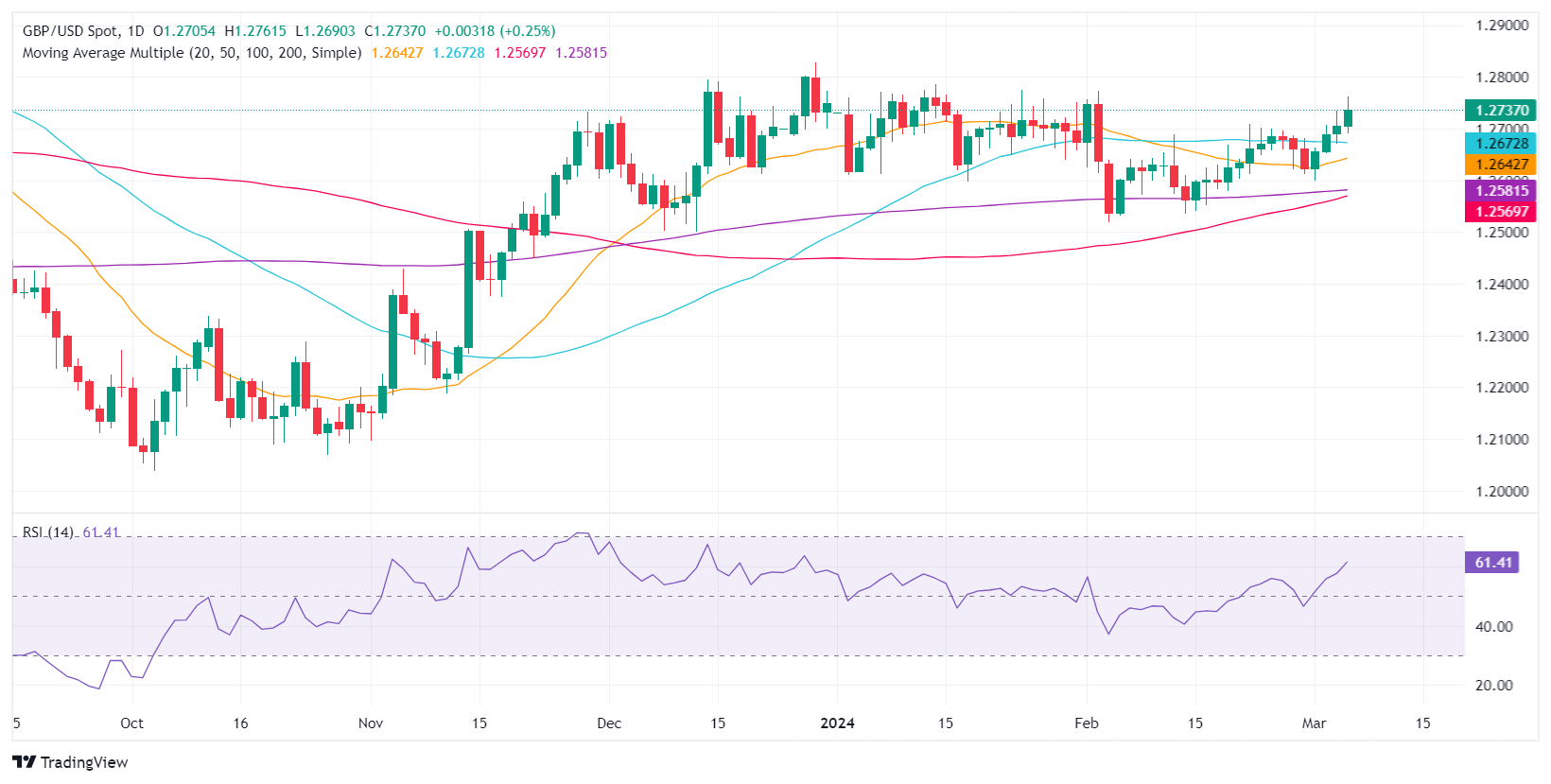
The GBP/USD climbed 0.31% during the North American session and traded at 1.2746 after bouncing off daily lows of 1.2690. UK’s spring budget announcement and US Federal Reserve’s Chair Jerome Powell's testimony sponsored a leg-up in the pair, which is set to test the 1.2800 mark.
Serling post gains in optimistic UK’s budget
The UK’s Chancellor of the Exchequer, Jeremy Hunt, presented the spring budget to the House of Commons. Hunt said that according to the Office for Budget Responsibility (OBR), the economy is expected to grow 0.8% in 2024 and 1.9% next year, 0.5% higher than the autumn forecast. Regarding debt, the OBR foresaw headline debt would rise above 100% of GDP, though they noted that it would fall every year to just 94.3% by 2028-29.
Hunt announced a tax rate cut in employees' National Insurance from 10% to 8%, while frozen fuel and alcohol duty, as rumored before the announcement.
Across the pond, US Federal Reserve Chair Jerome Powell said the US economy is nowhere near falling into recession, though the Fed failed to provide guidance regarding future interest rate cuts. Powell expects inflation to converge toward the Fed’s 2% goal while the economy grows. He added, “If that's the case, it will be appropriate for interest rates to come down significantly over the coming years.”
Data-wise, the US economic docket featured the US ADP National Employment report for February, a poll showing private companies hiring. The figures missed estimates but were above January’s data, suggesting the labor market remains tight. Nevertheless, the US Job Openings and Labor Turnover Survey (JOLTS) for January showed that there were 8.863 million job openings, a figure that fell short of expectations and was marginally lower than the previous month's reports of 8.9 million and 8.889 million, respectively.
After the data, the GBP/USD jumped from around 1.2720s toward the day highs before trimming some of its gains. UK Gilts were little changed, an indication that the UK’s Budget was well received amongst investors.
GBP/USD Price Analysis: Technical outlook
The pair has resumed to the upside, though it remains shy of testing 1.2800. With that said, buyers failing to reclaim the latter and the GBP/USD could be up for a pullback. The next support would be the 1.2700 figure, followed by the 50-day moving average (DMA) at 1.2673. On the other hand, if buyers prolong the rally, the next stop would be the 1.2900 mark.
Pound Sterling FAQs
The Pound Sterling (GBP) is the oldest currency in the world (886 AD) and the official currency of the United Kingdom. It is the fourth most traded unit for foreign exchange (FX) in the world, accounting for 12% of all transactions, averaging $630 billion a day, according to 2022 data. Its key trading pairs are GBP/USD, aka ‘Cable’, which accounts for 11% of FX, GBP/JPY, or the ‘Dragon’ as it is known by traders (3%), and EUR/GBP (2%). The Pound Sterling is issued by the Bank of England (BoE).
The single most important factor influencing the value of the Pound Sterling is monetary policy decided by the Bank of England. The BoE bases its decisions on whether it has achieved its primary goal of “price stability” – a steady inflation rate of around 2%. Its primary tool for achieving this is the adjustment of interest rates. When inflation is too high, the BoE will try to rein it in by raising interest rates, making it more expensive for people and businesses to access credit. This is generally positive for GBP, as higher interest rates make the UK a more attractive place for global investors to park their money. When inflation falls too low it is a sign economic growth is slowing. In this scenario, the BoE will consider lowering interest rates to cheapen credit so businesses will borrow more to invest in growth-generating projects.
Data releases gauge the health of the economy and can impact the value of the Pound Sterling. Indicators such as GDP, Manufacturing and Services PMIs, and employment can all influence the direction of the GBP. A strong economy is good for Sterling. Not only does it attract more foreign investment but it may encourage the BoE to put up interest rates, which will directly strengthen GBP. Otherwise, if economic data is weak, the Pound Sterling is likely to fall.
Another significant data release for the Pound Sterling is the Trade Balance. This indicator measures the difference between what a country earns from its exports and what it spends on imports over a given period. If a country produces highly sought-after exports, its currency will benefit purely from the extra demand created from foreign buyers seeking to purchase these goods. Therefore, a positive net Trade Balance strengthens a currency and vice versa for a negative balance.
Author
Christian Borjon Valencia
FXStreet
Markets analyst, news editor, and trading instructor with over 14 years of experience across FX, commodities, US equity indices, and global macro markets.