|

GBP/JPY Price Analysis: Stays bearish despite facing support around 187.00 as double top looms

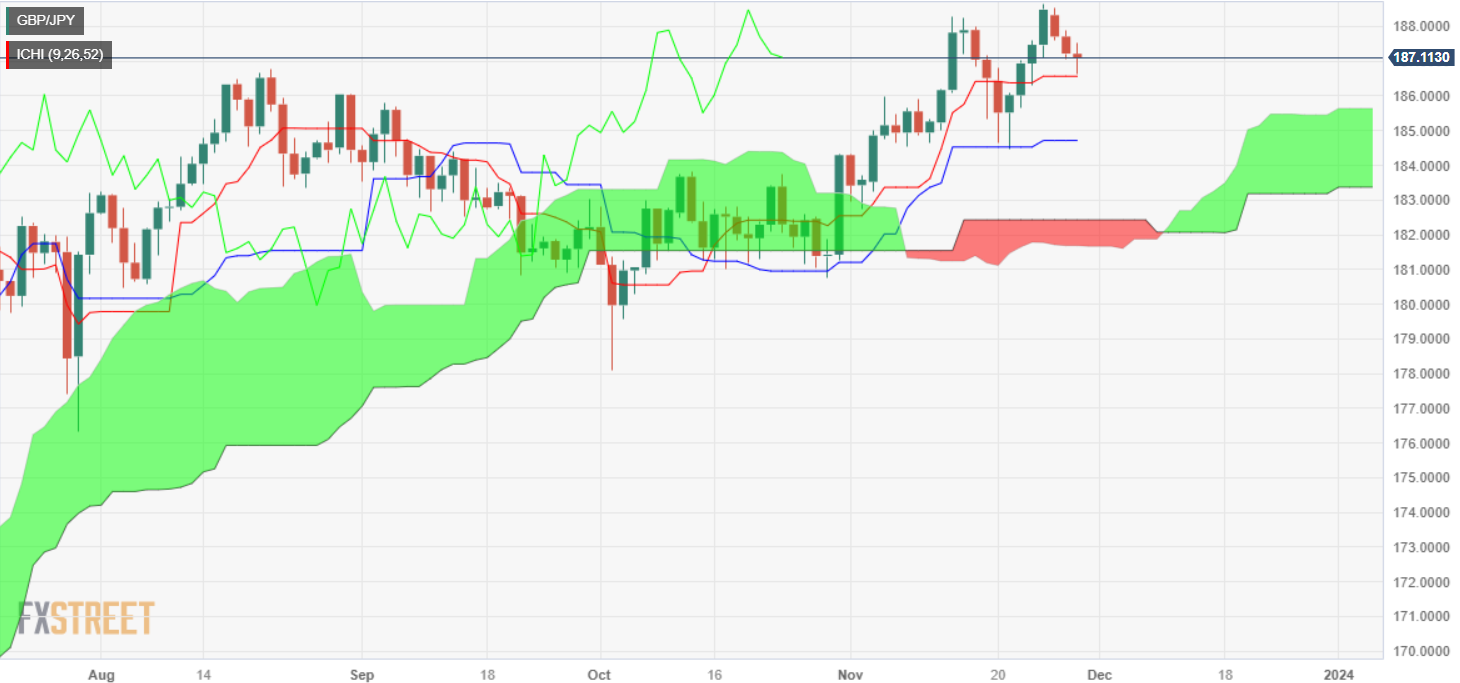
  • GBP/JPY daily chart depicts the formation of double top chart pattern.
  • If the pair drops below the Kijun-Sen, expect further downside toward 180.76, due to double top’s confirmation.
  • Buyers maintaining the exchange rate above 187.00, could increase the odds of challenging the YTD high.
The GBP/JPY drop extended to three straight days, as it printed losses of 0.09% late in the New York session, with the pair exchanging hands near its opening price at around 187.07.

Even though the GBP/JPY is trading with a negative bias, it has failed to extend its losses below the 187.00 figure, which could have exposed the Tenkan-Sen level at 186.55. A breach of the latter would likely resume the ongoing downtrend, with sellers eyeing the Senkou Span A at 185.63, followed by the Kijun-Sen support at 184.71.

Given the fact that a ‘double top’ chart pattern is pending further confirmation, a daily close below the abovementioned Kijun-Sen level would validate the pattern, which is targeting the October 30 swing low of 180.76.

On the other hand, keeping the spot price above the Tenkan-Sen and the 187.00 mark could put into play a test of the year-to-date (YTD) high seen at 188.65.

GBP/JPY Price Analysis – Daily Chart
GBP/JPY Technical Levels

GBP/JPY

Overview
Today last price187.11
Today Daily Change-0.11
Today Daily Change %-0.06
Today daily open187.22
 
Trends
Daily SMA20186.13
Daily SMA50183.69
Daily SMA100183.44
Daily SMA200176.83
 
Levels
Previous Daily High187.88
Previous Daily Low187.06
Previous Weekly High188.67
Previous Weekly Low184.47
Previous Monthly High184.33
Previous Monthly Low178.08
Daily Fibonacci 38.2%187.37
Daily Fibonacci 61.8%187.56
Daily Pivot Point S1186.89
Daily Pivot Point S2186.56
Daily Pivot Point S3186.07
Daily Pivot Point R1187.71
Daily Pivot Point R2188.21
Daily Pivot Point R3188.54

Author

Christian Borjon Valencia

Markets analyst, news editor, and trading instructor with over 14 years of experience across FX, commodities, US equity indices, and global macro markets.


More from Christian Borjon Valencia
Share:

Editor's Picks

EUR/USD keeps the bid bias just over 1.1800

EUR/USD has started the week on a positive foot, hovering around the 1.1800 region in the latter part of Monday’s session. The pair’s recovery comes on the back of a decent decline in the US Dollar, as investors keep their attention on the evolving US–EU trade relationship after President Trump’s announcement of sweeping global tariff hikes.

GBP/USD looks stuck around 1.3500 amid firm gains

GBP/USD is pushing further north on Monday, revisiting the 1.3500 hurdle and beyond. Cable’s uptick is largely being fuelled by the broader softness in the Greenback, amid lingering uncertainty around tariffs.

Gold pops above $5,200, four-week highs

Gold is holding onto its bullish tone on Monday, reaching new multi-week highs just past the $5,200 mark per troy ounce. Fresh trade-war concerns, coupled with rising geopolitical tensions in the Middle East, are keeping demand for the yellow metal well on the rise.

Crypto Today: Bitcoin, Ethereum, XRP intensify sell-off as tariff uncertainty weighs

Bitcoin, Ethereum and Ripple are trading amid increasing selling pressure at the time of writing on Monday, as investors react to fresh trade uncertainty over US President Donald Trump’s push for more tariffs.

Supreme Court nixes tariffs, Trump teases 15% global tariff

On February 20th, the Supreme Court ruled that Trump’s global tariffs under IEEPA authority were unconstitutional, effectively nullifying the framework. However, the relief was short-lived. Within hours, Trump floated a 15% blanket tariff under an alternative legal authority.

XRP recovers slightly as bearish sentiment dominates crypto market

Ripple is rising above $1.40 at the time of writing on Monday amid fresh tariff-triggered headwinds in the broader cryptocurrency market. The sell-off to $1.33, the token’s intraday low, can be attributed to macroeconomic uncertainty, geopolitical tensions and risk-averse sentiment among other factors.