Fed's Evans: Rates moving too high could have 'nonlinear' impact on economy

''Interest rates that move too high could have a "nonlinear" impact on the economy as businesses become more pessimistic about the future, Chicago Fed President Charles Evans said on Wednesday, mapping out a case for caution in the central bank's battle against high inflation,'' Reuters reported in Tokyo trade:
The Fed currently projects its target federal funds rate will rise to 4.6% next year, and Evans said that "if we have to increase the path of the fund rate much more ... it really does begin to weigh on the economy." "I worry that it's sort of a nonlinear kind of impact ... with businesses becoming very pessimistic and changing their strategies in a sort of notable way," Evans said in remarks to reporters after an event at the University of Virginia.
Key notes
- If the Fed pushes the policy rate much further than planned it could start to weigh on the economy.
- Worried that at some point rate increases could have a "nonlinear" impact, with businesses becoming more pessimistic.
- Fed "honing in" on the proper level for restrictive monetary policy.
- Following Sept. cpi still sees a policy rate next year of 4.5 to 4.75% range as appropriate.
- Don't think u.s. is embarking on a wage-price spiral, but inflation risk remains to the upside.
- Low unemployment, and consumer strength still leaves a path for a soft landing, though "closer call than normal".
- Fed facing hard communications challenge as it approaches a point to slow the pace of rate increases.
Meanwhile, the Fed is expected to lift rates by another 75 basis points when it meets on November 1-2, with an additional 50 basis points or 75 basis points also increase likely in December.
US dollar update
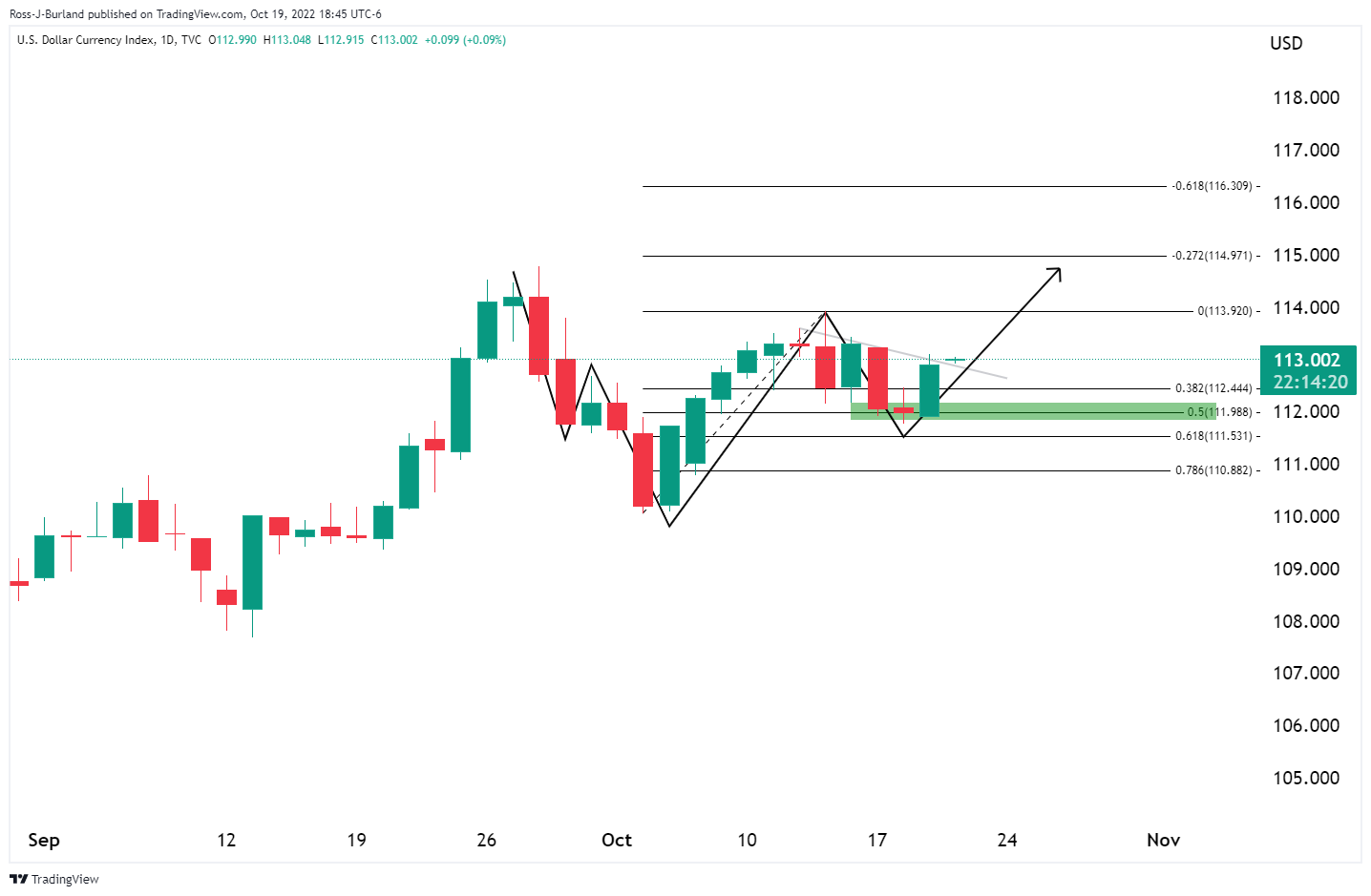
As for the US dollar, it rallied from two-week lows mid-week with a rise in US Treasury yields that made 14-year highs as investors maintained expectations that the Federal Reserve will continue to aggressively raise rates and is now breaking structure on the DXY daily chart as follows:
Author
Ross J Burland
FXStreet
Ross J Burland, born in England, UK, is a sportsman at heart. He played Rugby and Judo for his county, Kent and the South East of England Rugby team.