Euro drops to new three-month lows in the sub-1.0700 area
- The Euro accelerates its losses against the US Dollar.
- Stocks in Europe now trade mostly on the defensive.
- EUR/USD breaks below 1.0700 for the firs time since June.
- The USD Index (DXY) surpasses 105.00 to print fresh six-month tops.
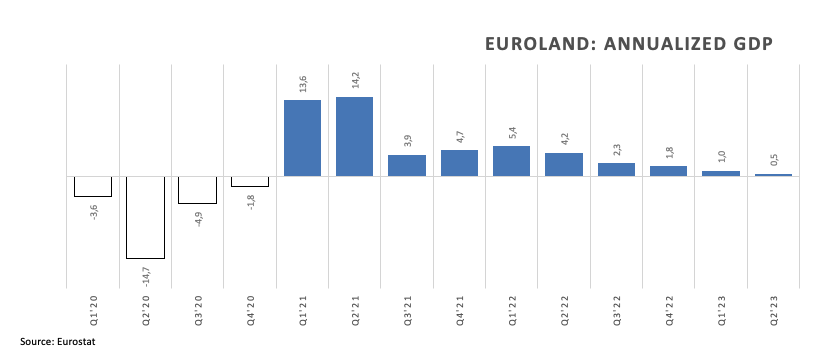
- Another revision saw Q2 Eurozone GDP growth rate lower than estimated.
- Weekly Claims came in below consensus during the past week.

The selling pressure around the Euro (EUR) gathers extra impulse against the US Dollar (USD), forcing EUR/USD to slip back below the 1.0700 key support and print new three-month lows on Thursday.
On the USD-side, the Greenback trades in the area of multi-month peaks north of the 105.00 hurdle when gauged by the USD Index (DXY) amidst the broad-based lack of direction in US yields across different maturities. The latter comes against the backdrop of increasing speculation over rate cuts by the Federal Reserve (Fed) around March 2024 and divided opinions around a potential rate hike in November.
Back to the European Central Bank (ECB), consensus among Board members remains pretty divided regarding the interest rate decision due on September 14.
In the domestic calendar, Industrial Production in Germany contracted 0.8% on month in July, while another revision of the Gross Domestic Product (GDP) growth rate in the eurozone for the April-June period expect the econmy to expand 0.1% inter-quarter and 0.5% over the last twelve months.
In the US, Initial Jobless Claims increased by 216K in the week ended on September 2. Later in the session, speeches by Philadelphia Fed Patrick Harker (voter, hawk), New York Fed John Williams (permanent voter, centrist), Atlanta Fed Raphael Bostic (2024 voter, hawk), and FOMC Governor Michelle Bowman (permanent voter, centrist) are also due.
Daily digest market movers: Euro debilitates further and breaks below 1.0700
- The EUR intensifies the downtrend against the USD.
- US, German yields gives away part of the recent advance.
- Chinese trade surplus shrank in August.
- The ECB’s interest rate decision in September is a close call.
- Markets continue to price in Fed rate cuts in Q2 2024.
- The outlook for the German economy continues to worsen.
- The EMU's economic activity decelerates in the second quarter.
- The US labour market remains tight, as per weekly Claims.
Technical Analysis: Euro could embark on a move to 1.0635
EUR/USD remains well under pressure and finally breaches 1.0700, opening the door at the same time to a potential move to the May low near 1.0630.
If EUR/USD clears Wednesday's low of 1.0702, it could revisit the May 31 low of 1.0635 prior to the March 15 low of 1.0516. The loss of the latter could prompt a potential test of the 2023 low at 1.0481 seen on January 6.
On the upside, spot is expected to target the critical 200-day Simple Moving Average (SMA) at 1.0821. North from here, bulls should meet the the weekly top of 1.0945 (August 30), which appears reinforced by the provisional 55-day SMA at 1.0948 and comes prior to the psychological 1.1000 barrier and the August 10 top at 1.1064. Once the latter is cleared, spot could challenge the July 27 peak at 1.1149. If the pair surpasses this region, it could alleviate some of the downward pressure and potentially visit the 2023 peak of 1.1275 registered on July 18.
A sustained decline is likely in EUR/USD while it remains below the 200-day SMA.
Interest rates FAQs
What are interest rates?
Interest rates are charged by financial institutions on loans to borrowers and are paid as interest to savers and depositors. They are influenced by base lending rates, which are set by central banks in response to changes in the economy. Central banks normally have a mandate to ensure price stability, which in most cases means targeting a core inflation rate of around 2%.
If inflation falls below target the central bank may cut base lending rates, with a view to stimulating lending and boosting the economy. If inflation rises substantially above 2% it normally results in the central bank raising base lending rates in an attempt to lower inflation.
How do interest rates impact currencies?
Higher interest rates generally help strengthen a country’s currency as they make it a more attractive place for global investors to park their money.
How do interest rates influence the price of Gold?
Higher interest rates overall weigh on the price of Gold because they increase the opportunity cost of holding Gold instead of investing in an interest-bearing asset or placing cash in the bank.
If interest rates are high that usually pushes up the price of the US Dollar (USD), and since Gold is priced in Dollars, this has the effect of lowering the price of Gold.
What is the Fed Funds rate?
The Fed funds rate is the overnight rate at which US banks lend to each other. It is the oft-quoted headline rate set by the Federal Reserve at its FOMC meetings. It is set as a range, for example 4.75%-5.00%, though the upper limit (in that case 5.00%) is the quoted figure.
Market expectations for future Fed funds rate are tracked by the CME FedWatch tool, which shapes how many financial markets behave in anticipation of future Federal Reserve monetary policy decisions.
Author
Pablo Piovano
FXStreet
Born and bred in Argentina, Pablo has been carrying on with his passion for FX markets and trading since his first college years.
















