EUR/USD rises on fears of potential US economic turbulence
- EUR/USD rises to near 1.0900 to start the week as investors await the Fed’s monetary policy decision on Wednesday.
- The Fed is widely anticipated to keep interest rates steady as the focus shifts to the dot plot and Powell’s comments.
- Greens’ signal to German debt restructuring deal and optimism over Russia-Ukraine peace could strengthen the Euro.


EUR/USD rises to near 1.0900 in North American trading hours on Monday. The major currency pair gains as the US Dollar (USD) drops as investors turn cautious ahead of the Federal Reserve’s (Fed) interest rate decision, which will be announced on Wednesday. The US Dollar Index (DXY), which tracks the Greenback's value against six major currencies, falls to near 103.50.
The Fed is almost certain to keep interest rates steady in the current range of 4.25%-4.50%. Therefore, the US Dollar’s (USD) outlook will be guided by the Fed’s dot plot, which shows where officials see interest rates heading in the near and longer term, as well as the growth, employment, and inflation outlook in the Summary of Economic Projections (SEP). In the December meeting, Fed policymakers anticipated two interest rate cuts this year.
Investors will also focus on Fed Chair Jerome Powell’s remarks on the US economic outlook in the press conference following the monetary policy decision. A slew of US officials, including President Donald Trump, have stated that tariff policies could lead to some economic shocks in the near term. On Sunday, US Treasury Secretary Scott Bessent said in an interview with NBC News, “I can predict that we are putting in robust policies that will be durable, and could there be an adjustment,” adding that the country needed to be weaned off of “massive government spending.” His comments came after the interviewer asked whether Trump’s agenda could lead the economy to a recession.
Last week, US Commerce Secretary Howard Lutnick said that policies by the President are the most important thing America has ever had, and “they worth it” after being asked whether it would be worth executing Trump’s policies even if they led to a recession. Market participants worry that Trump’s tariff policies could be inflationary and batter households’ consumption. Such a scenario bodes poorly for the US Dollar.
On the economic data front, the US Retail Sales data for February has come in weaker-than-expected. Retail Sales, a key measure of consumer spending rose by 0.2%, lower than estimates of 0.7%. In January, the consumer spending measure declined by 1.2%.
Daily digest market movers: EUR/USD gains despite some weakness in Euro
- EUR/USD moves higher due to significant weakness in the US Dollar (USD). The Euro (EUR) also underperforms despite German leaders, including Franziska Brantner-led-Greens, agreed to set up a 500 billion Euro infrastructure fund and dramatic changes in the borrowing rules or stretch in the so-called ‘debt brake’, which would be approved in the lower house of Parliament on Tuesday.
- Market participants expect the decision of German leaders to boost defense spending through a historic change in the debt brake will prompt economic growth. Ahead of the German leaders meeting on the debt deal, a March 10-14 Reuters poll showed that economists had revised their economic projections for the Eurozone on the optimism over debt reforms to 1.3% for 2026 from 1.2% anticipated a month ago.
- A historic German debt restructuring plan has also increased Eurozone inflation expectations. This scenario is contrary to the European Central Bank’s (ECB) current monetary expansion stance. On Friday, ECB policymaker and Austrian Central Bank Governor Robert Holzmann supported keeping interest rates steady in the April policy meeting. Holzmann's endorsement for a pause in the policy-easing cycle was backed by the assumption that US President Trump’s tariffs and Germany’s defense spending have stemmed risks of a resurge in inflationary pressures.
- Meanwhile, increased hopes of a Russia-Ukraine truce could strengthen the Euro’s appeal. Donald Trump is scheduled to meet Russian leader Vladimir Putin on Tuesday to discuss peace in Ukraine. Last week, Ukraine accepted a 30-day ceasefire deal after discussions with US leaders in Saudi Arabia.
- In the near term, the major risk for the Euro is a potential US-European Union (EU) tariff war. On Thursday, President Trump threatened to impose 200% tariffs on European alcohol after the EU proposed retaliatory tariffs on the US against a 25% blanket levy on steel and aluminum imported by the US. During European trading hours on Monday, ECB Vice President Luis de Guindos said, “Trade war is bad news for the world economy, everyone loses in that situation.”
Euro PRICE Today
The table below shows the percentage change of Euro (EUR) against listed major currencies today. Euro was the strongest against the US Dollar.
| USD | EUR | GBP | JPY | CAD | AUD | NZD | CHF | |
|---|---|---|---|---|---|---|---|---|
| USD | -0.15% | -0.25% | 0.15% | -0.28% | -0.22% | -0.68% | -0.21% | |
| EUR | 0.15% | -0.21% | -0.11% | -0.12% | -0.19% | -0.53% | -0.08% | |
| GBP | 0.25% | 0.21% | 0.43% | -0.12% | 0.00% | -0.33% | 0.07% | |
| JPY | -0.15% | 0.11% | -0.43% | -0.41% | -0.56% | -0.75% | -0.46% | |
| CAD | 0.28% | 0.12% | 0.12% | 0.41% | -0.14% | -0.39% | -0.47% | |
| AUD | 0.22% | 0.19% | -0.01% | 0.56% | 0.14% | -0.31% | 0.14% | |
| NZD | 0.68% | 0.53% | 0.33% | 0.75% | 0.39% | 0.31% | 0.45% | |
| CHF | 0.21% | 0.08% | -0.07% | 0.46% | 0.47% | -0.14% | -0.45% |
The heat map shows percentage changes of major currencies against each other. The base currency is picked from the left column, while the quote currency is picked from the top row. For example, if you pick the Euro from the left column and move along the horizontal line to the US Dollar, the percentage change displayed in the box will represent EUR (base)/USD (quote).
Technical Analysis: EUR/USD rises to near 1.0900
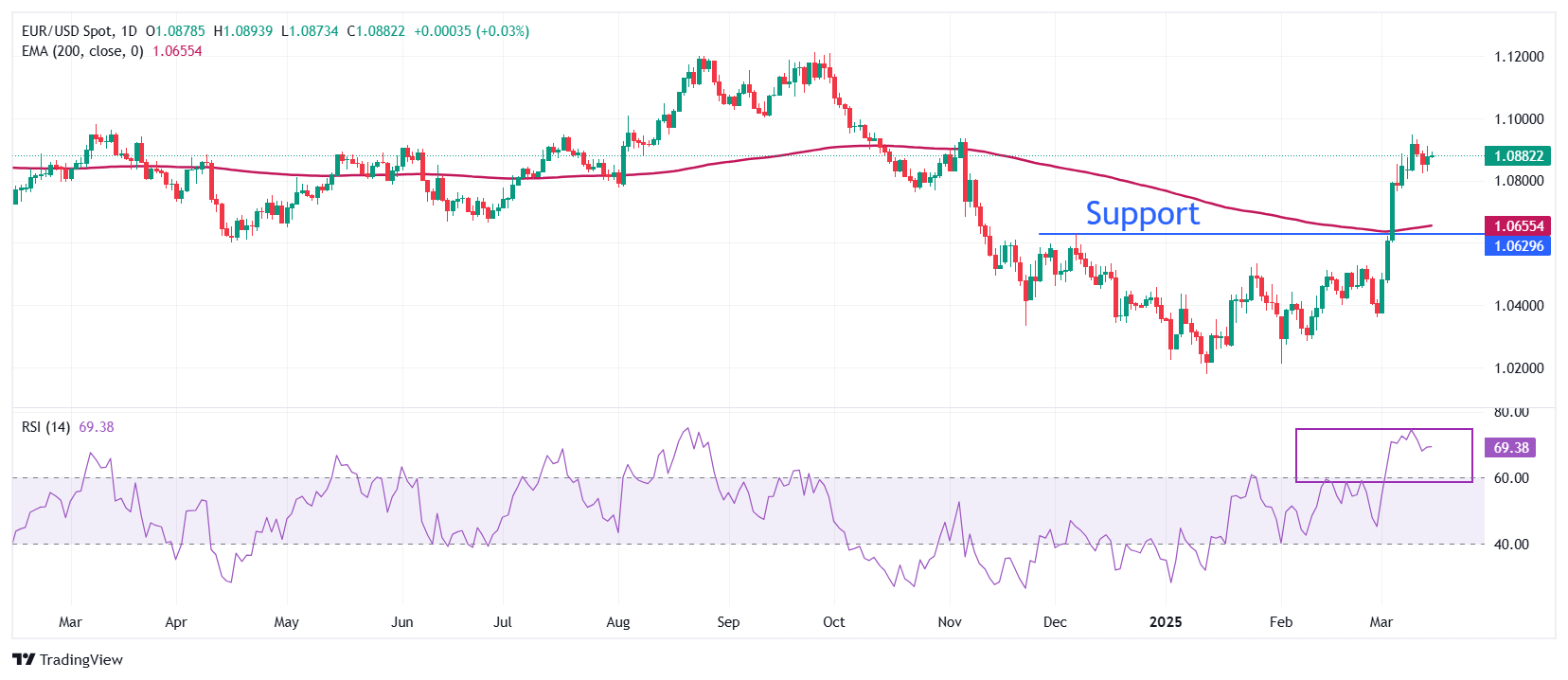
EUR/USD rises to near 1.0900 on Monday. The long-term outlook of the major currency pair remains firm as it holds above the 200-day Exponential Moving Average (EMA), which trades around 1.0655.
The pair strengthened after a decisive breakout above the December 6 high of 1.0630 last week.
The 14-day Relative Strength Index (RSI) wobbles near 70.00, suggesting the strong bullish momentum is intact.
Looking down, the December 6 high of 1.0630 will act as the major support zone for the pair. Conversely, the psychological level of 1.1000 will be a key barrier for the Euro bulls.
Fed FAQs
Monetary policy in the US is shaped by the Federal Reserve (Fed). The Fed has two mandates: to achieve price stability and foster full employment. Its primary tool to achieve these goals is by adjusting interest rates. When prices are rising too quickly and inflation is above the Fed’s 2% target, it raises interest rates, increasing borrowing costs throughout the economy. This results in a stronger US Dollar (USD) as it makes the US a more attractive place for international investors to park their money. When inflation falls below 2% or the Unemployment Rate is too high, the Fed may lower interest rates to encourage borrowing, which weighs on the Greenback.
The Federal Reserve (Fed) holds eight policy meetings a year, where the Federal Open Market Committee (FOMC) assesses economic conditions and makes monetary policy decisions. The FOMC is attended by twelve Fed officials – the seven members of the Board of Governors, the president of the Federal Reserve Bank of New York, and four of the remaining eleven regional Reserve Bank presidents, who serve one-year terms on a rotating basis.
In extreme situations, the Federal Reserve may resort to a policy named Quantitative Easing (QE). QE is the process by which the Fed substantially increases the flow of credit in a stuck financial system. It is a non-standard policy measure used during crises or when inflation is extremely low. It was the Fed’s weapon of choice during the Great Financial Crisis in 2008. It involves the Fed printing more Dollars and using them to buy high grade bonds from financial institutions. QE usually weakens the US Dollar.
Quantitative tightening (QT) is the reverse process of QE, whereby the Federal Reserve stops buying bonds from financial institutions and does not reinvest the principal from the bonds it holds maturing, to purchase new bonds. It is usually positive for the value of the US Dollar.
Author
Sagar Dua
FXStreet
Sagar Dua is associated with the financial markets from his college days. Along with pursuing post-graduation in Commerce in 2014, he started his markets training with chart analysis.