EUR/USD soars ahead of ECB rate call
- EUR/USD scorched the charts on Wednesday, rising 1.75%.
- Markets are tilting into the bullish side ahead of the ECB’s latest rate call.
- Key US NFP figures still loom ahead, but tariff pivots are a welcome relief for markets.


EUR/USD surged on Wednesday, climbing 1.75% and knocking on the 1.0800 handle as risk sentiment rises following yet another pivot from US President Donald Trump on his own tariff strategy. President Trump is once again pumping the brakes on his own trade strategy of threatening to impose stiff import taxes on his own citizens in order to punish other countries for a litany of Donald Trump’s perceived slights.
The European Central Bank (ECB) is set to trim interest rates by another 25 bps on Thursday, taking the Main Refinancing Operations Rate down to 2.65% and dropping its Rate on Deposit Facility to 2.5%. Despite an overall tone of weak or lopsided growth permeating the EU’s economic dataset in the first quarter, rate traders have trimmed their bets of additional ECB rate cuts through the rest of the year as inflation continues to prove to be more of a problem than central planners anticipated. Rate markets now see less than 70 bps in rate cuts for the remainder of 2025.
The US ADP Employment Change for February showed only 77K new jobs, significantly below the forecast of 140K and March’s 186K. Nonetheless, the ADP results have consistently failed to correlate with Nonfarm Payrolls (NFP) since a reporting change in 2022, indicating that the weak performance holds little significance.
Read more:
US White House Press Secretary Leavitt: Trump will give auto industry an extension on tariffs
US President Donald Trump mulls exempting certain agricultural products from Canada, Mexico tariffs
This week, the Trump administration announced a one-month delay on tariffs for the automotive sector, which heavily relies on foreign trade. This exemption was retroactively declared as Trump’s team aims to impose tariffs on trading partners without negatively impacting the US economy.
This Friday’s US Nonfarm Payrolls (NFP) report is the key focus for traders this week. US net job additions are projected to rebound slightly in February to 160K, up from January’s rather unremarkable 143K figure.
EUR/USD price forecast
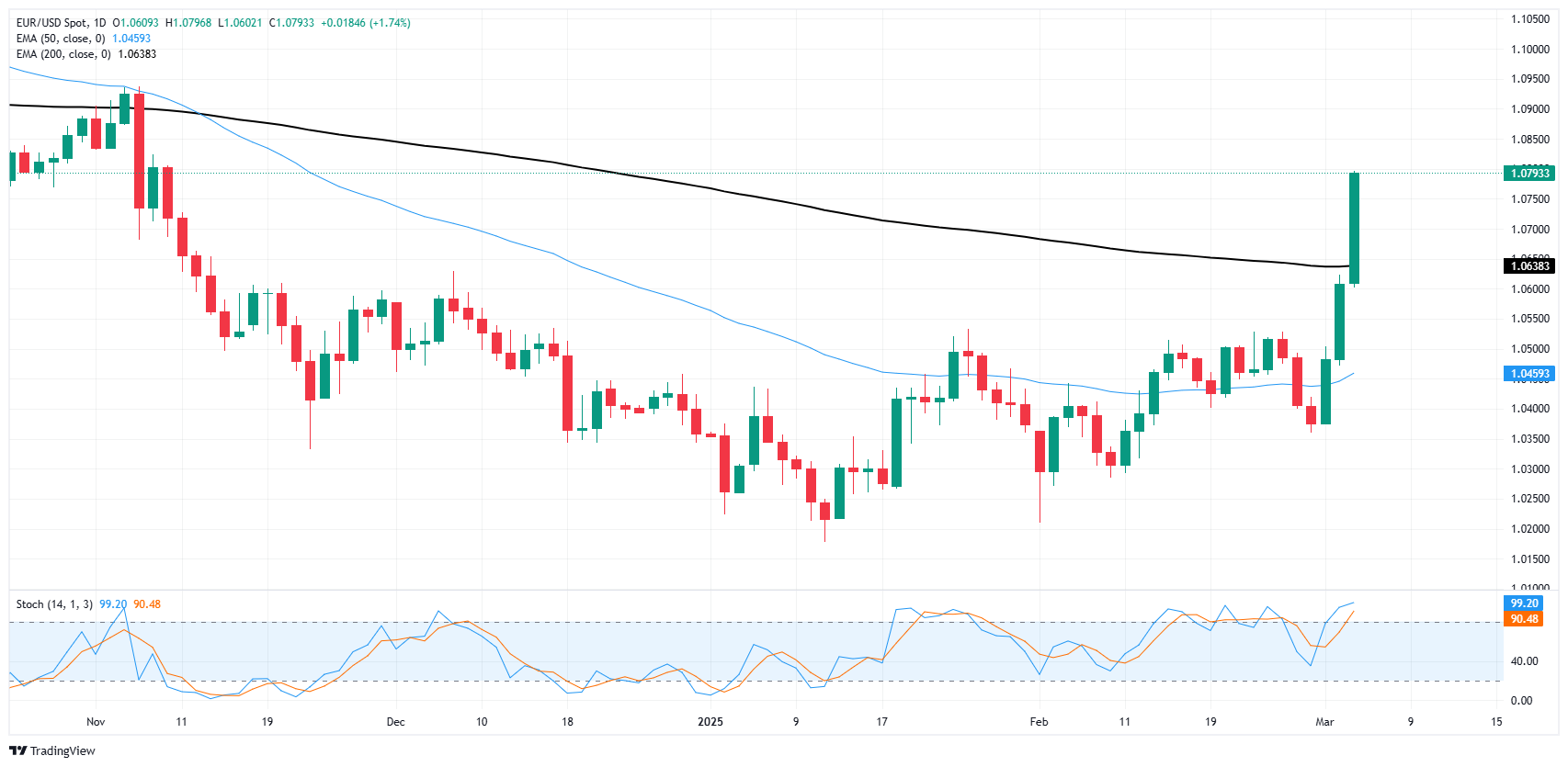
EUR/USD’s Wednesday rally saw Fiber put in its single best trading day in years, rising 185 pips in a single session and rising into touch range of the 1.0800 handle, a price level the pair hasn’t seen since early November 2024. The pair barely noticed the 200-day Exponential Moving Average (EMA) at 1.0640, with EUR/USD crashing through the key moving average on an intraday basis.
EUR/USD has risen 4% in three days, pushing into 17-week highs as price action goes one-sided this week. However, bulls could be poised to get caught with their hands in the cookie jar: technical oscillators remain in overbought territory, and a downside snap could drag bids back to the 200-day EMA before a new bullish trend is able to kickoff in earnest.
EUR/USD daily chart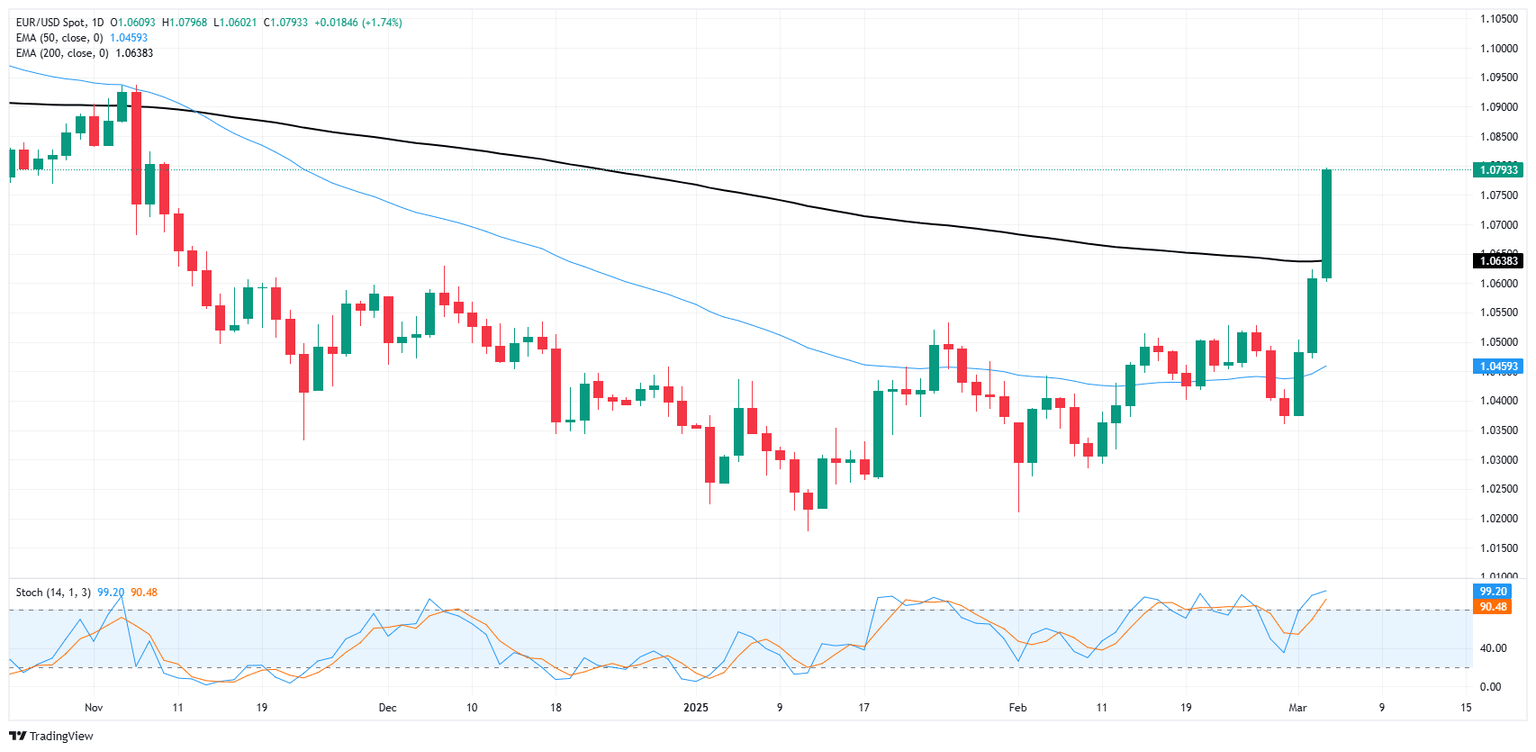
Euro FAQs
The Euro is the currency for the 19 European Union countries that belong to the Eurozone. It is the second most heavily traded currency in the world behind the US Dollar. In 2022, it accounted for 31% of all foreign exchange transactions, with an average daily turnover of over $2.2 trillion a day. EUR/USD is the most heavily traded currency pair in the world, accounting for an estimated 30% off all transactions, followed by EUR/JPY (4%), EUR/GBP (3%) and EUR/AUD (2%).
The European Central Bank (ECB) in Frankfurt, Germany, is the reserve bank for the Eurozone. The ECB sets interest rates and manages monetary policy. The ECB’s primary mandate is to maintain price stability, which means either controlling inflation or stimulating growth. Its primary tool is the raising or lowering of interest rates. Relatively high interest rates – or the expectation of higher rates – will usually benefit the Euro and vice versa. The ECB Governing Council makes monetary policy decisions at meetings held eight times a year. Decisions are made by heads of the Eurozone national banks and six permanent members, including the President of the ECB, Christine Lagarde.
Eurozone inflation data, measured by the Harmonized Index of Consumer Prices (HICP), is an important econometric for the Euro. If inflation rises more than expected, especially if above the ECB’s 2% target, it obliges the ECB to raise interest rates to bring it back under control. Relatively high interest rates compared to its counterparts will usually benefit the Euro, as it makes the region more attractive as a place for global investors to park their money.
Data releases gauge the health of the economy and can impact on the Euro. Indicators such as GDP, Manufacturing and Services PMIs, employment, and consumer sentiment surveys can all influence the direction of the single currency. A strong economy is good for the Euro. Not only does it attract more foreign investment but it may encourage the ECB to put up interest rates, which will directly strengthen the Euro. Otherwise, if economic data is weak, the Euro is likely to fall. Economic data for the four largest economies in the euro area (Germany, France, Italy and Spain) are especially significant, as they account for 75% of the Eurozone’s economy.
Another significant data release for the Euro is the Trade Balance. This indicator measures the difference between what a country earns from its exports and what it spends on imports over a given period. If a country produces highly sought after exports then its currency will gain in value purely from the extra demand created from foreign buyers seeking to purchase these goods. Therefore, a positive net Trade Balance strengthens a currency and vice versa for a negative balance.
Author
Joshua Gibson
FXStreet
Joshua joins the FXStreet team as an Economics and Finance double major from Vancouver Island University with twelve years' experience as an independent trader focusing on technical analysis.