EUR/USD slides lower on diverging interest-rate outlook
- EUR/USD resumes its short-term downtrend, due possibly to diverging commentary from central bankers.
- ECB officials are coming across as more dovish than their Federal Reserve peers.

EUR/USD edges lower on Wednesday on the back of diverging commentary from rate-setters at the US Federal Reserve (Fed) and European Central Bank (ECB).
ECB officials are now indicating a high likelihood the bank will cut interest rates in June, whilst mixed comments from Fed officials suggests a delay from the Fed is still plausible. This is causing weakness for the Euro and depressing EUR/USD, since lower interest rates tends to reduce foreign capital inflows.
EUR/USD falls as ECB language gets more dovish
On Tuesday, ECB Governing Council member Madis Muller said that “we’re closer to a point where the ECB can start cutting rates.”
He added that “data may confirm the inflation trend for the ECB’s June meeting.”
Just prior to his speaking. ECB Governing Council Member Fabio Panetta said that inflation was quickly falling to target and therefore there was a "consensus emerging" for a rate cut. His views were similar to that of the Bank of Greece Governor Yannis Stournaras.
ECB Chief Economist Philip Lane said on Tuesday that wage inflation – a metric the ECB is following very closely to inform its policy – was “on track” to coming back down to normal levels.
These dovish comments follow those from the Bank of France President Francois Villeroy de Galhau, who said April could even be in the frame for a first cut. Taken together with ECB President Christine Lagarde’s comments at the last ECB policy meeting, when she said the ECB would be reviewing policy on interest rates in June, the evidence is building to a compelling conclusion.
Fed looks more split
By contrast, the Federal Reserve seems more split. Whilst Federal Reserve Chairman Jerome Powell seems to continue to advocate for a June rate cut, and the Fed’s official forecast is for three 0.25% cuts to its feds funds rate in 2024, some individual members have diverged from the official script.
On Tuesday, Federal Reserve Bank of Atlanta Governor Raphael Bostic said the Fed should take things slowly and that he now only expected one rate cut in 2024.
His view echoed those of his fellow Fed member of the board of governors Lisa Cook, who advocated for the Fed taking a “careful approach” to easing over time to “ensure inflation returns sustainably to 2.0%.”
She mentioned housing inflation, which remains quite high, though her view was that it would fall on lower rental demand.
On Monday, Chicago Fed President Austan Goolsbee said the persistence of housing inflation continued to surprise him, but that he felt it would ebb away over time.
"The main puzzle has been about housing," Goolsbee said, a major component in the consumer spending basket that has accounted for a large share of recent headline inflation readings, according to Reuters.
In terms of US inflation, Friday’s Core Personal Consumption Expenditures (PCE) Price Index data for February, considered the Fed’s preferred gauge of inflation, is being held up as the next oracular event for determining when the Fed could cut interest rates.
A higher-than-expected inflation reading in line with most recent gauges of inflation in the US could push back further the time when the Fed is expected to cut interest rates, with negative consequences for EUR/USD.
Technical Analysis: EUR/USD resuming downtrend
EUR/USD turned tail at Tuesday’s highs in the 1.0860s and plunged back down, falling in line with the dominant short-term downtrend.
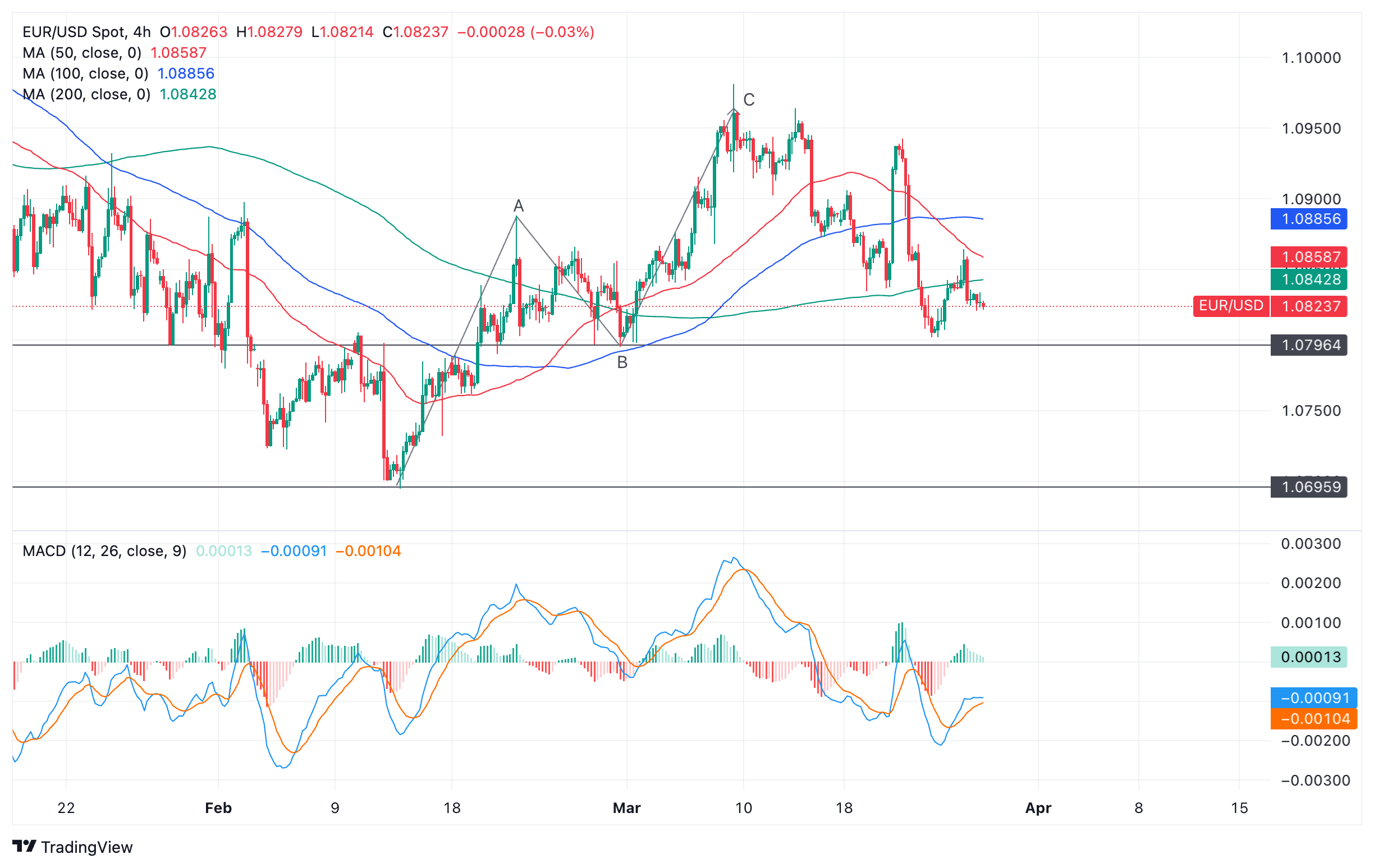
Euro versus US Dollar: 4-hour chart
A decisive break below the B-wave lows at roughly 1.0795 would signal a continuation of the downtrend to the next target at 1.0750 – then the February lows at roughly 1.0700.
A decisive break is one characterized by a long red bearish candle that breaks cleanly through the level and closes near its low, or three down candles in a row that breach the level.
Alternatively, a move above the 1.0950 level would bring into question the validity of the short-term downtrend.
US Dollar FAQs
The US Dollar (USD) is the official currency of the United States of America, and the ‘de facto’ currency of a significant number of other countries where it is found in circulation alongside local notes. It is the most heavily traded currency in the world, accounting for over 88% of all global foreign exchange turnover, or an average of $6.6 trillion in transactions per day, according to data from 2022. Following the second world war, the USD took over from the British Pound as the world’s reserve currency. For most of its history, the US Dollar was backed by Gold, until the Bretton Woods Agreement in 1971 when the Gold Standard went away.
The most important single factor impacting on the value of the US Dollar is monetary policy, which is shaped by the Federal Reserve (Fed). The Fed has two mandates: to achieve price stability (control inflation) and foster full employment. Its primary tool to achieve these two goals is by adjusting interest rates. When prices are rising too quickly and inflation is above the Fed’s 2% target, the Fed will raise rates, which helps the USD value. When inflation falls below 2% or the Unemployment Rate is too high, the Fed may lower interest rates, which weighs on the Greenback.
In extreme situations, the Federal Reserve can also print more Dollars and enact quantitative easing (QE). QE is the process by which the Fed substantially increases the flow of credit in a stuck financial system. It is a non-standard policy measure used when credit has dried up because banks will not lend to each other (out of the fear of counterparty default). It is a last resort when simply lowering interest rates is unlikely to achieve the necessary result. It was the Fed’s weapon of choice to combat the credit crunch that occurred during the Great Financial Crisis in 2008. It involves the Fed printing more Dollars and using them to buy US government bonds predominantly from financial institutions. QE usually leads to a weaker US Dollar.
Quantitative tightening (QT) is the reverse process whereby the Federal Reserve stops buying bonds from financial institutions and does not reinvest the principal from the bonds it holds maturing in new purchases. It is usually positive for the US Dollar.
Author
Joaquin Monfort
FXStreet
Joaquin Monfort is a financial writer and analyst with over 10 years experience writing about financial markets and alt data. He holds a degree in Anthropology from London University and a Diploma in Technical analysis.

















