EUR/USD recovers on weaker US Services PMIs
- EUR/USD rebounds after weaker ISM Services PMI data undermines the US Dollar.
- Services inflation in the US is proving sticky but the PMI’s Prices Paid component showed a fairly steep fall.
- The odds of a June interest-rate cut from the Fed have recovered after the data.


EUR/USD is rebounding and trading back above 1.0800 on Thursday, following the release of lower-than-expected ISM Services PMI data from the US.
The data increases the probability of the Federal Reserve (Fed) cutting interest rates by June, bringing it more in line with the more concrete expectations of when the European Central Bank (ECB) will start cutting rates.
The US Dollar (USD) suffered after the release because relatively lower interest rates or their expectation thereof are usually negative for a currency since they reduce inflows of foreign capital.
EUR/USD: Services inflation not so sticky
EUR/USD rebounded strongly on Wednesday after the release of ISM Services PMI for March undershot expectations. But it was probably the sharper fall in the ISM Services Prices Paid component figure, which measures inflation in the sector, which was the main driver of USD weakness.
Services inflation is considered stickier than other types of inflation and is one of the metrics being most closely watched by the Fed as they try to decide when or whether to cut interest rates.
-638478132076208757.png)
ISM Services Prices Paid: Monthly
The fall in Prices Paid to 53.4 from 58.6 prior, is a sign inflation in the sector is cooling considerably, making it more likely the Fed will cut interest rates by June.
Indeed, this was reflected by the CME FedWatch tool, which gives a market-based probability of future Fed decisions, which is now indicating an over-60% chance of a cut by June, from a probability in the mid-50% range on Monday.
Technical Analysis: EUR/USD threatening to reverse short-term downtrend
EUR/USD extends its recovery from short-term seven-week lows in the 1.0720s on Thursday.
It has now broken above a key resistance level from the swing low at the level of the B wave of the prior ABC pattern, suggesting the recovery is probably more than just a short pullback.
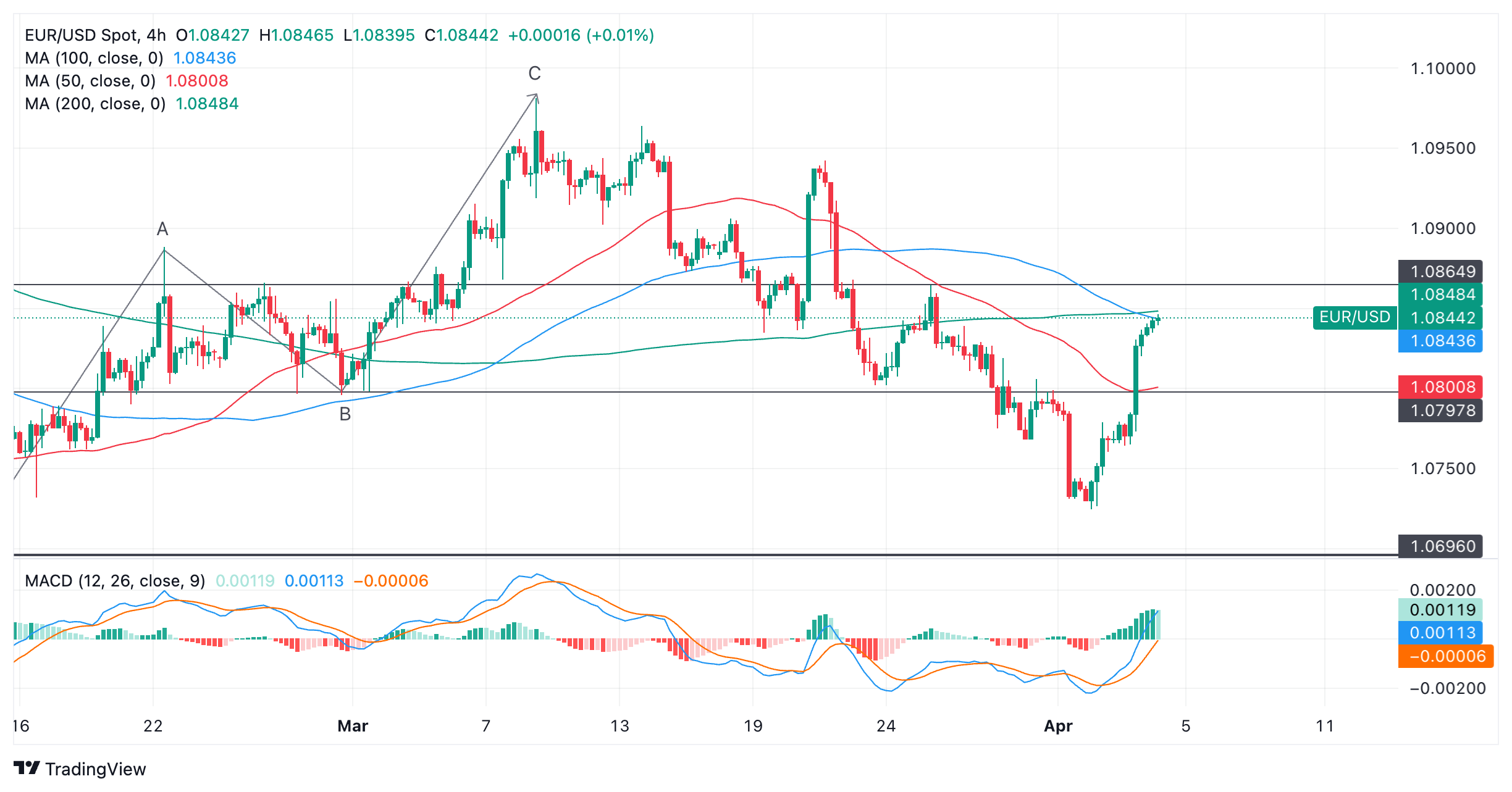
Euro versus US Dollar: 4-hour chart
The established short-term downtrend is in doubt as the peaks and troughs of price start trending higher on the 4-hour chart, which is primarily used to monitor that trend.
If price traces out one more higher low and higher high on the 4-hour timeframe, it will meet the criteria for a new uptrend, and switch the bias towards higher prices.
A break above the key March 26 peak would be a further bullish sign.
Should those criteria be met, the next upside target would be the 1.0940 high of March 21.
However, price is currently encountering substantial dynamic resistance from several major Moving Averages on different timeframes which may make further upside difficult.
As can be seen in the chart above, there are the 4-hour 100 and 200 Simple Moving Averages (SMA), as well as the 50-day and 200-day SMAs on the daily chart (not shown).
There is still, therefore, a risk of some weakness if bears manage to push price down from this confluence of SMAs.
The prior low at 1.0725 is the first downside target, followed by the 1.0694 February and year-to-date low.
Euro FAQs
The Euro is the currency for the 20 European Union countries that belong to the Eurozone. It is the second most heavily traded currency in the world behind the US Dollar. In 2022, it accounted for 31% of all foreign exchange transactions, with an average daily turnover of over $2.2 trillion a day. EUR/USD is the most heavily traded currency pair in the world, accounting for an estimated 30% off all transactions, followed by EUR/JPY (4%), EUR/GBP (3%) and EUR/AUD (2%).
The European Central Bank (ECB) in Frankfurt, Germany, is the reserve bank for the Eurozone. The ECB sets interest rates and manages monetary policy. The ECB’s primary mandate is to maintain price stability, which means either controlling inflation or stimulating growth. Its primary tool is the raising or lowering of interest rates. Relatively high interest rates – or the expectation of higher rates – will usually benefit the Euro and vice versa. The ECB Governing Council makes monetary policy decisions at meetings held eight times a year. Decisions are made by heads of the Eurozone national banks and six permanent members, including the President of the ECB, Christine Lagarde.
Eurozone inflation data, measured by the Harmonized Index of Consumer Prices (HICP), is an important econometric for the Euro. If inflation rises more than expected, especially if above the ECB’s 2% target, it obliges the ECB to raise interest rates to bring it back under control. Relatively high interest rates compared to its counterparts will usually benefit the Euro, as it makes the region more attractive as a place for global investors to park their money.
Data releases gauge the health of the economy and can impact on the Euro. Indicators such as GDP, Manufacturing and Services PMIs, employment, and consumer sentiment surveys can all influence the direction of the single currency. A strong economy is good for the Euro. Not only does it attract more foreign investment but it may encourage the ECB to put up interest rates, which will directly strengthen the Euro. Otherwise, if economic data is weak, the Euro is likely to fall. Economic data for the four largest economies in the euro area (Germany, France, Italy and Spain) are especially significant, as they account for 75% of the Eurozone’s economy.
Another significant data release for the Euro is the Trade Balance. This indicator measures the difference between what a country earns from its exports and what it spends on imports over a given period. If a country produces highly sought after exports then its currency will gain in value purely from the extra demand created from foreign buyers seeking to purchase these goods. Therefore, a positive net Trade Balance strengthens a currency and vice versa for a negative balance.
Author
Joaquin Monfort
FXStreet
Joaquin Monfort is a financial writer and analyst with over 10 years experience writing about financial markets and alt data. He holds a degree in Anthropology from London University and a Diploma in Technical analysis.