EUR/USD rebounds while US Trump’s tariffs threats keep investors on toes
- EUR/USD recovers some of its intraday losses and rebounds to near 1.0300 but renewed fears of US President Trump’s tariffs keep the outlook uncertain.
- US President Trump is poised to impose 25% tariffs on all aluminum and steel imports.
- Investors await Fed Powell’s testimony on Tuesday and Wednesday.


EUR/USD recovers to near 1.0300 after a weak opening around 1.0280 in Monday’s North American session but is still 0.17% down, at the press time. The major currency opened on a weak note as investors rushed to the safe-haven fleet on renewed United States (US) President Donald Trump’s tariff fears. The US Dollar Index (DXY), which tracks the Greenback’s value against six major currencies, surrenders some of its intraday gains but is 0.2% higher near 108.30. The USD Index is expected to remain firm amid renewed risks of a potential global trade war.
Over the weekend, President Trump threatened to raise 25% tariffs on imports of steel and aluminum, as well as reciprocal tariffs on those nations where he saw unfair trade practices. The biggest casualty of Trump’s decision of 25% tariffs on metals is expected to be Canada, the largest exporter of aluminum to the US. The pressure of higher levies on metals will also be borne by Mexico, Brazil, Vietnam, and South Korea, leading exporters to the US.
The impact of reciprocal tariffs is expected to be lethal on the Eurozone, which charges 10% tariffs on automobile imports from the US and pays 2.5% import duty for domestic autos supplied to it. Such a scenario will be unfavorable for the Euro (EUR), which is already vulnerable due to growing economic contraction risks and inflation undershooting the European Central Bank’s (ECB) target of 2%.
Last week, analysts at Macquarie warned that a US tariff bomb would likely find “fertile ground in the EU,” escalating unresolved issues rapidly into trade tensions, given that “Europe is target-rich”.
The ECB is about to continue reducing interest rates, and a few policymakers have also warned that the central bank might need to go below the neutral rate as the Eurozone economy is not strong enough to support inflation at 2%.
Economists at the ECB have predicted that the bank's so-called neutral rate will probably be between 1.75% and 2.25%.
On the economic data front, Eurozone Sentix Investor Confidence improves to -12.7 from -17.7 in February. The sentiment data indicates the market opinion of about the current economic situation and the expectations for the next semester.
Daily digest market movers: EUR/USD recovers as USD gives up some gains
- EUR/USD bounces back as the US Dollar (USD) surrenders some of its intraday gains. However, the outlook of the US Dollar remains firm growing expectations that the Federal Reserve (Fed) will keep interest rates in the current range of 4.25%-4.50% for the entire year.
- Strategists at Macquarie said, "Our updated view is for no change in the fed funds rate during 2025, with it likely to remain in the 4.25 to 4.5% range. Previously we had suggested there would be just one further 25 bps cut in either March or May." Analysts have revised their expectations for the Fed’s monetary policy outlook after the release of the upbeat US Nonfarm Payrolls (NFP) report for January.
- The US NFP report showed that the economy added 143K jobs in January, fewer than 307K in December, which were revised higher from 256K. Analysts at Macquarie argued that upward revisions to recent payroll months point to an even "steeper trend acceleration".
- Meanwhile, the Unemployment Rate decreased to 4% from the estimates and the prior release of 4.1%. Average Hourly Earnings surprisingly accelerated to 4.1% on the year and rose at a robust pace of 0.5% on the month.
- This week, the major trigger for the US Dollar will be the Consumer Price Index (CPI) data for January, which will be released on Wednesday. Investors will also pay close attention to Fed Chair Jerome Powell’s testimony before the Congress on Tuesday and Wednesday.
Technical Analysis: EUR/USD returns to near 1.0300
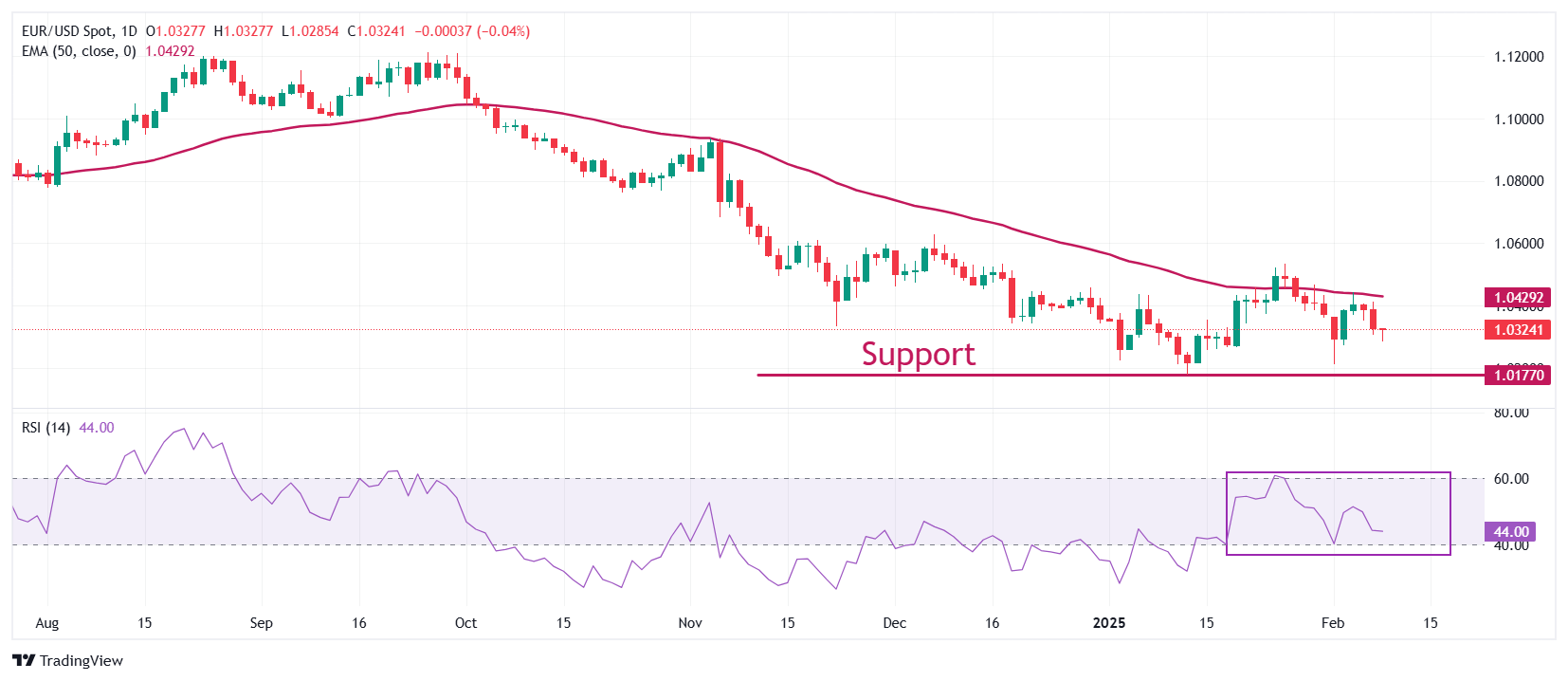
EUR/USD recovers to near 1.0300 in North American trading hours on Monday. However, the outlook of the major currency pair remains uncertain as it continues to face pressure near the 50-day Exponential Moving Average (EMA) around 1.0436 from the last week.
The 14-day Relative Strength Index (RSI) oscillates in the 40.00-60.00 range, indicating a short-term sideways trend.
Looking down, the January 13 low of 1.0177 and the round-level support of 1.0100 will act as major support zones for the pair. Conversely, the psychological resistance of 1.0500 will be the key barrier for the Euro bulls.
Tariffs FAQs
Tariffs are customs duties levied on certain merchandise imports or a category of products. Tariffs are designed to help local producers and manufacturers be more competitive in the market by providing a price advantage over similar goods that can be imported. Tariffs are widely used as tools of protectionism, along with trade barriers and import quotas.
Although tariffs and taxes both generate government revenue to fund public goods and services, they have several distinctions. Tariffs are prepaid at the port of entry, while taxes are paid at the time of purchase. Taxes are imposed on individual taxpayers and businesses, while tariffs are paid by importers.
There are two schools of thought among economists regarding the usage of tariffs. While some argue that tariffs are necessary to protect domestic industries and address trade imbalances, others see them as a harmful tool that could potentially drive prices higher over the long term and lead to a damaging trade war by encouraging tit-for-tat tariffs.
During the run-up to the presidential election in November 2024, Donald Trump made it clear that he intends to use tariffs to support the US economy and American producers. In 2024, Mexico, China and Canada accounted for 42% of total US imports. In this period, Mexico stood out as the top exporter with $466.6 billion, according to the US Census Bureau. Hence, Trump wants to focus on these three nations when imposing tariffs. He also plans to use the revenue generated through tariffs to lower personal income taxes.
Author
Sagar Dua
FXStreet
Sagar Dua is associated with the financial markets from his college days. Along with pursuing post-graduation in Commerce in 2014, he started his markets training with chart analysis.