EUR/USD rebounds as Trump's tariffs agenda seems less disruptive
- EUR/USD finds support below 1.0800 as the US Dollar struggles to extend upside amid easing fears of impending tariffs by the US on April 2.
- Preliminary US S&P Global Services PMI gained significantly in March.
- The ECB is expected to cut interest rates again in April.


EUR/USD finds cushion around 1.0780 and rises to near 1.0825 during North American trading hours on Tuesday. The major currency pair attracts bids as the US Dollar (USD) drops on the narrower-than-feared tariff agenda of United States (US) President Donald Trump. The US Dollar Index (DXY), which tracks the Greenback's value against six major currencies, falls to near 104.00 from an over two-week high of 104.50.
US President Trump signaled to reporters at the White House on Monday that not all tariffs will be implemented on April 2. Trump said that some countries could get exempted from additional import duties. Market participants have taken Trump’s comments as positive for risky assets, expecting that the impact of a limited trade war would be lower globally than initially feared. Trump also reiterated that he will announce tariffs on automobiles, aluminum and pharmaceuticals soon.
On Monday, the US Dollar strengthened after the release of the upbeat preliminary S&P Global Services Purchasing Managers Index (PMI) data for March. The agency reported that robust services sector activity offset the impact of an unexpected decline in the manufacturing sector and resulted in a sharp increase in the Composite PMI. The Services PMI rose to 54.3, significantly higher than the 51.0 recorded in February. Economists expected a mild increase in the service sector activity to 51.2. The services sector is the backbone of the US economy, given that it accounts for roughly two-thirds of the economy.
Meanwhile, accelerating consumer inflation expectations due to Trump’s trade policies have also strengthened the US Dollar. On Monday, Atlanta Fed Bank President Raphael Bostic said in an interview with Bloomberg that he expects “only one interest rate cut this year” as he sees a slowdown in the progress in the disinflation trend towards the 2% target, assuming that businesses will bear the burden of tariffs. Collectively, Federal Reserve (Fed) officials see two interest rate cuts this year, as shown by the dot plot in the Summary of Economic Projections of the March policy meeting.
US Dollar PRICE Today
The table below shows the percentage change of US Dollar (USD) against listed major currencies today. US Dollar was the strongest against the Canadian Dollar.
| USD | EUR | GBP | JPY | CAD | AUD | NZD | CHF | |
|---|---|---|---|---|---|---|---|---|
| USD | -0.11% | -0.19% | -0.60% | -0.08% | -0.46% | -0.17% | -0.23% | |
| EUR | 0.11% | -0.09% | -0.49% | 0.02% | -0.32% | -0.07% | -0.13% | |
| GBP | 0.19% | 0.09% | -0.43% | 0.11% | -0.23% | 0.02% | -0.08% | |
| JPY | 0.60% | 0.49% | 0.43% | 0.52% | 0.18% | 0.42% | 0.36% | |
| CAD | 0.08% | -0.02% | -0.11% | -0.52% | -0.33% | -0.11% | -0.19% | |
| AUD | 0.46% | 0.32% | 0.23% | -0.18% | 0.33% | 0.25% | 0.19% | |
| NZD | 0.17% | 0.07% | -0.02% | -0.42% | 0.11% | -0.25% | -0.10% | |
| CHF | 0.23% | 0.13% | 0.08% | -0.36% | 0.19% | -0.19% | 0.10% |
The heat map shows percentage changes of major currencies against each other. The base currency is picked from the left column, while the quote currency is picked from the top row. For example, if you pick the US Dollar from the left column and move along the horizontal line to the Japanese Yen, the percentage change displayed in the box will represent USD (base)/JPY (quote).
Daily digest market movers: EUR/USD rebounds while Euro trades with caution
- EUR/USD rises even though the Euro (EUR) trades cautiously across the board on expectations that the European Central Bank (ECB) could reduce interest rates again in April. The ECB has cut its key borrowing rates six times since June and expects to win the battle against inflation this year.
- Last week, ECB President Christine Lagarde said while testifying before the European Parliament Committee that the inflationary impact of the Trump-led trade war is temporary as the effect would “ease in the medium term” due to “lower economic activity dampening inflationary pressures”.
- Lately, traders have pared ECB dovish bets on expectations that the tariff war between the US and the Eurozone could lead to an increase in inflationary pressures in the old continent for a longer period.
- On the economic front, German IFO Business Climate data for March, an early indicator of current conditions and business expectations, has come in higher at 86.7 from the prior reading of 85.3 but missed estimates of 86.8. The Expectations component – which presents outlook for the next six months – increased to 87.7 from the prior release of 85.6. It also missed the expectations of 87.9. IFO Current Assessment data came in at 85.7, beating estimates of 85.5 and the former reading of 85.0.
Technical Analysis: EUR/USD stays above 200-day EMA
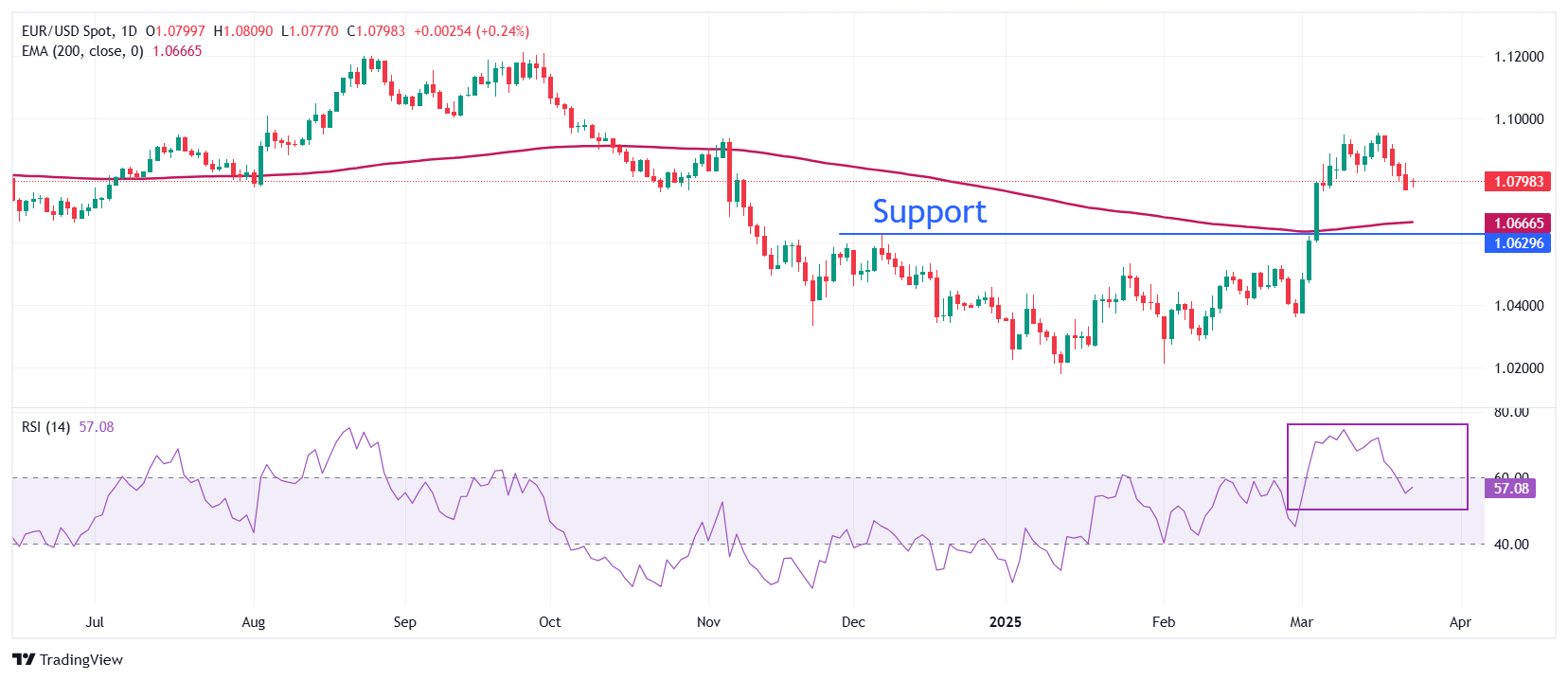
EUR/USD rebounds from 1.0785 at the time of writing on Tuesday. The major currency pair corrected from the five-month high of 1.0955 last week. However, the long-term outlook of the major currency pair is still bullish as it holds above the 200-day Exponential Moving Average (EMA), which trades around 1.0666.
The 14-day Relative Strength Index (RSI) cools down below 60.00, suggesting that the bullish momentum is over, but the upside bias is intact.
Looking down, the December 6 high of 1.0630 will act as the major support zone for the pair. Conversely, the psychological level of 1.1000 will be the key barrier for the Euro bulls.
ECB FAQs
The European Central Bank (ECB) in Frankfurt, Germany, is the reserve bank for the Eurozone. The ECB sets interest rates and manages monetary policy for the region. The ECB primary mandate is to maintain price stability, which means keeping inflation at around 2%. Its primary tool for achieving this is by raising or lowering interest rates. Relatively high interest rates will usually result in a stronger Euro and vice versa. The ECB Governing Council makes monetary policy decisions at meetings held eight times a year. Decisions are made by heads of the Eurozone national banks and six permanent members, including the President of the ECB, Christine Lagarde.
In extreme situations, the European Central Bank can enact a policy tool called Quantitative Easing. QE is the process by which the ECB prints Euros and uses them to buy assets – usually government or corporate bonds – from banks and other financial institutions. QE usually results in a weaker Euro. QE is a last resort when simply lowering interest rates is unlikely to achieve the objective of price stability. The ECB used it during the Great Financial Crisis in 2009-11, in 2015 when inflation remained stubbornly low, as well as during the covid pandemic.
Quantitative tightening (QT) is the reverse of QE. It is undertaken after QE when an economic recovery is underway and inflation starts rising. Whilst in QE the European Central Bank (ECB) purchases government and corporate bonds from financial institutions to provide them with liquidity, in QT the ECB stops buying more bonds, and stops reinvesting the principal maturing on the bonds it already holds. It is usually positive (or bullish) for the Euro.
Author
Sagar Dua
FXStreet
Sagar Dua is associated with the financial markets from his college days. Along with pursuing post-graduation in Commerce in 2014, he started his markets training with chart analysis.

















