EUR/USD Price Forecast: The first upside barrier emerges above 1.1200, eyes on the overbought condition
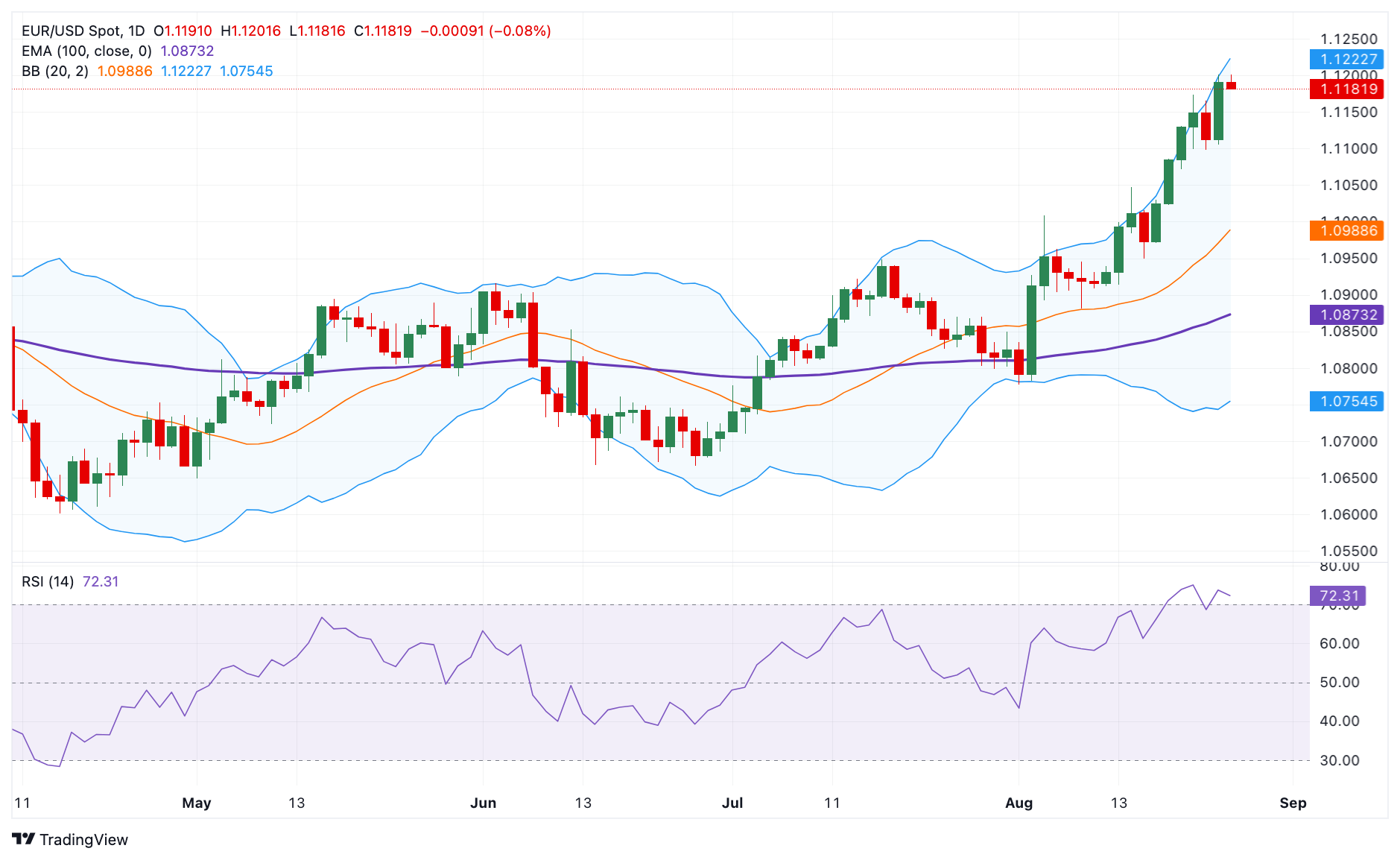
- EUR/USD drifts lower to near 1.1185 in Monday’s early European session.
- Constructive bias of the pair prevails above the 100-day EMA, but the overbought RSI condition might cap its upside.
- The immediate resistance level emerges at 1.1223; the key support level to watch is the 1.1100 round figure.

The EUR/USD pair weakens near 1.1185 during the early European session on Monday. The modest recovery of the US Dollar (USD) drags the major pair lower. However, the downside of EUR/USD might be limited as US Federal Reserve (Fed) Chair Powell gave a clear signal for a rate cut in September.
According to the daily chart, EUR/USD keeps the bullish vibe unchanged as the major pair holds above the key 100-day Exponential Moving Averages (EMA). The 14-day Relative Strength Index (RSI) stands above the midline near 72.70, indicating the overbought RSI condition. This suggests that further consolidation cannot be ruled out before positioning for any near-term EUR/USD appreciation.
The first upside barrier for the major pair emerges at 1.1223, the upper boundary of the Bollinger Band. Further north, the next hurdle is seen at 1.1275 (high of July 18) en route to 1.1360 (high of December 16). The additional upside filter to watch is 1.1483 (high of January 14).
On the downside, the crucial support level is located at the 1.1100 psychological level. A breach of this level will see a drop to 1.0940 (high of July 18), followed by 1.0873 (the 100-day EMA).
EUR/USD daily chart
Euro FAQs
The Euro is the currency for the 20 European Union countries that belong to the Eurozone. It is the second most heavily traded currency in the world behind the US Dollar. In 2022, it accounted for 31% of all foreign exchange transactions, with an average daily turnover of over $2.2 trillion a day. EUR/USD is the most heavily traded currency pair in the world, accounting for an estimated 30% off all transactions, followed by EUR/JPY (4%), EUR/GBP (3%) and EUR/AUD (2%).
The European Central Bank (ECB) in Frankfurt, Germany, is the reserve bank for the Eurozone. The ECB sets interest rates and manages monetary policy. The ECB’s primary mandate is to maintain price stability, which means either controlling inflation or stimulating growth. Its primary tool is the raising or lowering of interest rates. Relatively high interest rates – or the expectation of higher rates – will usually benefit the Euro and vice versa. The ECB Governing Council makes monetary policy decisions at meetings held eight times a year. Decisions are made by heads of the Eurozone national banks and six permanent members, including the President of the ECB, Christine Lagarde.
Eurozone inflation data, measured by the Harmonized Index of Consumer Prices (HICP), is an important econometric for the Euro. If inflation rises more than expected, especially if above the ECB’s 2% target, it obliges the ECB to raise interest rates to bring it back under control. Relatively high interest rates compared to its counterparts will usually benefit the Euro, as it makes the region more attractive as a place for global investors to park their money.
Data releases gauge the health of the economy and can impact on the Euro. Indicators such as GDP, Manufacturing and Services PMIs, employment, and consumer sentiment surveys can all influence the direction of the single currency. A strong economy is good for the Euro. Not only does it attract more foreign investment but it may encourage the ECB to put up interest rates, which will directly strengthen the Euro. Otherwise, if economic data is weak, the Euro is likely to fall. Economic data for the four largest economies in the euro area (Germany, France, Italy and Spain) are especially significant, as they account for 75% of the Eurozone’s economy.
Another significant data release for the Euro is the Trade Balance. This indicator measures the difference between what a country earns from its exports and what it spends on imports over a given period. If a country produces highly sought after exports then its currency will gain in value purely from the extra demand created from foreign buyers seeking to purchase these goods. Therefore, a positive net Trade Balance strengthens a currency and vice versa for a negative balance.
Author
Lallalit Srijandorn
FXStreet
Lallalit Srijandorn is a Parisian at heart. She has lived in France since 2019 and now becomes a digital entrepreneur based in Paris and Bangkok.