EUR/USD gains ground as markets look higher
- EUR/USD gained 0.5% after Greenback flows eased back on Tuesday.
- European economic data remains thin, and Fed Chair Powell sold a steady rate plan.
- US CPI and PPI inflation figures are due through the midweek sessions.


EUR/USD snapped a three-day losing streak, recovering ground and rebounding to just north of 1.0350 as broad-market flows reversed out of the safe haven Greenback and investor sentiment broadly rebounded. Investors are shrugging off US President Donald Trump’s latest tariff threats, and Federal Reserve (Fed) Chair Jerome Powell reiterated the Fed’s dedication to following a data-dependent approach in the face of volatile, inconsistent trade policy messaging from the Trump administration.
- Jerome Powell Testimony: Will commit to following data on tariff effects
- Fed's Williams: US should grow by 2% in 2025, 2026
- Fed’s Hammack: Likely appropriate to hold rates steady for some time
European data releases are overall tepid this week. German final Harmonized Index of Consumer Prices for the year ended January are due on Thursday, alongside pan-EU Gross Domestic Product figures for the fourth quarter slated for Friday. Neither datapoint is expected to move the needle very much, as neither figure is a preliminary print and European data tends to be well-forecast and priced in ahead of the release schedule.
Forex Today: Key US CPI takes centre stage amid a cautious Fed
US Consumer Price Index (CPI) inflation will be the dominant print on Wednesday. Headline US CPI inflation is expected to hold at 2.9% YoY, while core CPI inflation is forecast to tick down to 3.1% versus the last print of 3.2%. US Producer Price Index (PPI) inflation follows up on Thursday, with core PPI business-level inflation expected to cool slightly to 3.3% YoY from 3.5%.
EUR/USD price forecast
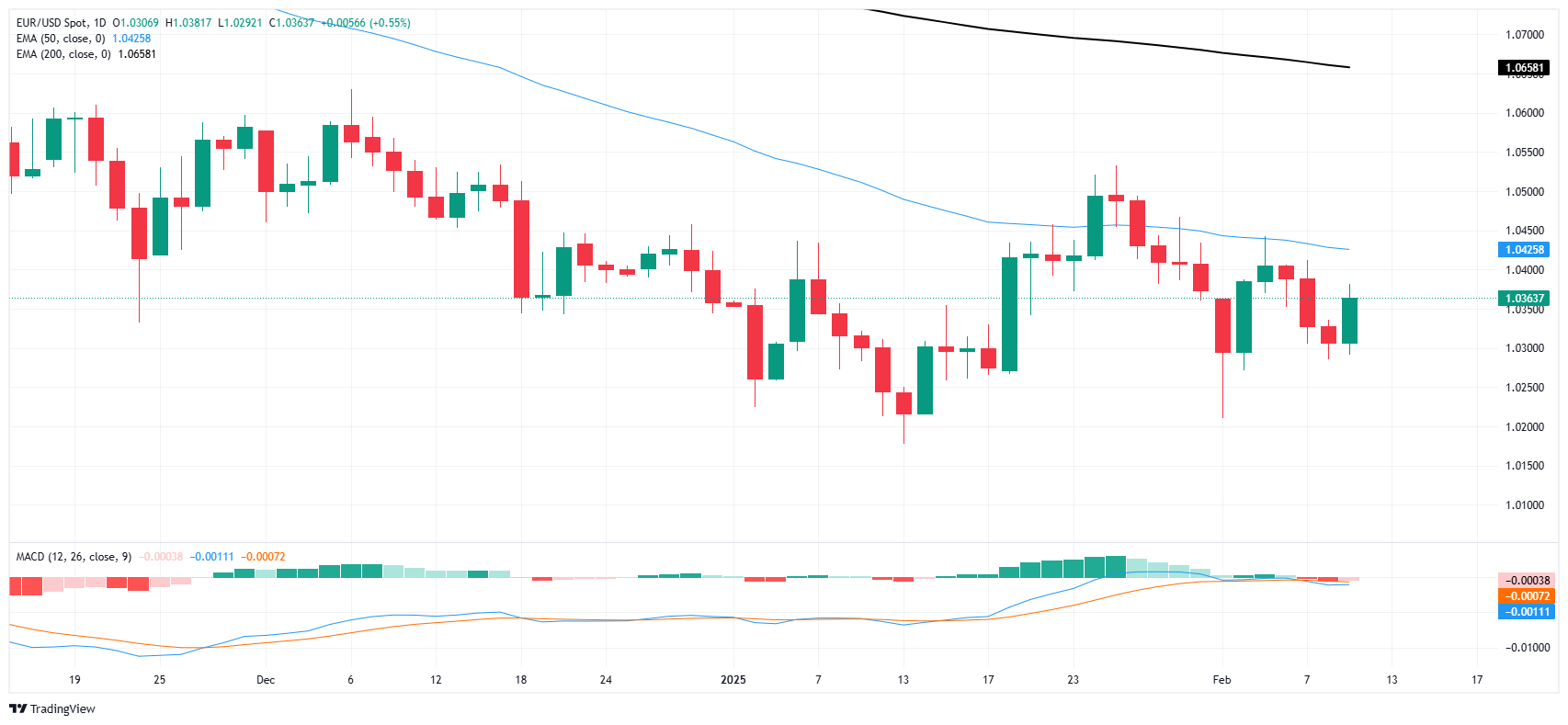
EUR/USD traders found the buy button and bolstered the pair back above the 1.0350 level on Tuesday. Fiber broke out of a three-day down streak. Still, momentum remains limited, and the pair continues to trade into a familiar congestion zone just below the 50-day Exponential Moving Average (EMA) near 1.0430.
EUR/USD daily chart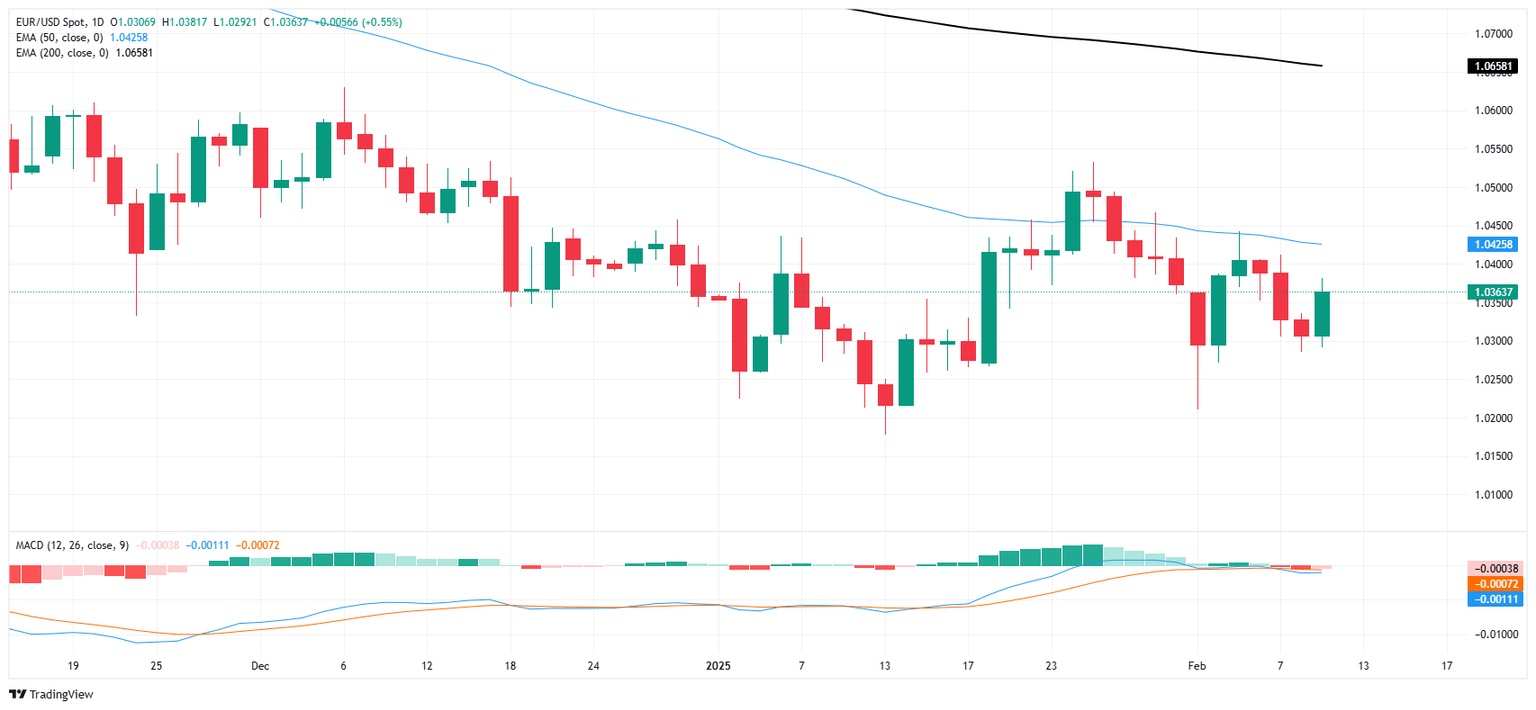
Euro FAQs
The Euro is the currency for the 19 European Union countries that belong to the Eurozone. It is the second most heavily traded currency in the world behind the US Dollar. In 2022, it accounted for 31% of all foreign exchange transactions, with an average daily turnover of over $2.2 trillion a day. EUR/USD is the most heavily traded currency pair in the world, accounting for an estimated 30% off all transactions, followed by EUR/JPY (4%), EUR/GBP (3%) and EUR/AUD (2%).
The European Central Bank (ECB) in Frankfurt, Germany, is the reserve bank for the Eurozone. The ECB sets interest rates and manages monetary policy. The ECB’s primary mandate is to maintain price stability, which means either controlling inflation or stimulating growth. Its primary tool is the raising or lowering of interest rates. Relatively high interest rates – or the expectation of higher rates – will usually benefit the Euro and vice versa. The ECB Governing Council makes monetary policy decisions at meetings held eight times a year. Decisions are made by heads of the Eurozone national banks and six permanent members, including the President of the ECB, Christine Lagarde.
Eurozone inflation data, measured by the Harmonized Index of Consumer Prices (HICP), is an important econometric for the Euro. If inflation rises more than expected, especially if above the ECB’s 2% target, it obliges the ECB to raise interest rates to bring it back under control. Relatively high interest rates compared to its counterparts will usually benefit the Euro, as it makes the region more attractive as a place for global investors to park their money.
Data releases gauge the health of the economy and can impact on the Euro. Indicators such as GDP, Manufacturing and Services PMIs, employment, and consumer sentiment surveys can all influence the direction of the single currency. A strong economy is good for the Euro. Not only does it attract more foreign investment but it may encourage the ECB to put up interest rates, which will directly strengthen the Euro. Otherwise, if economic data is weak, the Euro is likely to fall. Economic data for the four largest economies in the euro area (Germany, France, Italy and Spain) are especially significant, as they account for 75% of the Eurozone’s economy.
Another significant data release for the Euro is the Trade Balance. This indicator measures the difference between what a country earns from its exports and what it spends on imports over a given period. If a country produces highly sought after exports then its currency will gain in value purely from the extra demand created from foreign buyers seeking to purchase these goods. Therefore, a positive net Trade Balance strengthens a currency and vice versa for a negative balance.
Author
Joshua Gibson
FXStreet
Joshua joins the FXStreet team as an Economics and Finance double major from Vancouver Island University with twelve years' experience as an independent trader focusing on technical analysis.