EUR/USD dips post US Nonfarm Payrolls report
- A robust US Nonfarm Payrolls report for March propels the Greenback higher, impacting the EUR/USD.
- The Eurozone's mixed economic indicators, including Germany's Factory Orders and Retail Sales, contrast with the strong US employment landscape.
- Further downside seen at EUR/USD as technical suggests potential for declines below the 1.0800 threshold.


The Euro registers minimal losses of 0.13% following the release of a stronger-than-expected jobs report from the United States (US) that boosted the Greenback, sending the EUR/USD lower. At the time of writing, the pair trades at 1.0822 after hitting a daily high of 1.0847.
EUR/USD slides as upbeat US labor market data fuels US Dollar rally
On Friday, the US Bureau of Labor Statistics (BLS) revealed that the economy added more jobs than expected. Nonfarm Payrolls for March rose by 303K, crushing estimates and previous readings of 200K and 270K. Further data showed the Unemployment Rate ticking lower from 3.9% to 3.8%, while Average Hourly Earnings were aligned to the consensus.
After the data, the Greenback strengthens as the US Dollar Index (DXY) rises 0.155%, up at 04.36. US Treasury bond yields are climbing between 4.5 and 5 basis points. The US 10-year Treasury note rate is at 4.365%.
Elsewhere, the Richmond Fed President Thomas Barkin commented the rpoert was quite strong, adding that the reduction in inflation has been uneven. Earlier. Fed’s Boston Susan Collins made comments but not on monetary policy.
Across the pond, Factory Orders in Germany improved in February, to 0.2%, improving from January’s -1.4% plunge. Moreover, Retail Sales from the Eurozone (EU) dived -0.5% MoM, worse than the estimated -0.4% contraction.
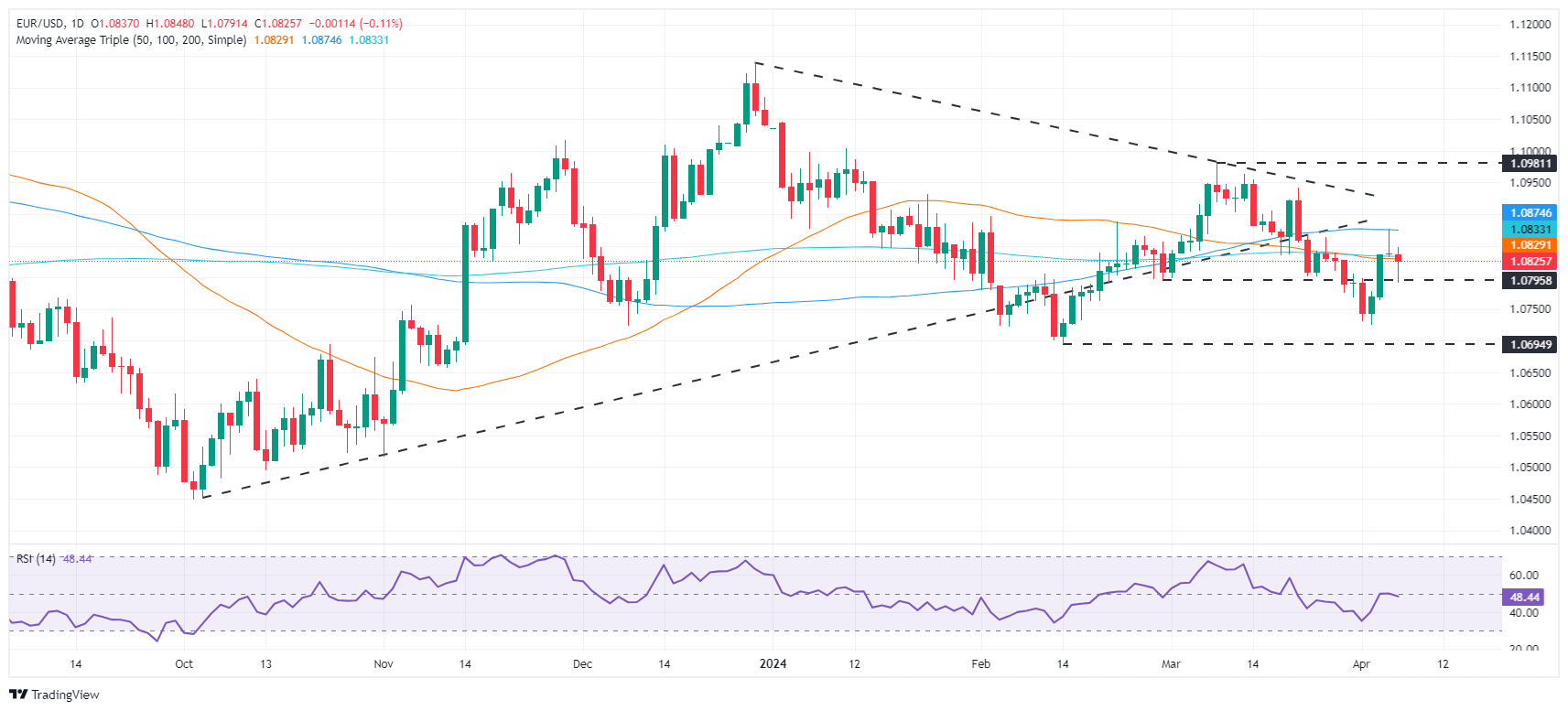
Given those factors, the EUR/USD retreated below the 200-day moving average (DMA). Traders' focus shifts to next week's data, with the release of US inflation data and consumer sentiment. On the EU’s front, the European Central Bank (ECB) will feature its monetary policy meeting, which will be the highlight of the week.
EUR/USD Price Analysis: Technical outlook
The formation of an ‘evening star’ chart pattern could pave the way for a drop below the 1.0800 figure. Momentum in the EUR/USD is tilted to the downside as the Relative Strength Index (RSI) aims lower and beneath the 50-midline level. A breach below 1.0800 will expose the April 2 low of 1.0724, ahead of 1.0700. On the other hand, buyers will face stirring resistance at the confluence of the 50 and 200-DMAs at around 1.0828/32.
Euro FAQs
The Euro is the currency for the 20 European Union countries that belong to the Eurozone. It is the second most heavily traded currency in the world behind the US Dollar. In 2022, it accounted for 31% of all foreign exchange transactions, with an average daily turnover of over $2.2 trillion a day. EUR/USD is the most heavily traded currency pair in the world, accounting for an estimated 30% off all transactions, followed by EUR/JPY (4%), EUR/GBP (3%) and EUR/AUD (2%).
The European Central Bank (ECB) in Frankfurt, Germany, is the reserve bank for the Eurozone. The ECB sets interest rates and manages monetary policy. The ECB’s primary mandate is to maintain price stability, which means either controlling inflation or stimulating growth. Its primary tool is the raising or lowering of interest rates. Relatively high interest rates – or the expectation of higher rates – will usually benefit the Euro and vice versa. The ECB Governing Council makes monetary policy decisions at meetings held eight times a year. Decisions are made by heads of the Eurozone national banks and six permanent members, including the President of the ECB, Christine Lagarde.
Eurozone inflation data, measured by the Harmonized Index of Consumer Prices (HICP), is an important econometric for the Euro. If inflation rises more than expected, especially if above the ECB’s 2% target, it obliges the ECB to raise interest rates to bring it back under control. Relatively high interest rates compared to its counterparts will usually benefit the Euro, as it makes the region more attractive as a place for global investors to park their money.
Data releases gauge the health of the economy and can impact on the Euro. Indicators such as GDP, Manufacturing and Services PMIs, employment, and consumer sentiment surveys can all influence the direction of the single currency. A strong economy is good for the Euro. Not only does it attract more foreign investment but it may encourage the ECB to put up interest rates, which will directly strengthen the Euro. Otherwise, if economic data is weak, the Euro is likely to fall. Economic data for the four largest economies in the euro area (Germany, France, Italy and Spain) are especially significant, as they account for 75% of the Eurozone’s economy.
Another significant data release for the Euro is the Trade Balance. This indicator measures the difference between what a country earns from its exports and what it spends on imports over a given period. If a country produces highly sought after exports then its currency will gain in value purely from the extra demand created from foreign buyers seeking to purchase these goods. Therefore, a positive net Trade Balance strengthens a currency and vice versa for a negative balance.
Author
Christian Borjon Valencia
FXStreet
Markets analyst, news editor, and trading instructor with over 14 years of experience across FX, commodities, US equity indices, and global macro markets.