EUR/USD surrenders gains after firm preliminary Eurozone/US PMI data
- EUR/USD holds above 1.0800 after strong preliminary Eurozone/US PMI data.
- The ECB is anticipated to reduce interest rates three times by the year-end.
- The US Dollar outlook is still suspicious on firm Fed rate-cut prospects for September.


EUR/USD surrenders the majority of intraday gains in Thursday’s American session. The major currency pair drops from the intraday high of 1.0860 after the S&P Global published a strong preliminary United States (US) Purchasing Managers Index (PMI) report for May. The agency showed that Manufacturing PMI rose to 50.9, beating expectations and the prior reading of 50.0. The Services PMI that represents the services sector, which accounts for two-thirds of the US economy, jumps to 54.8 from the estimates and the former reading of 51.3.
Strong US PMI readings suggest a strong US economic outlook that indicates strong labor demand and robust consumer spending. The agency commented, "The US economic upturn has accelerated again after two months of slower growth, with the early PMI data signalling the fastest expansion for just over two years in May. The data put the US economy back on course for another solid GDP gain in the second quarter.
The US Dollar Index (DXY), which tracks the US Dollar’s value against six major currencies, recovers its entire intraday losses and jumps to near 104.90. However, the near-term outlook is still uncertain as investors remain confident that the Federal Reserve (Fed) will start reducing interest rates from the September meeting.
Traders didn’t pare bets supporting Fed rate cuts in September despite hawkish commentary on the interest rate outlook by Fed officials indicated by the Federal Open Market Committee (FOMC) minutes for the May meeting, which was released on Wednesday.
The impact of the FOMC minutes was expected to be temporary on the US Dollar as officials were worried about stalling progress in the disinflation process on the basis of three hot inflation readings of the January-March period. While investors’ firm speculation on rate cuts in September is built on an expected decline in the inflation data indicated by the Consumer Price Index (CPI) report of April.
Meanwhile, the US Department of Labor has reported that the number of individuals claiming jobless benefits for the first time was lower than expected in the week ending May 17. Initial Jobless Claims were recorded at 215K, fewer than the consensus of 220K and the prior reading of 223K, upwardly revised from 222 K.
Daily digest market movers: EUR/USD grinds between strong Eurozone/US preliminary PMI
- EUR/USD gives up the majority of gains that were inspired by strong Eurozone HCOB preliminary PMI numbers for May. The agency reported that the Manufacturing PMI rose at a faster pace to 47.4, from the estimates of 46.2 and the prior reading of 45.7. However, a figure below the 50.0 threshold is considered as contraction. The Composite PMI jumps to 52.3, beats the consensus of 52.0 and the former release of 51.7. The Services PMI that represents the service sector grew steadily by 53.3 but missed expectations of 53.5.
- Dr. Cyrus de la Rubia, Chief Economist at Hamburg Commercial Bank (HCB) commented on flash PMI data, “We are heading in the right direction. Considering the PMI numbers in our GDP nowcast, the Eurozone will probably grow at a rate of 0.3% during the second quarter, putting aside the spectre of recession. Growth is mainly driven by the service sector whose expansion was extended to four months. Manufacturing acts less and less as a stumbling block for the economy and optimism about future output has increased further in this sector. With all this in place it seems plausible that GDP growth of almost 1% could be reached this year, and there is even some upward risk.
- Going forward, the Euro will be guided by market expectations about the European Central Bank (ECB) reducing interest rates in the July meeting. The ECB is widely anticipated to start lowering key borrowing rate from the June meeting. Therefore, investors remain uncertain over subsequent rate cuts by the ECB.
- Many ECB policymakers want to remain data-dependent for follow-up rate-cut move in July as an aggressive monetary policy easing could revamp price pressures again. Also, ECB policymakers worry that follow-up rate cuts could impact the balance between monetary stimulus, inflation and other financial triggers.
- For the full year, financial markets anticipate that the ECB will cut interest rates three times. Leading financial services provider UBS said that according to their baseline scenario, after the initial cut in June, the ECB may embark on a prolonged and incremental sequence of rate reductions. These would consist of 25 basis point cuts each quarter, leading to a total decrease of 75 basis points in 2024 and an additional 100 basis points in 2025.
Technical Analysis: EUR/USD remains firm above triangle breakout region
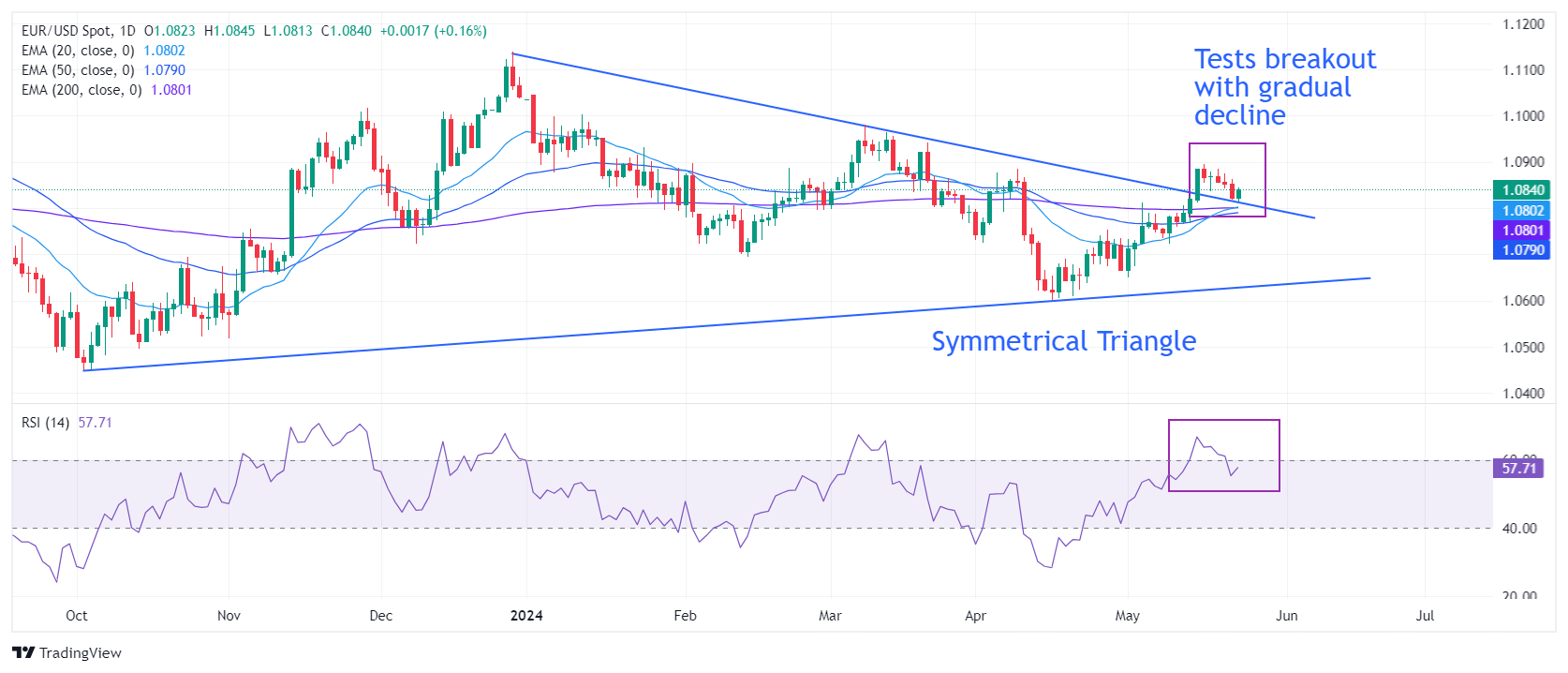
EUR/USD witnesses a stellar buying interest after testing the breakout region of the Symmetrical Triangle formed on a daily timeframe near the crucial support of 1.0800. The near-term outlook of the shared currency pair remains firm as the 20-and 50-day Exponential Moving Averages (EMAs) have delivered a bullish crossover around 1.0780.
The 14-period Relative Strength Index (RSI) has shifted comfortably into the bullish range of 60.00-80.00, suggesting that the momentum has leaned toward the upside.
The major currency pair is expected to recapture two-month high around 1.0900. A decisive break above the same will drive the asset towards March 21 high around 1.0950 and the psychological resistance of 1.1000. However, a downside move by the major below the 200-day EMA at 1.0800 could push it inside the woods.
Economic Indicator
S&P Global Composite PMI
The S&P Global Composite Purchasing Managers Index (PMI), released on a monthly basis, is a leading indicator gauging US private-business activity in the manufacturing and services sector. The data is derived from surveys to senior executives. Each response is weighted according to the size of the company and its contribution to total manufacturing or services output accounted for by the sub-sector to which that company belongs. Survey responses reflect the change, if any, in the current month compared to the previous month and can anticipate changing trends in official data series such as Gross Domestic Product (GDP), industrial production, employment and inflation. The index varies between 0 and 100, with levels of 50.0 signaling no change over the previous month. A reading above 50 indicates that the private economy is generally expanding, a bullish sign for the US Dollar (USD). Meanwhile, a reading below 50 signals that activity is generally declining, which is seen as bearish for USD.
Read more.Last release: Thu May 23, 2024 13:45 (Prel)
Frequency: Monthly
Actual: 54.4
Consensus: 51.1
Previous: 51.3
Source: S&P Global
Author
Sagar Dua
FXStreet
Sagar Dua is associated with the financial markets from his college days. Along with pursuing post-graduation in Commerce in 2014, he started his markets training with chart analysis.