EUR/USD declines as Fed moderates dovish stance
- EUR/USD declines as the US Dollar bounces back on expectations that the Fed will deliver fewer interest rate cuts in 2025
- The Fed sees fewer interest rate cuts in 2025 as the disinflation process stalls and amid increasing uncertainty over Trump’s policies.
- ECB Lagarde is confident that inflation will sustainably return to the bank's target of 2% sooner.

EUR/USD sustains below 1.0400 in Monday's North American session as the US Dollar (USD) bounces back on Monday after a sharp sell-off on Friday. The US Dollar Index (DXY), which tracks the Greenback’s value against six major currencies, climbs to near 108.20. The Greenback gains as Federal Reserve (Fed) policymakers see the central bank delivering fewer interest rate cuts next year amid a slowdown in the disinflation process and the uncertainty over the impact on the economy of incoming immigration, trade, and tax policies by President-elect Donald Trump.
Cleveland Fed President Beth Hammack, the only official who voted for leaving interest rates unchanged in the policy meeting last Wednesday, said on Friday that she prefers to hold interest rates steady "until the Fed gets further evidence that inflation is resuming its path to its 2% objective,” Reuters reported.
On Friday, Chicago Fed President Austan Goolsbee told in an interview with CNBC that the uncertainty over Trump’s policies after taking office compelled him to project fewer interest rate cuts for 2025 while he had previously anticipated a 100-basis points (bps) interest rate reduction.
The sell-off in the US Dollar on Friday was triggered by slower-than-expected growth in the United States (US) Personal Consumption Expenditure Price Index (PCE). Core PCE inflation, which is the Federal Reserve’s (Fed) preferred inflation gauge, rose steadily by 2.8% but slower than estimates of 2.9%. Month-on-month, headline, and core PCE inflation grew marginally by 0.1%, which raised some uncertainty over whether the Fed will follow a shallow rate-cut path in 2025.
On the economic front, the US Durable Goods Orders data for November have come in weaker than projected. Fresh Durable Goods Orders declined by 1.1%, faster than estimates of 0.4%. In October, fresh orders for durable goods rose by 0.8%, upwardly revised from 0.2%.
Daily digest market movers: EUR/USD weakens as ECB Lagarde sees inflation sustainably returning to 2% in near term
- EUR/USD falls sharply after failing to extend its upside above Friday's high of 1.0445 in Monday's North American session. The major currency pair declines amid Euro’s (EUR) underperformance as European Central Bank (ECB) President Christine Lagarde said she remains confident about further progress in disinflation in an interview with the Financial Times (FT) published Monday. “We're getting very close to that stage when we can declare that we have sustainably brought inflation to our medium-term 2%”, Lagarde said.
- The ECB has cut its Deposit Facility rate by 100 bps this year and is expected to deliver another 100-bps interest rate reduction next year amid deepening Eurozone economic risks and inflation remaining under control.
- Almost all ECB policymakers have agreed to market expectations for a consistent reduction in interest rates until it reaches 2%, which they see as a neutral rate to avoid risks of inflation undershooting the bank’s target of 2%.
Euro PRICE Today
The table below shows the percentage change of Euro (EUR) against listed major currencies today. Euro was the strongest against the Swiss Franc.
| USD | EUR | GBP | JPY | CAD | AUD | NZD | CHF | |
|---|---|---|---|---|---|---|---|---|
| USD | 0.35% | 0.15% | 0.27% | 0.19% | -0.06% | 0.05% | 0.34% | |
| EUR | -0.35% | -0.22% | -0.15% | -0.18% | -0.34% | -0.32% | -0.02% | |
| GBP | -0.15% | 0.22% | 0.02% | 0.05% | -0.12% | -0.09% | 0.22% | |
| JPY | -0.27% | 0.15% | -0.02% | -0.02% | -0.25% | -0.18% | 0.08% | |
| CAD | -0.19% | 0.18% | -0.05% | 0.02% | -0.20% | -0.14% | 0.16% | |
| AUD | 0.06% | 0.34% | 0.12% | 0.25% | 0.20% | 0.03% | 0.33% | |
| NZD | -0.05% | 0.32% | 0.09% | 0.18% | 0.14% | -0.03% | 0.26% | |
| CHF | -0.34% | 0.02% | -0.22% | -0.08% | -0.16% | -0.33% | -0.26% |
The heat map shows percentage changes of major currencies against each other. The base currency is picked from the left column, while the quote currency is picked from the top row. For example, if you pick the Euro from the left column and move along the horizontal line to the US Dollar, the percentage change displayed in the box will represent EUR (base)/USD (quote).
Technical Analysis: EUR/USD drops from the intraday high of 1.0440
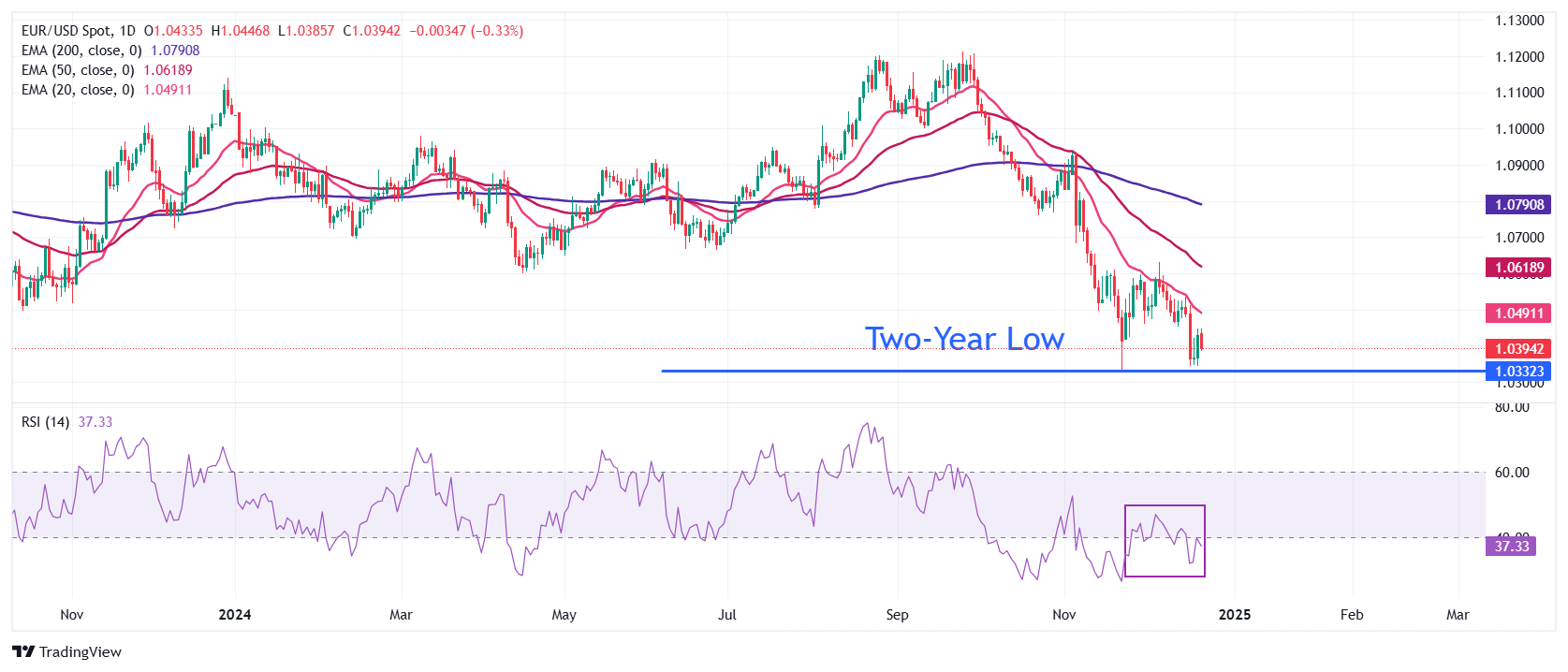
EUR/USD drops from the key resistance of 1.0440 but still holds the major support of 1.0350. The outlook of the major currency pair remains strongly bearish as all short-to-long-term Exponential Moving Averages (EMAs) are declining.
The 14-day Relative Strength Index (RSI) oscillates in the bearish range of 20.00-40.00. indicating a downside momentum.
Looking down, the asset could decline to near the round-level support of 1.0200 after breaking below the two-year low of 1.0330. Conversely, the 20-day EMA near 1.0500 will be the key barrier for the Euro bulls.
ECB FAQs
The European Central Bank (ECB) in Frankfurt, Germany, is the reserve bank for the Eurozone. The ECB sets interest rates and manages monetary policy for the region. The ECB primary mandate is to maintain price stability, which means keeping inflation at around 2%. Its primary tool for achieving this is by raising or lowering interest rates. Relatively high interest rates will usually result in a stronger Euro and vice versa. The ECB Governing Council makes monetary policy decisions at meetings held eight times a year. Decisions are made by heads of the Eurozone national banks and six permanent members, including the President of the ECB, Christine Lagarde.
In extreme situations, the European Central Bank can enact a policy tool called Quantitative Easing. QE is the process by which the ECB prints Euros and uses them to buy assets – usually government or corporate bonds – from banks and other financial institutions. QE usually results in a weaker Euro. QE is a last resort when simply lowering interest rates is unlikely to achieve the objective of price stability. The ECB used it during the Great Financial Crisis in 2009-11, in 2015 when inflation remained stubbornly low, as well as during the covid pandemic.
Quantitative tightening (QT) is the reverse of QE. It is undertaken after QE when an economic recovery is underway and inflation starts rising. Whilst in QE the European Central Bank (ECB) purchases government and corporate bonds from financial institutions to provide them with liquidity, in QT the ECB stops buying more bonds, and stops reinvesting the principal maturing on the bonds it already holds. It is usually positive (or bullish) for the Euro.
Author
Sagar Dua
FXStreet
Sagar Dua is associated with the financial markets from his college days. Along with pursuing post-graduation in Commerce in 2014, he started his markets training with chart analysis.