EUR/USD extends gains to near 1.0780 amid a stable US Dollar
- EUR/USD gains ground for the fourth successive session on Monday.
- European share markets ease after recording gains in the previous week, weighing on the Euro.
- Mary C. Daly, President of the San Francisco Fed suggested that three rate cuts are a reasonable baseline for 2024.
- The US Fed is expected to refrain from rate cuts in both March and May.

The EUR/USD pair continues its upward momentum for the fourth consecutive session on Monday, with the US Dollar (USD) remaining subdued amid light trading due to the Presidents’ Day holiday in the United States (US). Despite the improved US Producer Price Index (PPI) strengthening the Greenback against the Euro (EUR) on Friday, the EUR/USD pair still closed the session with gains.
European money markets edge lower after registering gains in the previous week, which could weigh on the Euro. However, Asian markets are higher, possibly driven by expectations that major central banks will refrain from further interest rate hikes. Additionally, European Central Bank (ECB) Governing Council member Francois Villeroy de Galhau mentioned that there are several reasons why they should not delay the first rate cut.
The US Dollar Index (DXY) continues its decline after dovish remarks from Mary C. Daly, President of the San Francisco Federal Reserve (Fed) on Friday. Speaking at the Annual National Association for Business Economics Economic Policy Conference, Daly suggested that three rate cuts are a reasonable baseline for 2024. She emphasized that it's premature to consider allowing the economy to run without intervention. These comments led to a weakening of US Treasury yields, consequently putting pressure on the US Dollar.
Daily digest market movers: EUR/USD gains ground on subdued US Dollar
- Former Fed official James Bullard's suggestion that the Fed should contemplate lowering interest rates at the March meeting to prevent hindering economic activity due to higher rates is influencing market sentiment.
- Market sentiment suggests that the US Federal Reserve is likely to abstain from rate cuts in both March and May. According to the CME FedWatch Tool, there is approximately a 52% probability of a 25 basis points (bps) rate cut in June.
- US Producer Price Index (PPI) demonstrated an annual growth rate of 0.9%, against the anticipated 0.6% and the prior figure of 1.0%. Additionally, there was a month-over-month PPI improvement of 0.3%, contrasting with the previous decline of 0.1%.
- US Core Producer Price Index (YoY) increased by 2.0%, exceeding the expected 1.6% and the previous 1.7%. Similarly, the Core PPI (MoM) data reported a 0.5% rise, compared to the predicted 0.1% increase from the prior decline of 0.1%.
- The preliminary Michigan Consumer Sentiment Index improved to 79.6 from the previous figure of 79.0, falling short of the anticipated 80.0.
- Christine Lagarde, the President of the European Central Bank (ECB), stated last week that recent data indicates ongoing subdued economic activity in the near term. While the current disinflationary trend is anticipated to persist, Lagarde emphasized the importance of ensuring confidence that this trajectory will ultimately lead to the sustainable achievement of the ECB's 2% inflation target.
Technical Analysis: EUR/USD faces a barrier at 1.0800 aligned with previous week’s high
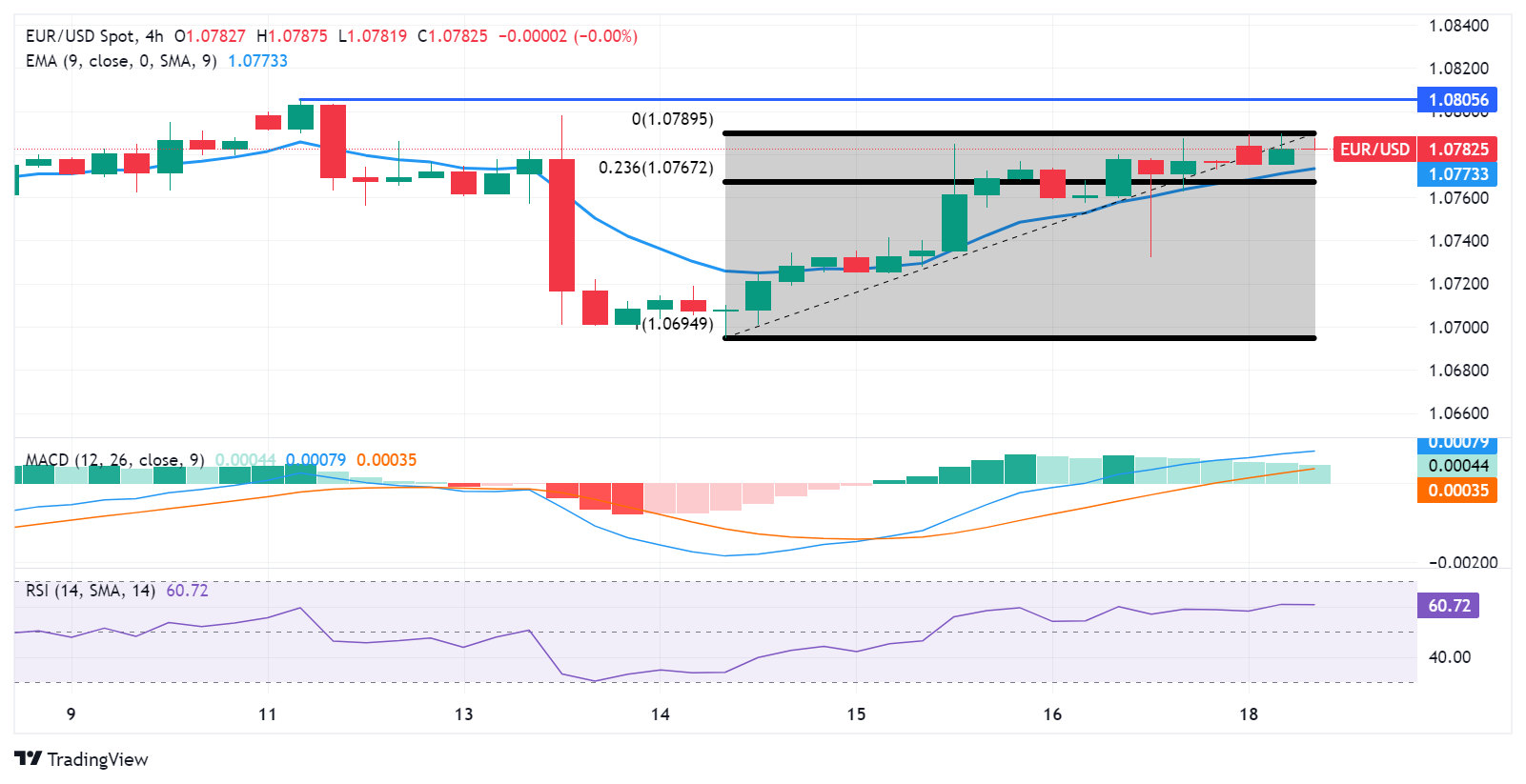
EUR/USD trades near 1.0780 on Monday, which is located below the psychological resistance level of 1.0800. A break above this psychological barrier could exert upward support for the EUR/USD pair to revisit the previous week’s high at 1.0805.
On the downside, the EUR/USD pair could find the key support region around the nine-4hour Exponential Moving Average (EMA) at 1.0773 and 23.6% Fibonacci retracement level at 1.0767. A break below this region could push the pair to test the major support of 1.0750 following the psychological level of 1.0700.
In technical analysis, the EUR/USD pair exhibits a 14-4hour Relative Strength Index (RSI) above the 50 mark, indicating bullish sentiment. Furthermore, the Moving Average Convergence Divergence (MACD) is situated above both the centerline and shows a divergence above the signal line, suggesting a confirmation of the bullish momentum.
EUR/USD: Four-Hour Chart
Euro price today
The table below shows the percentage change of Euro (EUR) against listed major currencies today. Euro was the strongest against the US Dollar.
| USD | EUR | GBP | CAD | AUD | JPY | NZD | CHF | |
| USD | 0.05% | -0.05% | -0.04% | 0.00% | -0.08% | -0.09% | -0.05% | |
| EUR | -0.05% | -0.09% | -0.10% | -0.08% | -0.14% | -0.15% | -0.10% | |
| GBP | 0.04% | 0.10% | 0.00% | 0.01% | -0.04% | -0.05% | -0.01% | |
| CAD | 0.04% | 0.08% | -0.01% | 0.03% | -0.05% | -0.05% | -0.01% | |
| AUD | 0.02% | 0.07% | -0.02% | -0.02% | -0.05% | -0.07% | -0.01% | |
| JPY | 0.09% | 0.13% | 0.06% | 0.05% | 0.05% | 0.00% | 0.04% | |
| NZD | 0.09% | 0.15% | 0.05% | 0.06% | 0.06% | 0.00% | 0.06% | |
| CHF | 0.04% | 0.10% | 0.01% | 0.01% | 0.01% | -0.05% | -0.04% |
The heat map shows percentage changes of major currencies against each other. The base currency is picked from the left column, while the quote currency is picked from the top row. For example, if you pick the Euro from the left column and move along the horizontal line to the Japanese Yen, the percentage change displayed in the box will represent EUR (base)/JPY (quote).
Euro FAQs
What is the Euro?
The Euro is the currency for the 20 European Union countries that belong to the Eurozone. It is the second most heavily traded currency in the world behind the US Dollar. In 2022, it accounted for 31% of all foreign exchange transactions, with an average daily turnover of over $2.2 trillion a day.
EUR/USD is the most heavily traded currency pair in the world, accounting for an estimated 30% off all transactions, followed by EUR/JPY (4%), EUR/GBP (3%) and EUR/AUD (2%).
What is the ECB and how does it impact the Euro?
The European Central Bank (ECB) in Frankfurt, Germany, is the reserve bank for the Eurozone. The ECB sets interest rates and manages monetary policy.
The ECB’s primary mandate is to maintain price stability, which means either controlling inflation or stimulating growth. Its primary tool is the raising or lowering of interest rates. Relatively high interest rates – or the expectation of higher rates – will usually benefit the Euro and vice versa.
The ECB Governing Council makes monetary policy decisions at meetings held eight times a year. Decisions are made by heads of the Eurozone national banks and six permanent members, including the President of the ECB, Christine Lagarde.
How does inflation data impact the value of the Euro?
Eurozone inflation data, measured by the Harmonized Index of Consumer Prices (HICP), is an important econometric for the Euro. If inflation rises more than expected, especially if above the ECB’s 2% target, it obliges the ECB to raise interest rates to bring it back under control.
Relatively high interest rates compared to its counterparts will usually benefit the Euro, as it makes the region more attractive as a place for global investors to park their money.
How does economic data influence the value of the Euro?
Data releases gauge the health of the economy and can impact on the Euro. Indicators such as GDP, Manufacturing and Services PMIs, employment, and consumer sentiment surveys can all influence the direction of the single currency.
A strong economy is good for the Euro. Not only does it attract more foreign investment but it may encourage the ECB to put up interest rates, which will directly strengthen the Euro. Otherwise, if economic data is weak, the Euro is likely to fall.
Economic data for the four largest economies in the euro area (Germany, France, Italy and Spain) are especially significant, as they account for 75% of the Eurozone’s economy.
How does the Trade Balance impact the Euro?
Another significant data release for the Euro is the Trade Balance. This indicator measures the difference between what a country earns from its exports and what it spends on imports over a given period.
If a country produces highly sought after exports then its currency will gain in value purely from the extra demand created from foreign buyers seeking to purchase these goods. Therefore, a positive net Trade Balance strengthens a currency and vice versa for a negative balance.
Author
Akhtar Faruqui
FXStreet
Akhtar Faruqui is a Forex Analyst based in New Delhi, India. With a keen eye for market trends and a passion for dissecting complex financial dynamics, he is dedicated to delivering accurate and insightful Forex news and analysis.