Dow Jones soars close to 500 points as Trump calms Powell firing fears, China tariff relief eyed
- DJIA jumps 1.8% to trade above 39,800 after Trump says Powell won’t be removed.
- The Wall Street Journal reports the US is weighing tariff cuts on China to ease tensions.
- Treasury’s Bessent confirms no unilateral offer, but both sides see the need for mutual relief.
- Apple, Nvidia surge 3% and 5% as US-China sentiment improves.


The Dow Jones Industrial Average (DJIA) rallied over 490 points or close to 1.30% on Wednesday amid traders' relief on a possible de-escalation of the US-China trade war and US President Donald Trump's comment that he doesn’t plan to remove Federal Reserve (Fed) Chair Jerome Powell. At the time of writing, the DJIA remains above 39,800 after hitting a daily low of 39,544.
De-escalation hopes in US-China trade war spark tech rally; Apple and Nvidia lead gains, Gold tumbles despite falling yields
On Tuesday, Trump said that tariffs on China would be less than 145% but threatened that “it’ll come down substantially, but it won’t be zero.” A story in The Wall Street Journal that Washington is considering reducing tariffs on China to ease tensions between the latter and the US improved traders' risk appetite.
US Treasury Secretary Scott Bessent added, “No unilateral offer from Trump to cut China tariffs,” adding that the trade war needs to be de-escalated for discussions to proceed.
Shares of US companies exposed to China jumped, led by Apple (APPL) and Nvidia (NVDA), by 3% and 5% respectively. Meanwhile, market sentiment trumped Gold’s rally so far, with the yellow metal diving over 2.75% down at $3,286 even though US Treasury yields are also falling, with the 10-year T-note coupon down three basis points to 4.364%.
Dow Jones price forecast
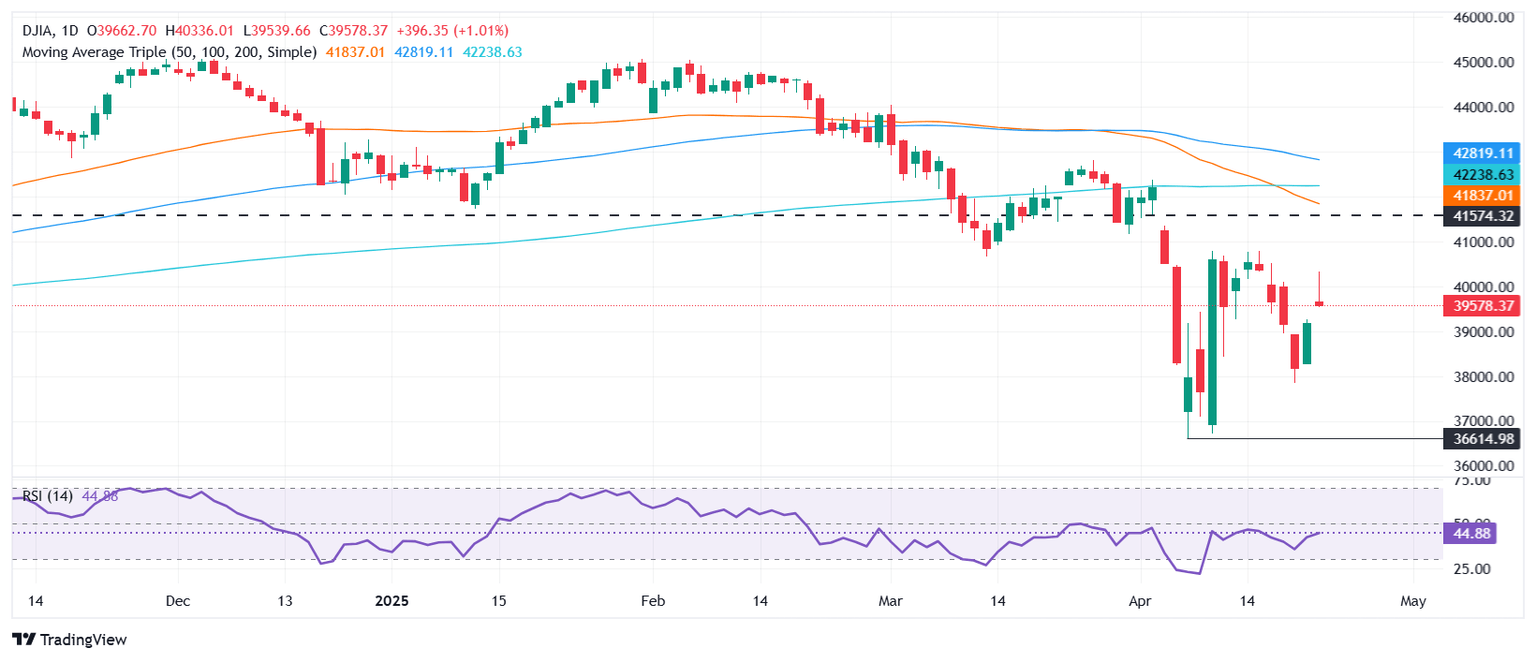
The DJIA's downtrend is intact, though. After hitting a daily high of 40,336, the index seems poised to close the ‘gap up’ sponsored by Trump's comments on Tuesday. This means the Dow could fall and challenge the April 22 high, which turned support at 39,271, before trying to rally toward the 40,000 mark, which was briefly tested before Bessent's remarks.
Conversely, bears need to drag the index below 39,000 for a bearish continuation, which would open the door for lower prices. The next support would be 38,500, followed by 38,000, ahead of testing the year-to-date (YTD) low of 36,614, which was hit on April 7.
Dow Jones FAQs
The Dow Jones Industrial Average, one of the oldest stock market indices in the world, is compiled of the 30 most traded stocks in the US. The index is price-weighted rather than weighted by capitalization. It is calculated by summing the prices of the constituent stocks and dividing them by a factor, currently 0.152. The index was founded by Charles Dow, who also founded the Wall Street Journal. In later years it has been criticized for not being broadly representative enough because it only tracks 30 conglomerates, unlike broader indices such as the S&P 500.
Many different factors drive the Dow Jones Industrial Average (DJIA). The aggregate performance of the component companies revealed in quarterly company earnings reports is the main one. US and global macroeconomic data also contributes as it impacts on investor sentiment. The level of interest rates, set by the Federal Reserve (Fed), also influences the DJIA as it affects the cost of credit, on which many corporations are heavily reliant. Therefore, inflation can be a major driver as well as other metrics which impact the Fed decisions.
Dow Theory is a method for identifying the primary trend of the stock market developed by Charles Dow. A key step is to compare the direction of the Dow Jones Industrial Average (DJIA) and the Dow Jones Transportation Average (DJTA) and only follow trends where both are moving in the same direction. Volume is a confirmatory criteria. The theory uses elements of peak and trough analysis. Dow’s theory posits three trend phases: accumulation, when smart money starts buying or selling; public participation, when the wider public joins in; and distribution, when the smart money exits.
There are a number of ways to trade the DJIA. One is to use ETFs which allow investors to trade the DJIA as a single security, rather than having to buy shares in all 30 constituent companies. A leading example is the SPDR Dow Jones Industrial Average ETF (DIA). DJIA futures contracts enable traders to speculate on the future value of the index and Options provide the right, but not the obligation, to buy or sell the index at a predetermined price in the future. Mutual funds enable investors to buy a share of a diversified portfolio of DJIA stocks thus providing exposure to the overall index.
Author
Christian Borjon Valencia
FXStreet
Christian Borjon began his career as a retail trader in 2010, mainly focused on technical analysis and strategies around it. He started as a swing trader, as he used to work in another industry unrelated to the financial markets.