Dow Jones Industrial Average gains 100 points on steady Tuesday
- The Dow Jones rose slightly as investors digest Fed Chair remarks.
- Markets are brushing off the latest batch of tariff threats.
- Key US inflation data looms ahead this week.


The Dow Jones Industrial Average (DJIA) is mostly on balance on Tuesday, rising around 100 points to 44,600 after Federal Reserve (Fed) Chair Jerome Powell signaled that the Fed is willing to wait as long as necessary to make sure the economy is stable and further progress on inflation will be made before cutting rates again. United States (US) President Donald Trump escalated his ongoing efforts to spark a global trade war between the US and everybody else. Investors are banking on another last-minute resolution and shrugging off President Trump’s tariff bluster.
Jerome Powell Testimony Live: Not for the Fed to comment on tariff policy
Fed Chair Powell reiterated most of his recent talking points when he presented the Fed’s Monetary Policy Report to the Senate Banking Committee on Tuesday. The Fed head noted that neutral rates have likely risen since the 2020 pandemic and that the Fed is comfortable holding interest rates where they are for the time being unless a drastic shift in US labor or inflation figures presents itself.
US President Donald Trump launched a fresh round of tariff threats this week, but market participants are getting used to his “all bark, no bite” approach to blustery trade statements. Since the pre-election campaign trail, President Trump has been kicking the can down the road on his own tariff threats, promising day-one widespread tariffs that have yet to appear outside of a meager tariff increase on Chinese goods.
The latest batch of still-hypothetical tariffs that Donald Trump signed into pseudo-existence this week is a wide, catch-all 25% tariff on all steel and aluminum imports into the US, with warnings that the Trump administration will give no exemptions or exceptions to anyone, and will be looking at automobiles and microchips next. According to reporting, potential exemptions have already been floated toward both Australia and China, and the tariffs themselves may not come into effect until March 12. After a heady spin around the tariff threat carousel last week, investors are now chalking President Trump’s tariff threats up to strong-armed negotiating, and that another reason to stall actually implementing the tariffs will be found at the eleventh hour.
Dow Jones news
The Dow Jones is roughly balanced at the midpoint on Tuesday, though some major players are finding room to move higher and keeping the index tilted into the bullish side. Salesforce (CRM) withered around 1.4% to fall below $323 per share as the AI-driven tech sector stutters. Coca-Cola (KO) rose 3.5%, climbing to $67 per share after beating Wall Street earnings forecasts, and Apple also gained ground, moving 3.2% higher to $235 per share.
Dow Jones price forecast
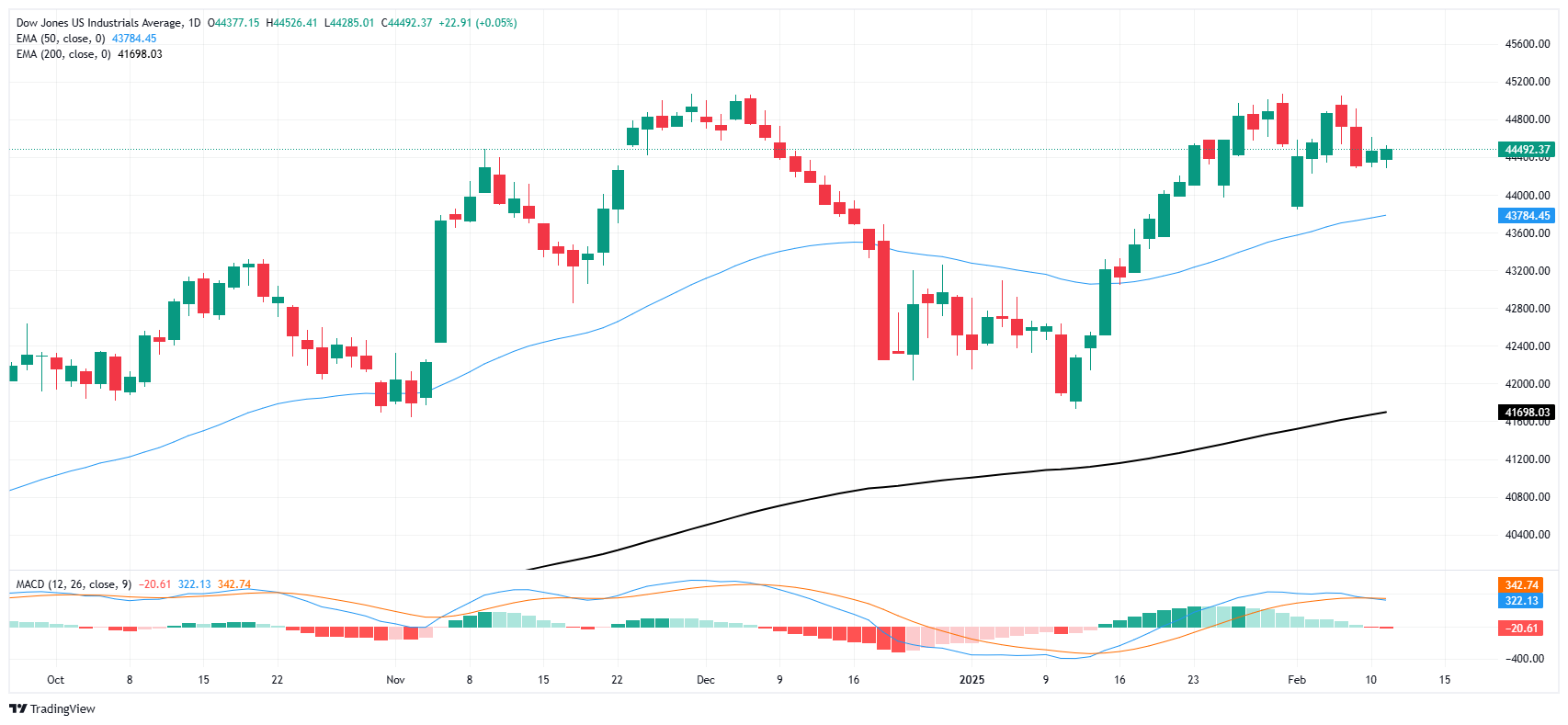
The Dow Jones is looking higher but treading water for the time being, holding close to record high territory as bidders try to gather momentum. The major equity index got knocked lower last week on tariff threats, testing the 44,00 handle, but investor risk appetite remained firm enough to find a technical floor and keep price action on the high side.
The trend is still leaning into the top end, but it’s been a while since the Dow Jones could chalk in a new record high, with 45,071 being the current number to beat, set in late November. The ongoing bullish trend remains well intact, with DJIA outrunning its own 200-day Exponential Moving Average (EMA) for 15 straight months. The 200-day EMA is well below current price action, rising into the 42,000 level.
Dow Jones daily chart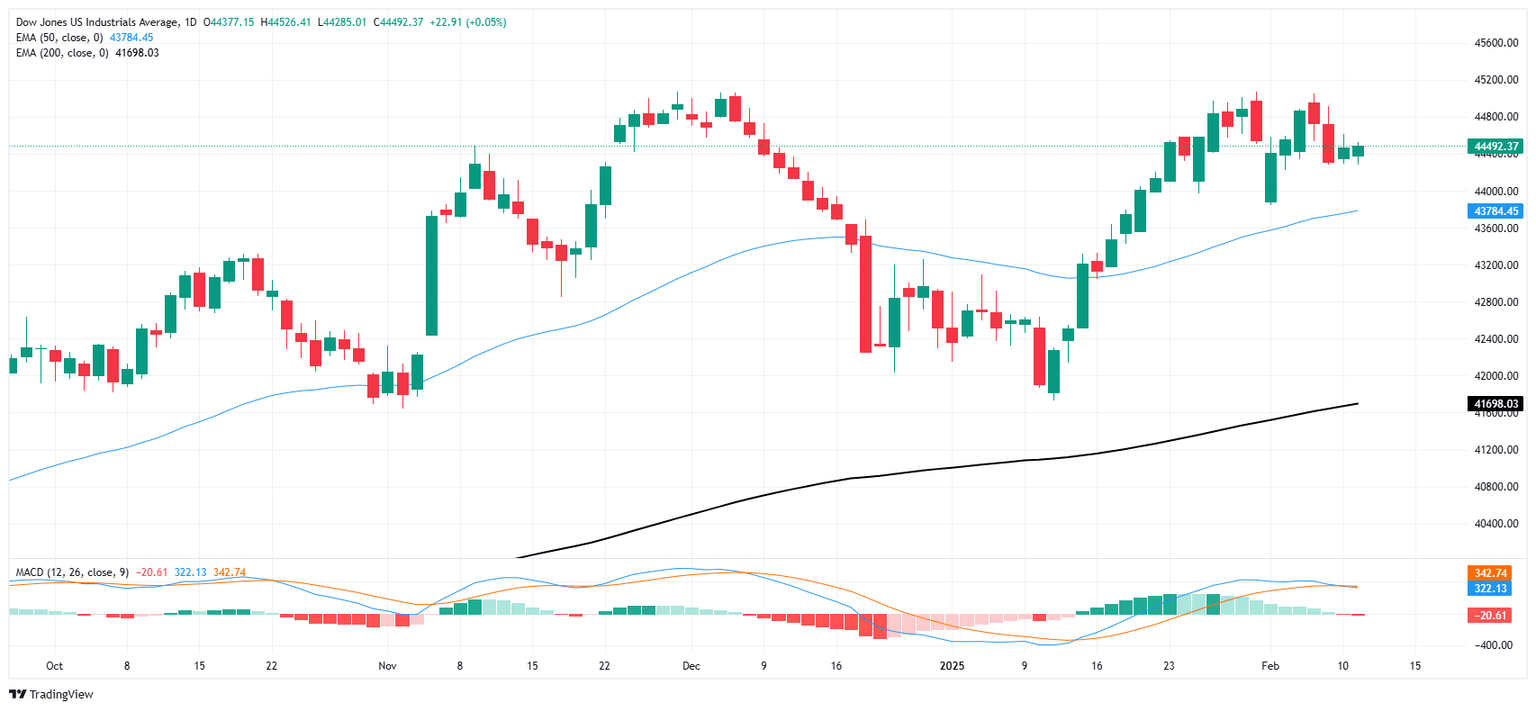
Tariffs FAQs
Tariffs are customs duties levied on certain merchandise imports or a category of products. Tariffs are designed to help local producers and manufacturers be more competitive in the market by providing a price advantage over similar goods that can be imported. Tariffs are widely used as tools of protectionism, along with trade barriers and import quotas.
Although tariffs and taxes both generate government revenue to fund public goods and services, they have several distinctions. Tariffs are prepaid at the port of entry, while taxes are paid at the time of purchase. Taxes are imposed on individual taxpayers and businesses, while tariffs are paid by importers.
There are two schools of thought among economists regarding the usage of tariffs. While some argue that tariffs are necessary to protect domestic industries and address trade imbalances, others see them as a harmful tool that could potentially drive prices higher over the long term and lead to a damaging trade war by encouraging tit-for-tat tariffs.
During the run-up to the presidential election in November 2024, Donald Trump made it clear that he intends to use tariffs to support the US economy and American producers. In 2024, Mexico, China and Canada accounted for 42% of total US imports. In this period, Mexico stood out as the top exporter with $466.6 billion, according to the US Census Bureau. Hence, Trump wants to focus on these three nations when imposing tariffs. He also plans to use the revenue generated through tariffs to lower personal income taxes.
Author
Joshua Gibson
FXStreet
Joshua joins the FXStreet team as an Economics and Finance double major from Vancouver Island University with twelve years' experience as an independent trader focusing on technical analysis.