Dow Jones Industrial Average struggles to find bidders ahead of Fed rate call
- The Dow Jones is trading sluggish on Monday, stuck near 43,800.
- Markets await what is broadly anticipated to be the Fed’s last rate cut of 2024.
- Increases in telecoms and retail stocks have offset declines in key tech and health stocks.

The Dow Jones Industrial Average (DJIA) continues to churn on the low end of recent chart action, with the major equity index bogged down near 43,800. Investors are gearing up for the Federal Reserve’s (Fed) last policy meeting of the year, with the US central bank widely expected to deliver one last quarter-point rate cut before investors wrap it up for the holiday season.
US Purchasing Managers Index (PMI) activity figures came in mixed on Monday, with the US Services component accelerating to its highest print in just over three years while the Manufacturing component eased back further into contraction territory. December’s US Services PMI confidence survey results showed aggregated expectations for business activity have risen to 58.5, the highest level since November of 2021. Median market forecasts had expected a downside print of 55.7 versus November’s 56.1. On the Manufacturing PMI side, business expectations declined more than expected, falling to 48.3 compared to the anticipated 49.4 and last month’s 49.7.
It’s a full docket this week with high-weight US data dropping on markets every day through to the weekend, with US Retail Sales on Tuesday, US Gross Domestic Product (GDP) figures on Thursday, and US Personal Consumption Expenditure Price Index (PCE) inflation on Friday. However, the key event this week is the Fed’s last rate call of 2024. Fed officials head behind closed doors to deliberate during a two-day meeting on Tuesday, with the Fed’s final decision rendered on Wednesday. This week’s Fed meeting carries additional weight, as the US central bank will also be updating its ‘dot plot’ of interest rate expectations. Traders widely expect the Fed to reduce its policy rate by 25 bps to 4.5%.
Dow Jones news
The Dow Jones is teetering near the midpoint on Monday, with winners and losers cut roughly down the middle. Unitedhealth Group (UNH) is shedding weight, falling 3.7% and testing $501 per share, while Honeywell International (HON) is rising after news the company may be streamlining its operations and splitting off its aerospace division into a separate company. HON is up around 3.6%, trading near $236 per share.
Dow Jones price forecast
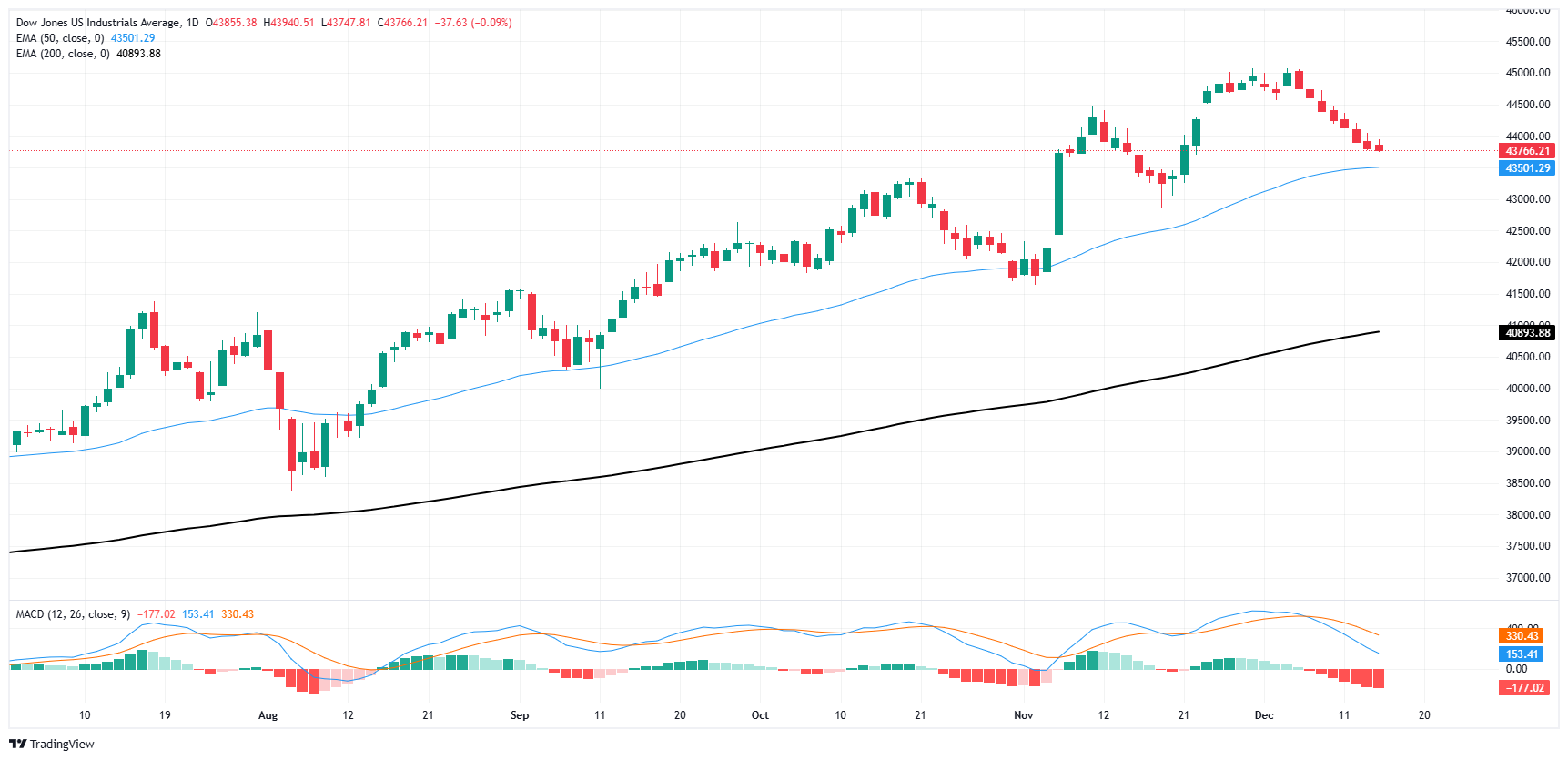
The Dow Jones is continuing its slow bleed down the charts on Monday, kicking off a new trading week holding on the low end. The Dow has posted declines for the last seven consecutive sessions, and further weakness is likely as price action falls back to the 50-day Exponential Moving Average (EMA) near 43,500.
Despite near-term softness, the Dow Jones still holds comfortably on the high end of long-term momentum. The Dow is still trading above the last swing low into the 43,000 handle, and has closed higher for all but two of the last 12 straight trading months.
Dow Jones daily chart
Fed FAQs
Monetary policy in the US is shaped by the Federal Reserve (Fed). The Fed has two mandates: to achieve price stability and foster full employment. Its primary tool to achieve these goals is by adjusting interest rates. When prices are rising too quickly and inflation is above the Fed’s 2% target, it raises interest rates, increasing borrowing costs throughout the economy. This results in a stronger US Dollar (USD) as it makes the US a more attractive place for international investors to park their money. When inflation falls below 2% or the Unemployment Rate is too high, the Fed may lower interest rates to encourage borrowing, which weighs on the Greenback.
The Federal Reserve (Fed) holds eight policy meetings a year, where the Federal Open Market Committee (FOMC) assesses economic conditions and makes monetary policy decisions. The FOMC is attended by twelve Fed officials – the seven members of the Board of Governors, the president of the Federal Reserve Bank of New York, and four of the remaining eleven regional Reserve Bank presidents, who serve one-year terms on a rotating basis.
In extreme situations, the Federal Reserve may resort to a policy named Quantitative Easing (QE). QE is the process by which the Fed substantially increases the flow of credit in a stuck financial system. It is a non-standard policy measure used during crises or when inflation is extremely low. It was the Fed’s weapon of choice during the Great Financial Crisis in 2008. It involves the Fed printing more Dollars and using them to buy high grade bonds from financial institutions. QE usually weakens the US Dollar.
Quantitative tightening (QT) is the reverse process of QE, whereby the Federal Reserve stops buying bonds from financial institutions and does not reinvest the principal from the bonds it holds maturing, to purchase new bonds. It is usually positive for the value of the US Dollar.
Author
Joshua Gibson
FXStreet
Joshua joins the FXStreet team as an Economics and Finance double major from Vancouver Island University with twelve years' experience as an independent trader focusing on technical analysis.